︎A Joke Cuts Deeper︎Ned Beauman in conversation with Pamela Zoline︎A Joke Cuts Deeper︎Ned Beauman in conversation with Pamela Zoline
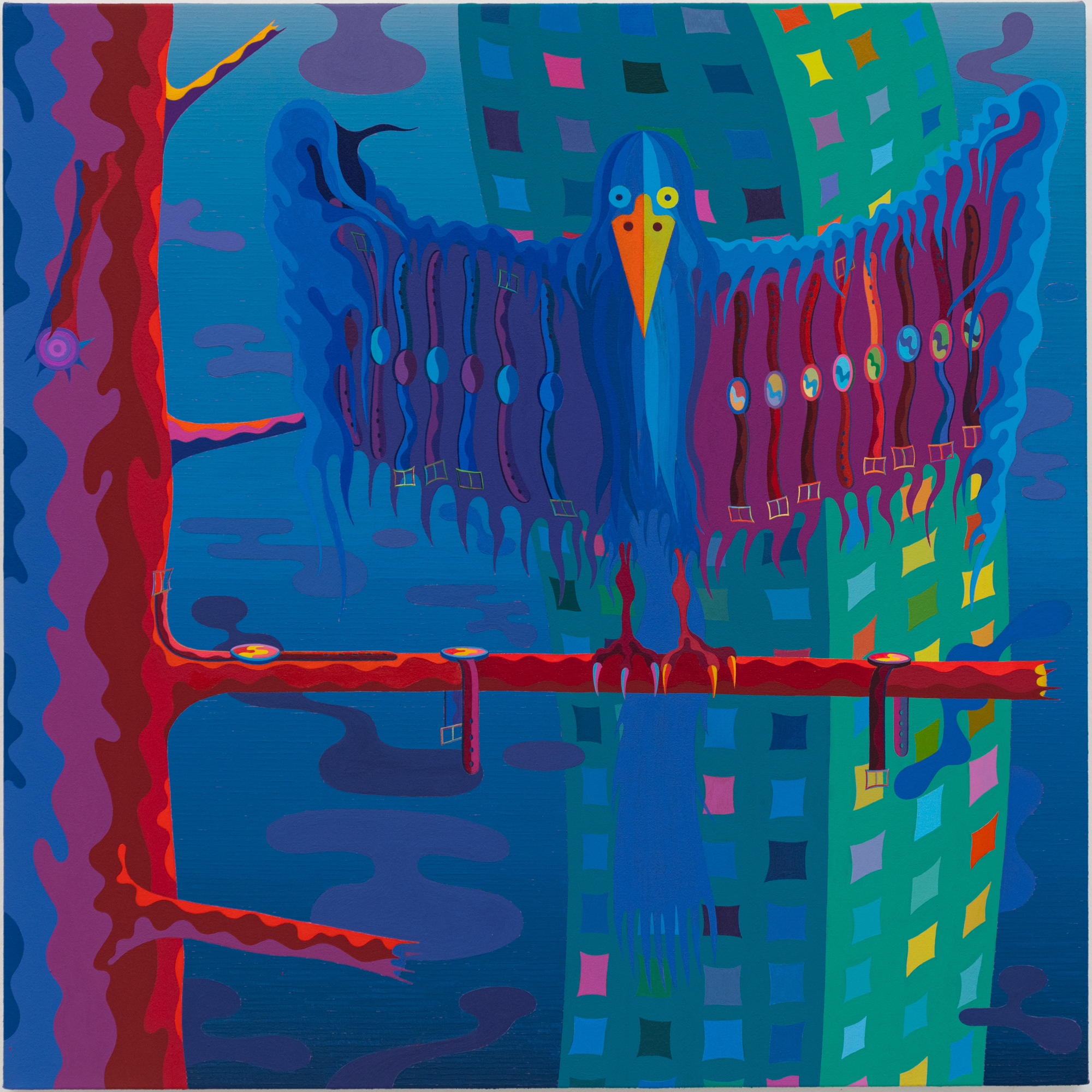
Bird Watcher, Adam Amram, 2023–24. MFA ‘24.
A Joke Cuts Deeper
Ned Beauman in conversation with Pamela Zoline
The writer and artist Pamela Zoline published her landmark short story, Heat Death of the Universe, in the British science fiction magazine New Worlds in 1967. An American living in London and attending The Slade, she was painting like crazy and had found her crowd. Among them: the writers J.G. Ballard, Tom Disch, John Sladek, the critic and writer John Clute, and her future husband, the artist and architect John Lifton.
They were all part of the Drury Lane Arts Lab, a project space that focused on new tech in art, which meant avant-garde cinema, performance, and workshops; this later split into the Institute for Research in Art and Technology (IRAT) on Robert Street. It was countercultural terrain: provocative, meaningful, idealistic. Everyone did a little bit of everything. (Zoline curated the notorious “Crashed Cars” exhibition by Ballard.) Science fiction was escaping its alien-and-spaceship canon, and writers were transforming the genre to heckle the folly of the present moment, emphasizing the dark absurdities of modern life with experimental form, humor, and sensuality. In Heat Death (now part of a full collection) a young wife in California catalogs her racing thoughts as she prepares to throw a children’s birthday party. Her sense of self begins to unravel, echoing both her reality and the titular thermodynamic theory that states our universe is fated toward imbalance, disorder, and nothingness.
In the early ’70s, Zoline and Lifton moved to Colorado. They founded the Telluride Institute, into which they infuse their art and activism, and where Clute has built his science fiction library. Zoline is a new presence at CCAM: Heat Death is being adapted into a short film by Dana Karwas and Chaitanya Harshita Nedunuri Khan. I asked Zoline if she had any favorite current writers, and she immediately named Ned Beauman, describing him as cresting on the New Wave movement that she and her contemporaries began.
London-born and raised, 40-year-old Beauman has written five prize-winning books, including the Man Booker-longlisted The Teleportation Accident (2012), and Venomous Lumpsucker (2022), which won the Arthur C. Clarke Award for best science fiction novel. His eye is unerringly caustic and painfully funny, and he creates exaggerated, reality-adjacent worlds that reflect our existence back to us with an overbright glare. His ideas are heightened by leaps into the past and near-future with un-self-aware protagonists whose humanity, already tainted by murky instincts and corrupted desires, both betrays them and reveals how irrevocably the world has lost control. Venomous Lumpsucker confronts our rising nightmare of ecological crisis, setting us in a perilously near zone of animal extinction, consciousness databanks, and corporations devastating the planet—with a focus on an ugly fish, the venomous lumpsucker, as an elusive species that could reverse the fortunes of its hunters in more ways than one.
Before this conversation, Zoline and Beauman had never met, but their commonalities ask: How else to reconcile with a seemingly impossible future, other than by writing about it like this?
—Alex Zafiris
Pamela Zoline: Do you think of yourself as being in conversation with other writers and artists and thinkers—either vertically through time, or horizontally in the present?
Ned Beauman: When I was younger, I was much more interested in reference and pastiche. I felt like I couldn’t write fiction without acknowledging everything I was drawing on. I’ve since become less interested in intertextual games. In Venomous Lumpsucker, I find it hard to isolate any influences, or people I was really thinking about—apart from William Gibson, who I think about in all my books. I don’t particularly feel in conversation with anyone horizontally in time—what I do is so out of fashion that I feel quite isolated. In [the UK], literary fiction has turned towards short, very internal, present day autofiction, which doesn’t use quotation marks for dialogue, and is quite arid and quiet. It is so not my kind of thing. When I was starting out, what felt interesting was the breakdown of barriers between science fiction and literary fiction, and various forms of postmodernism and game-playing. All of that has vanished without trace from the landscape. So there is a bit of a dearth of people for me to compare myself to.
PZ: The polite fiction or the internal, super sensitive stuff happens over here [in the US], too, and I find it infinitely boring. I was thinking more Pynchon, Ballard, and Nabokov.
NB: I love all those writers. That exuberance—which I definitely aim for—is not what people are trying to do at the moment. For someone who has been described as Pynchonesque, and also thinks of himself as Pynchonesque, the number of Pynchon novels I’ve read beginning to end is really embarrassingly low. It’s hard to say how much of an influence Ballard has these days, because he’s a bit more austere, but is any of the current austerity drawing on him at all? I don’t get that sense. You were in the same circles as him, right?
PZ: Yeah, he was a good friend. That austerity you reference is, I would say, very, very compressed. It’s the simple that comes after all that work of compression.
NB: That’s a good distinction. That’s definitely true.
I do find it frustrating that, in our public discourse, there is so little philosophy.︎I do find it frustrating that, in our public discourse, there is so little philosophy.︎
PZ: You read philosophy at Cambridge. I also, in my non-rigorous way, read philosophy at University College. I was at The Slade, and crossed over to the philosophy department. I had some amazing professors who totally changed my mind and my life.
NB: My three years of undergraduate training are still really important to me. They definitely shaped the way I think. Venomous Lumpsucker was the first time I was trying to pose questions of that kind in my fiction. I do find it frustrating that, in our public discourse, there is so little philosophy. So many debates in politics are completely unproductive. People are just talking past each other, because they haven’t defined their terms. I do feel the basics should be taught, in the same way we teach gravity or algebra. It makes you more able to navigate disagreement.
I had one review which said that a lot of the ethics in the book draw on Derek Parfit and the questions he asked, which I was really happy about. I wasn’t consciously doing that, but I have huge admiration for him and the terrain he claims. Cambridge has the most chauvinistically analytic, Anglo American course still remaining in the world. That training is so deep in me, even though there are probably useful things I could get from the other side of the aisle, like Continental philosophy. I just find it completely unreadable, whatever its merits.
PZ: [laughs] That’s hilarious.
NB: I was taught to find it unreadable. What was the kind of philosophy that you did at the time?
PZ: My professor was Richard Wollheim. He did a lot of writing on aesthetics, and was a disciple of Anna Freud, Melanie Klein, and Adrian Stokes. G.A. Cohen and Ted Honderich were there. I learned so much. When I went to London, I’d been living in New York for two or three years. I’d been going to Barnard. Before that, I’d mostly been this suburban kid. I had notions of a Bohemian life, which is what I would have called it at that time. But I had no proper politics. Coming across people who were able to think substantially—with the rage that accompanies good ethical thinking—was really a huge deal for me.
NB: Well, by coincidence, Ted Honderich’s third wife, Jane O’Grady, was friends with my parents. When I was a boy, they got her to come over and give me philosophy lessons. I was already interested in that stuff, and it really helped develop my interest in it. The Cambridge course had no contemporary politics. It definitely had no psychoanalysis. And indeed, one of the reasons it’s been impossible for me to do therapy as an adult is because it turned me into such a positivist. Anytime a therapist says anything to me, I say, "Well, that’s a claim about something that’s happening in a mind, which seems to me unfalsifiable.”
PZ: [laughs] You are definitely a walking example of the dangers of higher education. Now that you see how those things operated, could you undo that internal puzzle a bit?
NB: Yes, but on some level, I still think it’s right. So I almost don’t want to undo it.
PZ: People who take psychoanalysis and that whole layer of things seriously also argue about what is true and what is right. What is useful tends to be the question that dominates. If people keep getting healthier after having done it, it almost doesn’t matter if you can’t defend it.
If you want therapeutic action in your life, you might have to go into a totally different direction, where the intellect is not so involved. I recommend Adrian Stokes, who was also a pretty good painter, and led an amazingly interesting and strange life. I think where the rubber hits the road is where philosophy actually moves into life in some way.
Alex Zafiris: Pamela, I read an interview with you from 1988 in The New York Times where you said: “Art is really meant to be practical and illuminating. To move the furniture of the world around.” Do you remember saying that?
PZ: [laughs] I continue to think it! It’s often thought of as the decorative aspect of life. But it’s much more like a survival element that happens right at the core of who we are and what we do. John Cage came to the Telluride Institute, and we got to be quite good friends. He said that a composer’s job wasn’t finished when the composer took the pen off the paper, having written the last note. It was only finished when they saw the work come alive, played and heard, into the world. Those of us who are artists don’t do it just because it gives us enjoyment, or because it might give us a nice life. We do it because we think we have something important to share. I think its practicality is in proportion to how shareable and how useful it is, in fact.
NB: There’s art that makes an impact on you, and is a source of consolation: you see yourself reflected in it, you feel less lonely, it articulates something you haven’t put into words. But there is a tension between this and the other times when art is someone showing you their point of view, and you’re thinking, “I can’t believe you look at things in this way.” I feel like I’ve had many more profound experiences of fiction when reading the latter category, where you think, “Wow, it’s so interesting to spend time inside the mind of this person who feels so aberrant and almost unrecognizable to me that there’s nothing I could possibly take from it, except in the sense that it expands my sense of what other minds can be.”
The number of novels where I feel, “Wow, I see myself here,” is quite small. Which is surprising, because I’m a middle aged, straight, white, Western, middle class male. In theory, half of fiction is about me and my concerns. Sometimes I try and add things in my books where I feel someone might think, “Yeah, life is like that, isn’t it?” But more often, what happens is someone says, “Wow, when you have that character say that psychotic thing, it was so interesting. How did you come up with something so awful and unspeakable?” And I’m like, “That was meant to be my attempt to reach out to the reader!” Realistically, my stuff is more likely to succeed by showing people the strangeness of my way of thinking, than on the relatability of my outlook.
PZ: I was very much amongst the first group of people. Your book seemed to me exactly the way the world is. Super, super realistic. Like I was reading an incredibly fabulous newspaper.
AZ: Ned, there’s a lot of humor and mistrust in your writing. It feels like those two things go together for you.
NB: Humor is really missing from a lot of literary fiction. There are times when I’m reading a contemporary novel and think, “How dare you not even try to make this funny?” I’ve always felt, with everything you write, you should try and make it either funny or insightful. But it’s hard to be insightful, so to me it’s safest to make it funny as a fallback position. If it’s not funny or insightful, then you really have nothing. I do sometimes read novels where I think, “You don’t have either of them. So what are you giving me?” It’s like: Your guests shouldn’t leave completely hungry and empty-handed.
The novel I’m writing at the moment probably has the fewest jokes of anything I’ve done. I’m slightly struggling with this. I can’t imagine writing something without any jokes, because on some level, I’m trying to entertain, or at least not be boring. But then it does also reflect an incapacity to take things seriously, which in some ways is a disability. I’m not [reading a] particularly tragic Graham Greene denouement and thinking, “Why didn’t you put any jokes in this?”—there are some things which, by virtue of their gravity and profundity, have earned the right to not be funny and shouldn’t be funny. But that gravity and the profundity feel out of my reach. In that English way, I’m slightly embarrassed by the idea of them. So sometimes I retreat to jokes instead.
PZ: I find that a really fascinating viewpoint. For me, it always surprises me. I’m typing away, and I’m going, “Oh, I didn’t know this was funny.” I think, in a strange way, it’s a coping mechanism. So much about the world, and translating the world into story form, is almost unbearable—how huge and harsh and amazing and beautiful and totally frightening things are. The absurd aspect of it makes me write with a somewhat funny tone that I didn’t necessarily intend. For instance, here’s Bitcoin, which, apart from everything else, uses up an immense amount of energy and pushes us way more into carbon fuck, just because they have this bizarre notion of how you validate the value of each coin. With this pretend money, we are going further into an irretrievable hell. Either that makes you cry and you can’t write anything, or you find it seriously, insanely funny.
Either that makes you cry and you can’t write anything, or you find it seriously, insanely funny.︎Either that makes you cry and you can’t write anything, or you find it seriously, insanely funny.︎
NB: Sometimes a joke cuts deeper. If you’re trying to be brutal about something—and some things deserve our brutality—then sometimes the joke is more brutal than just sincerely lamenting it.
PZ: With Venomous Lumpsucker, I had the sense that I was reading the book of an appalled moralist, akin to Swift or Jimmy Ballard. If you find the world totally perverse, and self-harming, what voice is appropriate to that?
NB: What do you think Ballard was appalled by, in that way?
PZ: I recently spent some time thinking about him, because I wrote this article about his 1970 “Crash Cars” exhibition that appears in this recent New Worlds anniversary issue. I thought of his experience as a young child of the Second World War, when he and his family lived in Shanghai, and that time spent in a prison camp. Then there was liberation, while he was still a child. He said it was clear to him that war didn’t really end, it just sort of continued. What he brought with him was a sense that everything was pretty provisional. It was more or less a stage set, and it could be struck and dismantled at any time. That brings with it a certain sense of bearing witness to appalling realities. He came to England for the first time when he was about 16, and he said he found it incredibly small and dark and cold and wet. This place that been the center of everybody’s cultural imaginings. He never took it at face value, and he saw it as happening all around him. I read an interview where somebody asked him, “Is what you write really science fiction? I don’t see any spaceships, blah, blah, blah.” He said, “Yeah, I’m not so interested in what happens in the next 10,000 years. I’m really interested in what happens in the next five minutes.” For him, the emperor was always naked.
AZ: What will we see next from both of you?
NB: I have a horror novel called The Captive out now under the pen name Kit Burgoyne, about a left-wing revolutionary group who kidnap an heiress who turns out to be pregnant with the Antichrist. And I’m working on a literary novel about the malign influence that old boarding schools have on British society. They’re very different in style, but along with Venomous Lumpsucker, they’re all about people finding ways to lash out against these seemingly unshakeable power structures.
PZ: I’m working on my next short story. It’s set largely on the Colorado Plateau. The main drama has to do with water. The Colorado River is graced with two enormous dams, and the reservoirs that build up behind them. And now there isn’t enough water in the Colorado River to make that system work. It’s about living in the midst of all these natural systems, all interacting with each other. The human systems feed right into that. It’s about understanding nature and the natural world in a cause and effect perspective. Come and visit sometime!