︎Tethered Lightly︎Priyamvada Natarajan in conversation with Alex Zafiris︎Tethered Lightly︎Priyamvada Natarajan in conversation with Alex Zafiris︎Tethered Lightly︎Priyamvada Natarajan in conversation with Alex Zafiris
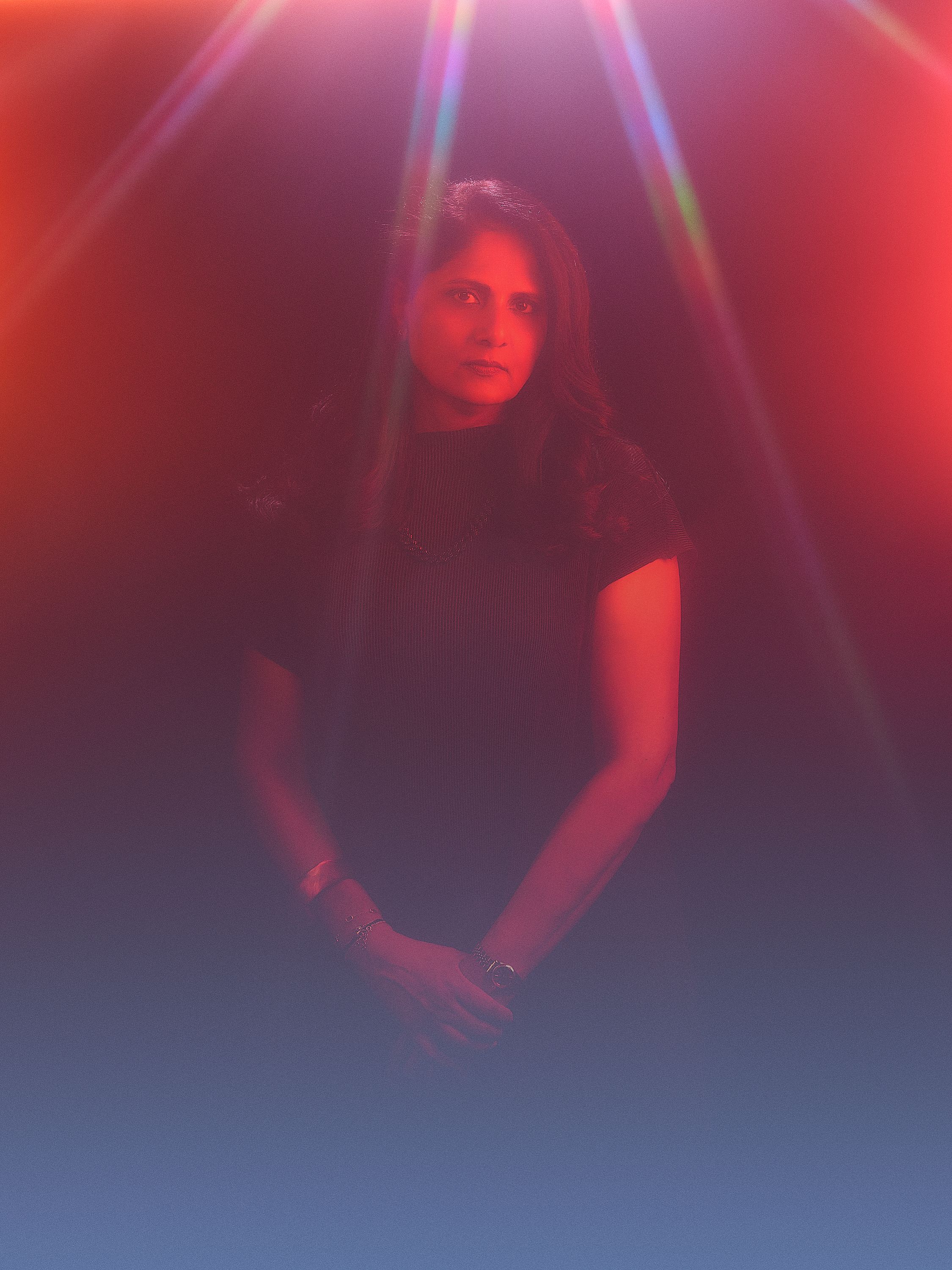
Priyamvada Natarajan by Balarama Heller, special commission for CCAM, 2025. © Balarama Heller.
Tethered Lightly
Priyamvada Natarajan in conversation with Alex Zafiris
Theoretical astrophysicist Priyamvada Natarajan has an instinct for the arts that illuminates her lifelong obsession with the universe. Her focus is dark matter, dark energy, and black holes—three of the most mysterious cosmic constituents whose existence we can now formally acknowledge, but whose purpose we have yet to grasp. She compares her fascination with these unseen entities to the act of creation: writers and artists also wrestle with containing the elusive spirit of their inspiration. Her approach to physics—born from a childhood love of cartography—is both methodical and visionary, and led to the 2023 breakthrough of how supermassive black holes form at the centers of galaxies. She established the theory almost two decades ago, and it was finally proven with the use of the new, ultrapowerful James Webb Space Telescope.
This development won Natarajan a place on the Time 100 list the following year; a few months later, she was awarded the Heineman Prize. At Yale, she is the inaugural Joseph S. and Sophia S. Fruton Professor of Astronomy and Professor of Physics, the Chair of Astronomy, and the Director of the Franke Program in Science and the Humanities. She is the author of Mapping the Heavens: The Radical Scientific Ideas That Reveal the Cosmos (2016), a poetic and eye-opening history of our understanding of the universe, full of ancient stories, mythologies, and sharply drawn figures whose beliefs, insights, and innovations all contributed to what astronomy is today.
For many of us, the concepts Natarajan deals with on a daily basis can feel nearly impossible to make sense of. Uninspired teaching, impenetrable language, outdated or incorrect information, and anti-science rhetoric all contribute to a general haze of overwhelm and mistrust. But the desire to find meaning within this seemingly chaotic cosmos has been a human preoccupation since the beginning of civilization. Philosophers, priests, alchemists, and even an orphan glassblower were instrumental in the discoveries recounted in Mapping the Heavens—and many breakthroughs were the result of wild leaps of creativity. Most often, these were initially rejected by baffled, frightened, or jealous peers anxious to maintain the status quo. For this reason, Natarajan explains, the capacity for curiosity is fundamental to progress, as in all areas of life—especially in moments of uncertainty. “Our attitude toward change is deeply connected to our sense of self,” she writes in the preface. “Understanding the power and provisionary nature of scientific thinking is the challenge of our time.”
Alex Zafiris: On top of everything, you’re a fantastic writer. Many of the people, ideas, and facts in Mapping the Heavens are so complex, but you describe them all with such simplicity and energy. Will you be writing more?
Priyamvada Natarajan: I’m finishing this very ambitious book on trying to redefine what science really is, by bringing scientific ideas and the practice of science into much better alignment. My claim is that previous accounts of how science progresses and advances—such as those by Thomas Kuhn, and many others—don’t actually capture what really happens on the untidy lab bench, or in front of the blackboard, or in discussions during seminars. This is because they were not practicing scientists. Ideally, someone like me—who’s really on the inside, who can unpack the messiness—is the new kind of interlocutor needed to share with the public what scientists really do. Amongst all the wrong turns, missed experiments, dropped things, blind alleys, passionate arguments, and dead ends, there is rigor to the process. This comes from a community of scientists, all of them with domain knowledge, who actually interrogate new ideas and arrive at a consensus.
What constitutes a scientific fact is adjudicated collectively, and this is a very powerful process that is completely unknown to the public. There’s contestation, there are fierce debates. While there are many subjective angles that come into play in how scientists—domain experts—arrive at a consensus on a radical new idea that is proposed, the ultimate arbiter is data. Scientific information is the solid substrate. Then there’s who’s proposing the idea, how well they present it, who else is supporting it, how they disseminate it, and so on. These additional factors make a big difference on how quickly something radical is going to get accepted. That’s what I’m delving into, and writing about.
AZ: This sounds like a natural progression from Mapping the Heavens.
PN: Yes. People often ask me, “What is this obsession with mapping?” For me, mapping really feels like the most compelling way to know, to understand and comprehend the visual representation and the visual lexicon. The visual lexicon is very intertwined with the mathematical lexicon. And the reason for that, partly, is the specific subjects that I work on. The theoretical underpinning of what I work on is Albert Einstein’s theory of general relativity. That whole theory posits that we live in four dimensions: we live in three in space, and one in time. Physically, it’s abstract. It’s not physically comprehensible, in the sense that you can’t depict four dimensions on a sheet of paper.
However, there’s a way in which you can visually access it. That’s what I have found fascinating. That’s precisely the kind of conceptual basis that really drives me and excites me. It literally does seduce me. There is also a deep, profound layer of really important and elegant mathematics. But that language is very severely limiting for scientists. Many of them can manipulate those equations, but having those line up with a conceptual visual lexicon is really important. It takes extra work and a very specific kind of imaginative bent. That’s what has helped me frame the conceptual ideas that I have proposed, elaborated, and delved deeply into. Most of my contributions—I say this not in a boasty way—are ultimately very simple conceptually, but have inadvertently led to interesting breakthroughs. The seed of my ideas and insights have really come from a place of unconstrained questioning of the status quo, and current view of phenomena. I like to believe that it’s my childlike curiosity, that I have fortunately managed to retain, that really propels me. I think that these out-of-the-box ideas (to use a well-worn cliché) also come out of this marrying of transcending disciplines and approaches.
There’s a way in which the visual “solution” finally gives me the aha moment.︎There’s a way in which the visual “solution” finally gives me the aha moment.︎
For me, the visual has always been part of it. There’s a way in which the visual “solution” finally gives me the aha moment. I feel lucky to have this tool in my mental arsenal, and I am grateful for this advantage. When you work with very complex problems, the first challenge is setting it up, framing it, so that you can actually solve it. The next challenge is to have a feel for the problem. This takes a lot of experience and expertise—and this is where immersion really comes in handy. Say you have a complex phenomenon that you want to explain. You have to somehow have the intuition to say: “You know what, I’m going to build a bare bones model that is pared down. Simplify, simplify, simplify.” But not oversimplify, because then you lose key features. Recognizing what might be the essence, the key elements that absolutely need to be retained, is what takes practice, training, and intuition. Once you do that, you can really understand the problem deeply. Then you can add back the bells and the whistles, step-by-step, in a very systematic way. A complex problem involves the interplay of many different aspects. When you add in the complexities one by one, you slowly expand your map of the solution space. At each point, when you add something, your mental map grows a little bit more. The way I look at it, everything is like a mapping problem. Ultimately, you see the whole map.
One direct analogy is: problem-solving is akin to building up the features of a cartographic landscape. Initially, you can pick out only the highest peaks in the mountains. You’re not able to see the valleys, the ridges, or the mounds; you’re just picking up the most essential, prominent features of that problem. Then as you get a deeper understanding, you start to be able to see all the complex geography of that landscape. This is how I personally navigate my work.
It turns out, this is not just a metaphor. It transfers literally when you talk about dark matter, one of the cosmic constituents that I work on. Dark matter is clumped, lumped, and distributed spatially in the cosmos. This spatial distribution is quite rich in information, and you first need to be able to map it before you can extract the information on its properties. Because it’s all unseen.
This is my problem-solving approach. Fortunately for me, the two problems of black holes and dark matter in the invisible universe—that are really parlayed by general relativity—are very amenable to this kind of approach and to visual imagination. It’s not like somebody can solve these equations better, because the theory is quite mature by the time I’ve shown up in the field. It’s been around since 1915. But now, what’s more interesting about the theory is that there are deeper ways to understand it—to understand how it applies and might be relevant in the observed universe, and the specific contexts where it really applies.
AZ: Your choice of language, too, is very striking. You describe the universe as violent. Black holes are monsters. You are seduced. One of the things I learned about you was that you love art, that you love Louise Bourgeois and Mark Rothko. These are enigmatic artists who deal with mystery. If anyone, including someone who has no interest in art, stands in front of a Rothko or Bourgeois, they know they are being confronted with something extremely profound. And so, to hear you talk about that mystery, that seduction, with that language, conjures a similar feeling. The second chapter of Mapping the Heavens begins with this incredible story of Edgar Allan Poe—another artist of dark inclinations who held a fascination with the unknown—who, in 1848, at the peak of his career, suddenly decided to declare his own thoughts about a “restless and evolving” universe in a public lecture in New York. His audience was stunned and disappointed. This talk was later turned into a prose poem, “Eureka.” His ideas were formed purely through his creative intuition, and were in total contrast to the common beliefs at the time. But he was proven correct by scientists, almost a century later.
PN: Exactly. And he was not informed by mathematics or physics, but yet, it is such an apt description. It’s very prescient. I am also obsessed with Joan Miró. I feel that with artists, there’s a way in which they are trying to capture the essence of things that are so elusive. There’s a materiality, and they are really trying to explore it with a simple visual language. It’s the same paring down idea that I was just describing. I think that’s part of my fascination. These people are driven by something that they can’t quite touch and sense. It’s just a little bit beyond comprehension, beyond reach.
What I really love about the artists I like and who inspire me is that they are constantly experimenting and playing. You can see it in a Paul Klee drawing. It’s fun. I feel the same way about the science that I do. It’s really fun to unpack and unravel, and to feel that you have a personal sense of revelation. The fact that you uniquely bring a way of looking at the problem is a huge source of satisfaction and contentment, even if the result is not a publishable thing, or even if other people already know about it because it’s well-known. It doesn’t matter. The sheer joy of figuring things out is something I really savor.
I find with a lot of my colleagues, when I talk to them, this is lost a little bit. Understandably, people get preoccupied with a professional or a careerist view of what they do, and that is what motivates them. For me, it’s been a real privilege to work in science as a calling, almost a compulsion; more so than just a profession. I’m not saying everybody should feel this, or that everybody can, because I am very aware that just even having all these opportunities is a privilege. I feel really deeply grateful that I can do all this. But some of it is definitely temperament: wanting to retain that sense of awe and curiosity. At some level, you have to do it self-consciously, because it’s very easy to get trapped by the histrionics of academia. You have to write papers, get grants—it’s the ground reality. I’m still tethered to the ground reality, because I am in a university, in a department, in a profession. But I like to be tethered lightly, so I’m floating just a little bit above, with a sense of detachment. For me, that sense of detachment is what allows the imagination to soar.
How I feel about it is very much part of how I tackle the problem.︎How I feel about it is very much part of how I tackle the problem.︎
I want to underline that not everybody has this privilege. But if you happen to win the birth lottery, and are born in a home where you don’t have the fundamental challenges of survival—where you are surrounded by beauty, and your imagination and curiosity are encouraged from a very young age, and you have the capacity to actually get into that as a profession and excel in that realm—then you can get to do all of this. I understand that not a lot of my colleagues are sitting and interrogating themselves and their work to see, “Why do I like this? Why do I calculate like this?” Or: “How do I feel when I do this?” For me, that’s very important: I do a calculation, and I end up with something. It’s a puzzle, or it leads to deeper understanding. How I feel about it is very much part of how I tackle the problem. How do I feel when it gets done? Or when I get stuck? Self-knowledge really helps. That gives you a unique take which you can flow with, and it leads to more exciting, interesting landscapes. This further allows you to think in unusual, surprising ways.
AZ: You’re describing an artist mentality. This can go the other way, when artists become too self-obsessed, and their work becomes quite thin and flat. What made me laugh out loud several times in Mapping the Heavens is how you speak of all these male scientists and their egos, and all the clashes and roadblocks that ensue. These people are everywhere in all professions. But here, Einstein pops up throughout the chapters, and you are kind of eye-rolling him. And then near the end, you say—and it’s like I can hear you sigh: “Yeah, but he’s the best.” I love how you created that arc. It allowed for so much insight around it.
PN: Yes! My friends give me a hard time because I really think that dismantling this idea of heroes, and hero worship, is important. I actually don’t particularly like the word “genius.” That notion has really kept a lot of us behind the scenes, many of whom remain unacknowledged and not given their due. But on the other hand, there are these singular creative minds. Einstein probably was a genius. He’s the blind spot in my argument. It does seem like his capacity for dealing with abstraction was remarkable and unparalleled. In many ways, other than just the originality of his ideas, I think he was quite detached, not as emotionally invested in his theories as one would imagine someone of his stature to have been, and given all the original and transformative ideas that he proposed.
In fact, for all the big theoretical ideas that he came up with, he often did not like some of their mathematical consequences. For instance, his equations lead, inevitably, to the description of our universe as one that is expanding. He found this deeply uncomfortable and disorienting, because he had an aesthetic and philosophical preference for fixity.
AZ: It’s a perfectly balanced vision. An ideal image. Almost like a sense of justice. The opposite of chaos.
PN: I think it was a classical notion as well. This idea of being tethered, and not moving. A sense of stability. It also makes it easier to figure out our place in the cosmos, if we are not adrift. He pushed back against ideas of the expanding universe. He finally did get convinced. He was visiting Mount Wilson Observatory, and the astronomer Edwin Hubble had found these galaxies that are external galaxies, beyond our own, that were hurtling away at speeds that were larger the farther away they were from us. There is no other way to reconcile it, other than to accept that the universe is actually expanding. I remember reading accounts where Einstein is supposed to have stood up and said, “OK, I was wrong, and I agree the universe is expanding.” And that there was an audible gasp in the room. No one expected him to actually admit he had been wrong, nor that he would admit it openly. This humility, despite his initial stubbornness, was quite remarkable.
The same thing happened with the idea of black holes. He actually believed that the black hole solution was merely a mathematical artifact of his equations. He was not convinced, for a very long time, that they would actually correspond to real astrophysical objects, or real spaces in the universe. This was because he didn’t like the properties of that solution: again, it felt very uncomfortable. In particular, what he didn’t like was the notion of the singularity, the fact that there was a place where everything that we know—all known laws of nature—break down, and we don’t even have the language for it. The mathematics breaks down. Another intriguing thing was that he was someone who had an incredible physical intuition, but wasn’t necessarily driven by mathematics. It was his friends and the people around him at the time—such as Marcel Grossmann—who taught him that the rigor of mathematics is actually the most effective language to frame his physical intuition about geometry of space and its relation to time—four dimensions. He had geometrical insight in spades, which nobody else had.
So: The mathematical framing came from people around him, with whom he discussed his theory of general relativity. They found a framework of tensors, of metric spaces and manifolds, that offered him the language. When you think about it, what he figured out about the universe was incredibly profound: the fact that the geometry, fate, and contents of the universe are interlinked; and that geometry, the shape of space itself, plays an absolutely fundamental role. Before this, it was not part of the conceptual repertoire. This was all linked to the deep nature of gravity. Before Einstein, Isaac Newton told us how gravity worked, not what it was. That’s the difference. Einstein was able to explain what gravity really, fundamentally, is.
Because, with Newton’s view, there were lots of unanswered questions: What is it about the fact that when two bodies have mass, this causes them to get attracted to each other? The next big problem was that, with two objects, why does it not take a finite amount of time for them to infer each other’s presence, and therefore feel the tug of the force of gravity? Why is gravity transmitted instantaneously to the other object in the vicinity, such that their force of attraction falls off by 1/r2 ? Why is that instantaneous? That is not something Newton could explain. Because he was just giving you an operational definition of gravity. He wasn’t trying to tell you what gravity is, deeply.
In a way, that’s where we are, if you will, with the dark universe. We know what dark matter does, how it manifests; we don’t know what it is. We know how dark energy manifests in the universe, in terms of phenomenology, but we don’t yet know what it is. With black holes, we have made significantly more progress. Not only do we know how they manifest in the universe, but we also understand a lot more about their true nature. That’s why the three cosmic constituents that I study—dark matter, dark energy, and black holes—are really deeply related. And this is the level at which they are deeply related: They are all manifestations of something. They are very, very real, physically rooted manifestations of these phenomena that we understand quite well. However, we have no idea what these entities really are, their true nature. That’s what unites all three of them: dark matter, dark energy, and black holes. In a way, that’s what I find deeply fascinating, that with all of these essential invisible ingredients of the universe, we are really in the same intellectual stage of discovery, probing, and awaiting the transition akin from Newton to Einstein for gravity.
AZ: Do you recall the moment when the image of the recent breakthrough began to form? When the intuition began to glimmer, and you started going in that direction?
PN: Yes. In 2005, 2006, working with my postdoctoral collaborator Giuseppe Lodato. We were trying to answer an emerging puzzle. As telescopes were looking back into time, they were revealing populations of supermassive black holes in place in the very early universe. We were starting to run into a peculiar timing problem. At these early times, there was not much time available since the Big Bang to grow these large black holes from the tiny ones that we knew had to form in the universe. It was very well established that small black holes would form as the end state of stars after they had lived out their lives, leaving them as stellar corpses. The question was that there were limits to the sizes of the black holes that you could make that way; it was challenging to grow them from this starting point to account for the massive ones that were being uncovered. Part of what I was looking around to see was: Is there any cosmic setting in which physics would allow us to circumvent this standard way to make black holes? For example, fundamental to the formation of a light black hole seed is the formation of the initial massive star. What happens if you skip forming a standard star? Can you still make a black hole some other way? That’s what guided me.
Then there was this visualization. Aha, so the way this could work—in order to really make a black hole—is that you have to concentrate a lot of matter into a very tiny space fairly rapidly. What are the conditions you would need in a universe for that to happen? Then came the visual idea: How do you move matter rapidly to a very compact space to make an object that’s very, very dense?
Even today, scientists think about black holes in multiple different ways.︎Even today, scientists think about black holes in multiple different ways.︎
The thing that I found really challenging about it is that, even today, scientists think about black holes in multiple different ways. Astrophysicists and astronomers believe in stellar evolution theory and think of a black hole very much as a material object where the mass is very, very tightly packed. Then there are people who think about a black hole as an extreme puncture in space-time—they think of it as a place, not as a thing. These are different ways of looking at the same object, and somehow, we haven’t fully reconciled them. Depending on the situation, whatever suits us best, we adopt that way of looking at a black hole, but we’re looking at the same phenomenon in the end, the same deep concept. We’re approaching it in different ways. This was part of what helped us. I was thinking, “OK, I want to do something about bringing in a lot of matter, so that not only would I make a very dense kind of object, but I can also see how that would create a deeper and deeper puncture in space-time.” When we found the physics would permit you to do that, then it was a question of looking for a very specific set of conditions. What are all the conditions you would need to line up for these conditions to happen? Then the question was logical: Are there places in the universe where you have these conditions? And then, if there are enough places, then we realized that, yes, there were enough places. The next question was: How does the larger environment, the setting, impact this formation process? Once again, we had the guidance of cosmological simulations to see that, but then they are limited, because these simulations cannot take you all the way.
The final step is imagination, which you need no matter what, because we don’t have the resolution. We didn’t have the computing facilities. Nobody has formed a black hole in a simulation. We cannot follow the process of gravitational collapse down to the end point. We just don’t know how to do it. We know that it’s inevitable that it becomes so compact; there’s no other way but to keep shrinking. But we haven’t actually computed it and seen it happen in a simulation yet. Given that you don’t have that, then how can you make predictions that are testable and can be validated?
That’s where this kind of visual idea really helped—the mental map of what a region that would give you a direct collapse black hole could look like. Over the years, it’s become clear that there is not just one way in which this whole phenomenon could manifest. You could likely make these so-called direct collapse black holes in a bunch of different ways. The key was crafting this connection between these theoretical spaces where this phenomenon can occur, and probably occurs; mapping that onto the real universe, where, if this phenomenon does happen, what, and how, would it manifest?
That was the prediction. And that was something I was pretty adept at—how things manifest. So that’s what led to the breakthrough. I think we were lucky. I mean, we really got a gift from the universe. There’s no other way to put it. When this object, UHZ1, which provides compelling evidence for this new way of assembling a black hole, was detected, it just was absolutely in the right place, physically speaking, and also with all the right properties. It was a classic textbook case. That was very gratifying. .
AZ: And you were using the James Webb Space Telescope (JWST)?
PN: Yes. The problem with black holes is that they can’t tell you how they form. You don’t have that information. You have to infer it from the environment: the relationship of the black hole to where it’s sitting in the galaxy, its mass, and how it relates to properties of the galaxy. One of the key predictions was that if such objects exist, they would have to be simultaneously observable in two wavelengths: In X-rays, because that’s the energy range in which any mass that is being gobbled by a black hole visually reveals itself. These are the dying gasps of gas; when they get pulled in by the intense gravity of the gas, they get heated to such high temperatures that they start glowing in X-rays. But this object—a direct collapse black hole—would form in the very distant universe. Wavelengths of light are stretched out, due to the expansion of the universe. So as light travels, its wavelength would be stretched and much of the light would actually be seen in the infrared today. These are much longer wavelengths, because they get stretched. X-rays meanwhile are extremely energetic and have very short wavelengths. The mid, near, far infrared are the wavelengths that JWST is sensitive to capturing. So such an object would have to be detected both in the X-rays by the Chandra Space Telescope and by JWST. That was the first clue. Then there were five other properties that it had to satisfy, and so the fact that it was seen was miraculous, really, nothing short of a literal gift from the universe. I mean, amazing!
AZ: Truly amazing! In your book, you speak about individuals versus teams. You mentioned earlier the importance of your sense of detachment, being tethered lightly, but obviously, because of the way science is now, you need a team.
PN: Yes. I have typically chosen to work in very small teams. The one large collaboration that I’m part of is the NANOGrav Collaboration, which recently reported evidence for the stochastic gravitational wave background. When two supermassive black holes collide, the space-time around them feels a tremor in the moment when they actually collide and merge. That sort of tremor, or disturbance in space-time, travels out. We have detected the collective disturbance, (not from any particular single source) from thousands of such supermassive black hole binaries that are merging throughout the universe. This was so cutting-edge, and such an important feature and property of black holes that I’ve been studying, that I got enticed to get involved.
Big science is all good and great, but there are different ways and styles of pursuing science that all have to be encouraged and supported. Small teams, big teams, and groups of a handful of scientists—I think all of these need to be funded. I cannot imagine us recruiting a young kid who is interested in science to pursue a scientific career by saying, “Do astronomy and astrophysics, because then you can be the 1,000th author on a paper that is reporting a major discovery, and you can make a contribution that will be critical to that result, but you will be one of 1,000 people who’ve done critical things to make something happen.” I don’t think we’re going to get the next generation of minds to push at the frontiers of science with just that. It might work for recruiting some. Big teams tend to be risk-averse, because big science requires so much public money that they cannot take the intellectual risks that you can take as a small group or as individuals. I think we need to have both of those styles of pursuing scientific research going at the same time.
My personal choice has been to work in small groups. I think you also can take certain creative risks with that mode of working that you cannot take with large collaborations. The downside is that it’s very hard to get funded, because now you’re competing with large teams of excellent scientists with multiple members contributing varied expertise. In many ways, making the choice of working in small groups, one faces more obstacles. And I have always found that obstacles test you—they’re annoying, and delay things, but I think, ultimately, they may actually have a huge intellectual payout.
AZ: I assume you choose your team now.
PN: Absolutely. It’s really important that the people I work closely with are collegial, and that we have a shared vision of why we are doing this. They tend to be people who are motivated by the genuine joy of figuring things out and are excited to do so. I have found, in my own experience, that when you stop thinking about external validation, that’s when recognition naturally comes to you. It’s the weirdest thing. The less attached you are to those kinds of trappings, the more you accrue them.
This also links to one other important thing, which is: I was born a Hindu, and I did learn Sanskrit. I have read a reasonable portion of our remarkable scriptures that are of great interest to me. These have served as unique windows into new systems of thinking about the world and about life. About being tethered lightly, having a bit of detachment from everything: that’s very much the essence in the Bhagavad Gita—part of the epic Mahabharata. In this epic, Lord Krishna advises the warrior Arjuna, “focus on the action and not the outcome.” The outcome is not in your hands. It’s hard because, unlike Einstein, I am emotionally invested in my theories and ideas. I want my colleagues to take them seriously enough to want to test them. So that’s the attachment.
AZ: At the end of your book, you say that earthlings take a rather self-centered, “completely anthropomorphic” view on the possibility of alien life. That instead, advanced life-forms could be found, or appear, in ways very unfamiliar to us. You describe the likelihood of a “menagerie of universes.” In another interview, you mention that you love the concept of plants being sentient.
PN: I love that idea. I’m obsessed. I found the 1872 novel Lumen, authored by French astronomer and writer Camille Flammarion, really fascinating. It’s pre-science fiction as a genre, and he transports you to a world where the plants are sentient. They talk to each other, they interact and behave collectively. What’s amazing is that now, this notion has resurfaced. Novelists like Richard Powers and scientists like Paco Calvo are uncovering how the roots of plants actually engage in information exchange. So I just think: Why not? By the way, confession, I love plants, and I talk to my plants, and I think they respond to me. They get me, and I get them. They are very supportive. They really make me happy. That’s something I’ve inherited from my mom. My parents were very avid gardeners and our house was always full of flowers.
As for what alien life could look like, Stephen Jay Gould—who I quote in Mapping the Heavens—said that if you rerun evolution back and then run it forward again on Earth, it’s quite possible that something else could have resulted. Because there are so many random elements that have shaped evolution and brought us to where we are, how we look, everything. And that’s with all the fundamental physics and chemistry being the same. What’s very exciting now are the new ways in which chemists and biologists are starting to think about the origin of life. They are opening up, going beyond these anthropocentric views of what life might be. Lumen is an early example of that. Can you imagine someone so open-minded and imaginative in 1872, who was not limited by what we and our surroundings look like, and was able to transcend it all? I was just fascinated.