Issue 3
︎A Coefficient of Luck︎Ian Cheng in conversation with Alex Zafiris︎A Coefficient of Luck︎Ian Cheng in conversation with Alex Zafiris
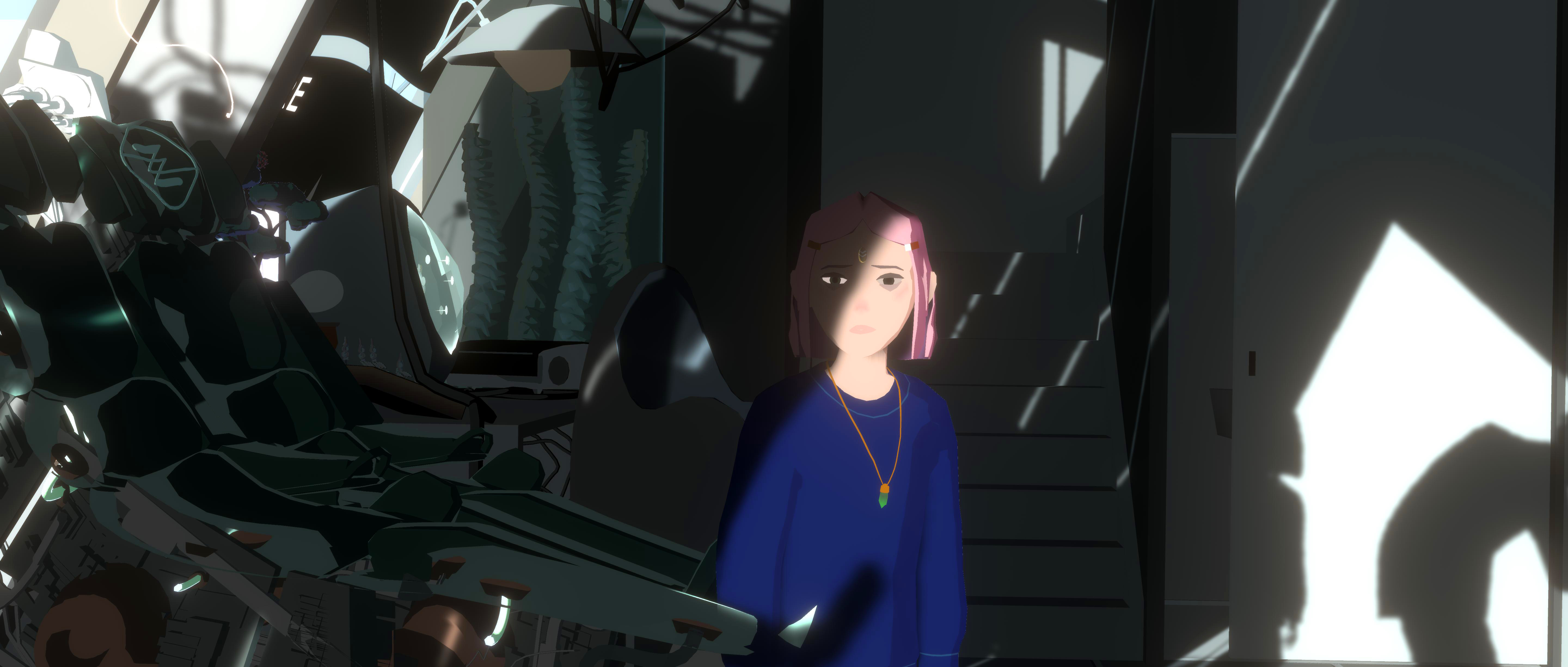
Still from Life After BOB: The Chalice Study, Ian Cheng, 2021. Real-time live animation, 48 min, color, sound.
A Coefficient of Luck
Ian Cheng in conversation with Alex Zafiris
Speaking to the artist Ian Cheng, you encounter his love for polarity: He explains how his 2019 artwork BOB (Bag of Beliefs), a sinewy autonomous creature programmed by artificial intelligence, faces trauma from its choices. He describes the courage that lurks deep in our worst nightmares; his joy of epic, cinematic dramas set in unremarkable suburbs; and the pleasure of seeing sweet children unafraid of—in love with!—huge scary monsters. Optimism reigns over these tensions, ushering in a kind of benevolence to chaos that, much like striking a match in a pitch black unconsciousness, invites us to uncover blind spots and open up space for alternate neural pathways.
His output increasingly contextualizes these extremes in a hyper-technological realm. In 2017, the MoMA acquired Emissaries, a trilogy of large-scale installations, and exhibited them at PS1. Each 10 foot-tall screen projected live simulations set in time zones thousands of years apart, beginning with the dawn of consciousness to the furthest-flung ideation of AI sentience. The enigmatic, puzzling cast of characters are programmed by Cheng to perform, or live, independently into infinity. They fade in and out of our recognition, with an all-seeing eye grazing the vast terrain to locate the lone emissary—a child, a Shiba Inu dog, a puddle—that drives these re-contoured narratives. Created using the game engine Unity, the effect is choppy, illusory. Figures loom and flicker, voices falter and vibrate, a low wind blows, shadows go long. There is a feeling of presence and emerging rhythms. Story is a moving target, pushing for a re-centering of logic and rationality. Cheng describes this as “a video game that plays itself,” which is an intentionally apt, mirror description of our reality. We are constantly trying to decode, create order, and find meaning. Watching Emissaries gently brings those instincts to the fore. He asks: How do our minds evolve? How do we accept change? What creates meaning?
Cheng graduated from UC Berkeley in 2006 with a double major in Cognitive Science and Art Practice. His first job was at Industrial Light & Magic, the special effects division of LucasFilm, founded by George Lucas to produce Star Wars. He then went back to school to complete an MFA at Columbia, graduating in 2009. He began showing work in 2011, and has since had solo presentations at the Serpentine Galleries, the Migros Museum, the Carnegie Museum of Art, the Fondazione Sandretto Re Rebaudengo, the Leeum Samsung Museum of Art, and the Julia Stoschek Collection; and has been included in group presentations at the Venice Biennale, the Moderna Museet, the MOCA, the Whitney Museum, the Hirshhorn Museum, the Tate Modern, the Louisiana Museum, the Fondation Louis Vuitton, among others. He is represented by Gladstone Gallery in New York, Pilar Corrias in London, and Standard in Oslo. He now works with a team under his company Metis Suns, led by producer Veronica So, and his impulse for collaboration extends to his audience via interactive apps, wikis, a book on worlding literacy, and in-gallery participation. He lives in New York with his wife, the artist Rachel Rose, their two children, and a corgi.
His most recent work, Life After BOB, first premiered at LUMA Foundation in Arles, then at The Shed in New York last year; it is currently showing at Light Art Space in Berlin. Also built using Unity, it is an anime series composed of real-time simulations, each programmed to adhere to a traditional filmic structure. Featured was the 48-minute first episode, “The Chalice Study” set in a not too-far future, centering around a ten-year-old girl, Chalice. Her father, the ambitious neural engineer Dr. Wong, has implanted a powerful, experimental AI named BOB into her nervous system, designed to support and steer Chalice through life with greater potential and ease. Realizing that she can outsource the greater discomforts of daily existence to BOB, Chalice avoids hardship and strain. Soon, her AI is performing Chalice far better than she can, and this is the side of her that wins her father’s adoration. When human Chalice awakens to this realization, she faces one of our biggest conflicts: Confrontation with the self. Who is she, really? How much time has slipped away? How does she choose a path? What forces, seen or unseen, are at play?
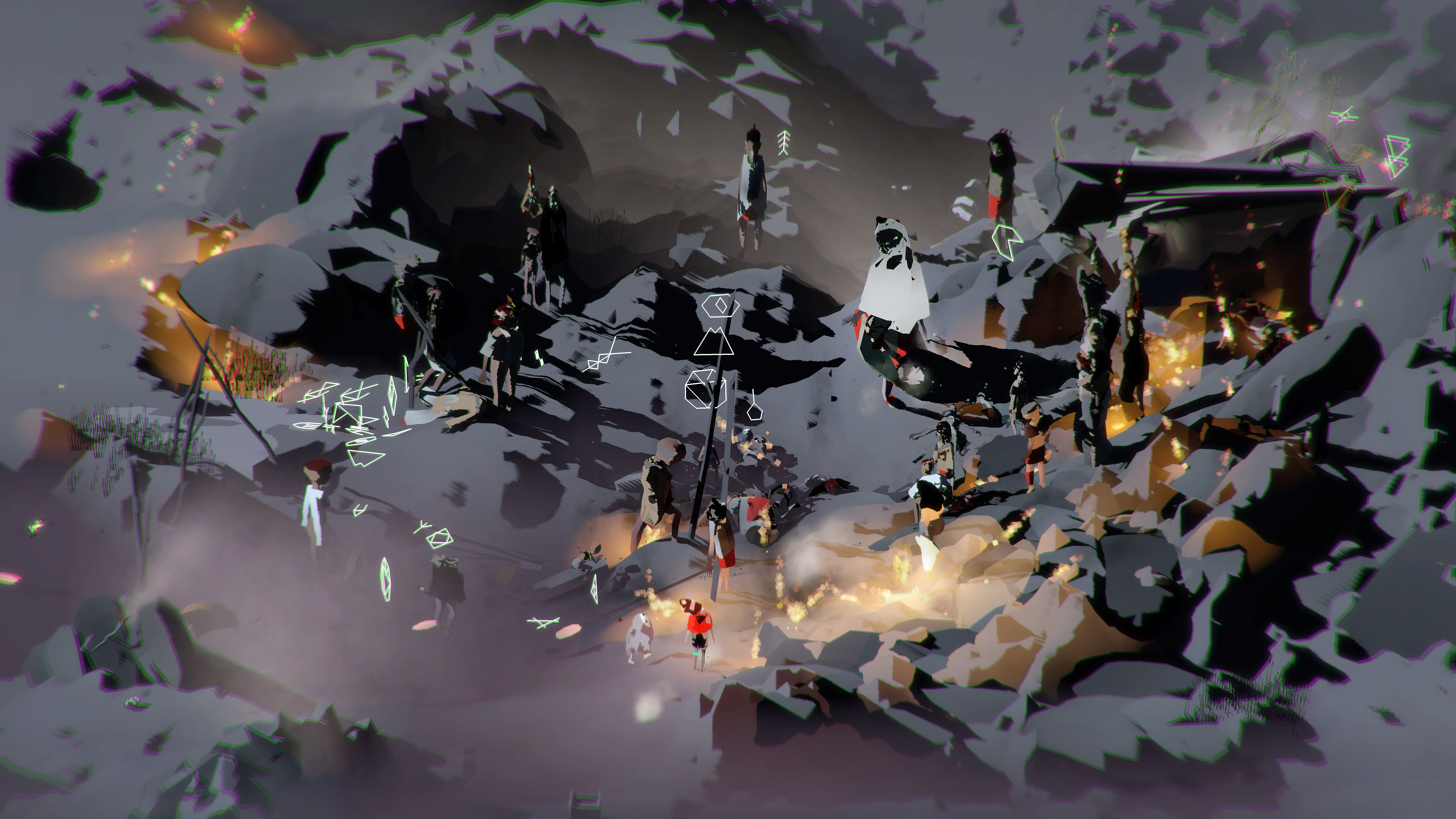
Emissary In The Squat Of Gods, Ian Cheng, 2015. Live simulation and story, infinite duration.
Image courtesy of the artist, Pilar Corrias, Gladstone Gallery, Standard (Oslo).
Alex Zafiris: Emissaries at MoMA PS1 was my first experience of your work. I was at the Printed Matter book fair. It was packed, and I was looking at all the books obsessively. I went upstairs and wandered into the exhibition space and was completely taken in. It was such a break from everything. I felt an extreme calm, watching. And I felt very free, from the chaos and anxieties of my mind. That feeling really stayed with me. I developed a connection to your work that day. How do you design emotion, in these worlds?
Ian Cheng: First of all, I’m happy to hear that the two things you felt were calm and free. The development of an emotional connection with the viewer is the primary thing any artist would hope to achieve. I’ve been thinking about this ever since I started making simulations. How do I make a work feel alive for a viewer, without having to use people or animals? How do I compress and play with the electricity of life, the unpredictability of life?
Over the years, I’ve realized that the art I really love, and aspire to always make, speaks in some language of the unconscious, which is inherently an emotional language. Dreams are so emotional. That’s the energy source. When you dream, all the rational circuitry in your brain is asleep. The remaining active part of your brain is working out something unresolved, in the medium of dream-space. For me, it’s the most courageous and curious part of a person’s mind. It wants to grope at an answer to problems that are unsolvable by the rational, conscious, wake brain. Your dreams are the first line of offense in sense-making. The answers come out hyperbolic, overly symbolic, exaggerated. It’s also the part of you that is capable of generating the darkest images. But the quality of the answer doesn’t matter: It’s the bravery of that part of your cognitive processing that even attempts to look at something unknown, scary, chaotic, and tries to make sense of it.
Your rational brain wants to use its maps, beliefs, and pre-existing stories. But those things might all be outdated for the problem at hand. As an artist, I want to mimic the language of a dream as a way to bridge things that are beyond us—too complex, too strange, moving too fast—for our current way of thinking, upbringing, and how we negotiate the world. Why? Because a dream language is the only one we permit, and even enjoy, to voluntarily confront the unknown and dwell in it. It’s de facto the artist’s job to powerfully integrate dream language into waking material reality.
For the PS1 show, I made a fuss about having deep archways, rather than just normal doorways. The curator and I both agreed that this produced a portal effect, a feeling that you’re entering another world; that you’re dropping into an unconscious space. We were very concerned with trying to create an architectural transition to approach the actual works, to help elicit a neuro-bridge with the viewer. Art is the domain in culture that positively prides itself in using an unconscious language as a source of nourishment. Advertising and mass entertainment use it too, of course, but for instrumental ends.
I want to mimic the language of a dream as a way to bridge things that are beyond us—too complex, too strange, moving too fast.︎I want to mimic the language of a dream as a way to bridge things that are beyond us—too complex, too strange, moving too fast.︎
AZ: I didn’t expect you to talk about dreams and the unconscious. I know that you have a background in cognitive science. I read that during your studies, you changed direction, because you felt that you could apply much more of that thinking in art.
IC: That’s true. I thought: Art is a place where you can choose your own problems. In other domains, you’re addressing a very specific problem, one often defined by pre-existing obligations, people, or processes. You try to find creative solutions, but it’s tough to back up and redefine it. Art is still very free in this respect. The art world can be stifling in some ways, but it’s still premised on artists having permission to explore problems that they want. We live in fraught cultural times, but I think that permission is inherently there. More than ever, I crave art that has the nerve to explore scary, complex, impossible problems, and the imagination to throw some answers at them.
AZ: You are moving more and more towards narrative in your work. Did you consider serendipity, chance, destiny, or fate, say with BOB: Bag of Beliefs? In Life After BOB, the protagonist Chalice is on a mission, which requires an arc, and a character profile.
IC: Yes, absolutely. BOB was a virtual creature; it was an opportunity for me to really dive deeply into ideas of artificial life. The current landscape of AI is dominated by deep learning models that all try to solve a domain or a game, like the game of trying to label images, or the game of generating sensible text. But BOB was a way for me to explore an embodied AI—albeit a virtual body—which presents a whole other set of AI problems. An embodied AI requires a way to unify its sensing of an unstructured environment with its working beliefs. It also requires motivations to help narrow the open-ended, continuous problem of how to act, and what to do with itself. In order to perpetuate itself, it needs the ability to perceive the world as opportunities for action, not as a landscape of platonic, objective objects.


BOB (Bag of Beliefs), Ian Cheng, 2019. Artificial life form.
When I began making BOB, I had to really consider the edges of BOB’s life as a work, and as a virtual creature. How it’s born, how it dies, what its life journey is. What I learned in developing the AI of BOB is that early experiences at the beginning of its life crystallized certain foundational beliefs. For instance, what things in its environment meant had to be boiled down to: Does an object present an opportunity for action for pain or pleasure on BOB’s body? There’s truth to this. Pain is the most real thing from an organism’s point of view. If you’re in deep pain, you can’t escape it. That’s your total experience, you can’t deny its reality in any way. BOB’s AI takes unstructured sensory information from its environment and tries to generalize a belief out of that. For example: After it’s born, if it sees what you and I perceive as an apple, it will instead just see a red shiny object. Maybe it will go and investigate it. Maybe it’ll put it near its mouth, and maybe it’ll bite into it. It tastes good, and gives energy. Now it has a belief about red shiny objects: Tastes good and gives energy. Therefore, the next red shiny object encounter is going to generate that same belief. It’s a very action-oriented sense of meaning.
The next object it encounters might be, to you and me, a red brick. But BOB’s stupid, the way babies are very stupid. BOB will bite into that brick, thinking it’s an apple, because that’s the only belief it has: it’s red, and shiny. Then, of course, BOB will be in severe pain, its teeth will crack, it will have indigestion, maybe it will throw up. And now it must develop a new belief because of that negative emotion. This red shiny thing—that is more square-like, cubic—is horrible. It’s death. It’s super pain. BOB now has to develop a belief to augment the original belief of red shiny objects being tasty and energizing. Over time, it develops a stack of beliefs that are nested within each other. No other forces are intervening yet, and it is left to its own beliefs. BOB’s worldview is limited to a string of early childhood experiences. What BOB comes to believe about those experiences shapes all its behavior going forward in its life. Which you could say is a form of destiny, or a kind of curse of your own beliefs.
What I learned is that BOB would basically believe itself into a corner, become rigid and brittle, and often die. So I made an interactive app called “BOB Shrine,” where you can make offerings to BOB in the form of different virtual objects. You can attach a caption, using your parental wisdom (or, parental sadism!), to override BOB’s initial beliefs about whatever it is presented with, and encourage it try something beyond its worldview. This was how I was able to get BOB to learn beyond the limitations of its initial childhood experiences. It was a way of reshaping BOB’s life course. Another word for life course, you might say, is destiny.
I learned a lot about animal psychology in doing BOB, but I think it extrapolates pretty similarly to human beings. I became obsessed with the idea of people’s destiny. The psychiatrist Eric Berne had this idea that everyone has a life script. This script is a way of organizing yourself in time, at the scale of a lifetime. Berne’s hypothesis was that, whether you consciously want it or not, everyone has a premonition about their life—whether or not you’ll get married, have children, be successful at a job, or be a perpetual failure. He asked, for example: Do you sense that you are prone to repeat failures over and over? Or do you persevere through difficulty, and level up in some way? Will you die with friends around you? Or will you die alone? These are existential questions. Berne described that, if you ask someone to stage a play of their life, and how they imagine it will go—not how they want it to go, but how they think it will go, how it’s destined to go—everyone can conjure that play. For many people, the play they imagine is often a tragedy, with flaws that they would not like to look at. Berne’s idea is that you develop a life script very young, based on parental modeling and early childhood experiences. Then you unconsciously go about enacting that script, especially at major forks in the road. One purpose of Transactional Analysis—Berne’s school of psychotherapy—is to become conscious of your life script, because then you can choose to rewrite it.
Carl Jung is a big inspiration for me. He said something very similar: “Everybody acts out a myth, but very few people know what their myth is. And you should know what your myth is because it might be a tragedy and maybe you don’t want it to be.” I came across this quote when I was writing Life After BOB. It’s very similar to Berne’s notion of life scripts. The first episode of Life After BOB is called “The Chalice Study,” and it’s about life scripts in a post-AI world. The title Life After BOB is shorthand for Life Scripts after AI. The main character, Chalice, is a ten-year-old girl. Her neural engineer father, Dr. Wong, gives her an AI called BOB to help co-parent her and guide her through childhood towards an idea of a satisfying existence. Chalice, being a ten-year-old, has an escapist, lazy, weak personality with a disposition to evade life and drift into fantasy. She abdicates more and more responsibility to BOB to deal with her conflicts. Like arguing and negotiating with her dad, or just walking up a flight of stairs because she doesn’t want to deal with the physical pain of it. BOB takes over her nervous system and drones her—possesses her—and does her life for her. Over time, her father falls more and more in love with the BOB side of Chalice. The human side of Chalice becomes increasingly jealous. It’s a Cain and Abel story, in a way.
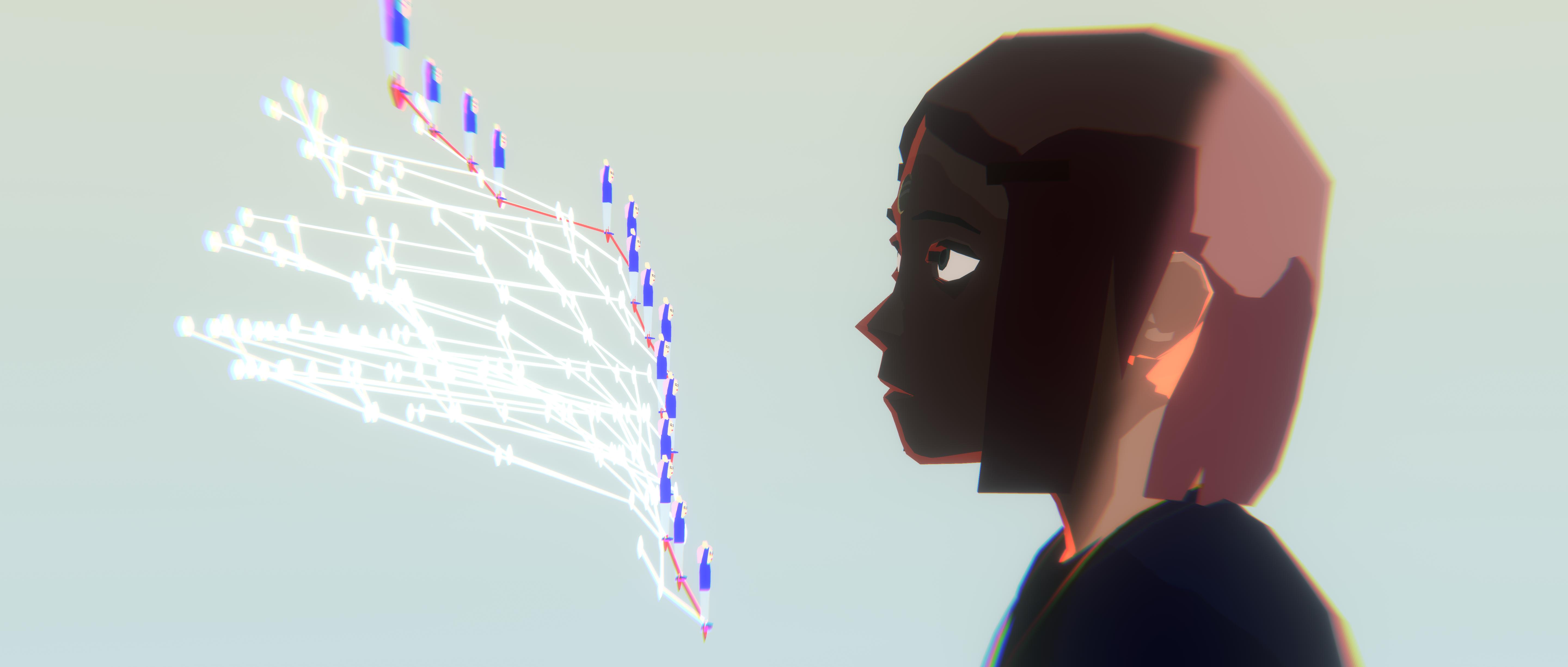
Still from Life After BOB: The Chalice Study, Ian Cheng, 2021. Real-time live animation, 48 min, color, sound.
At the height of the Dr. Wong/BOB dynamic, the human Chalice rebels and goes off and plays a neural game, like a kid sulking off to the basement to play video games and never coming back. What feels like 10 seconds in this neural game is actually 10 years in her real life. BOB has lived out her teenage years, from ages ten to 20 embodied as her, doing her life for her. By embodying Chalice for ten years, BOB has effectively become a real person (who renamed herself Chyna). So, the human side of Chalice—that human consciousness—sits outside of herself, seeing a version of her adult self that she does not recognize. It’s not who she imagined she’d become. It’s very upsetting. She hates the life that BOB has lived for her. So the core problem of the story is: Does Chalice reject this life that BOB has created and built for her? Is it merely a case of AI gone wild? After all, Chalice did not have any agency in this life that BOB created without her input for ten years. Or: Does Chalice integrate some part of what BOB did, even if it upsets her expectations? Because an AI living in your nervous system leaves behind—over the course of its experiences—all this muscle memory. Even if you wipe out all the episodic memory, there is still evidence of a life lived, in your posture, in your reactions. Chalice has to decide whether or not to integrate some of that. She has to accept that part of her story is: She went away, BOB did her life for her, she returned, and had to deal with putting herself back together into someone coherent. It’s an attempt at defining a new archetype. A person who lives with unearned life experience. A person who inherits unhuman experience, now baked into her nervous system and body.
AZ: I want to know about the aesthetics of the project. Last year you posted a picture of Chalice on your Instagram, and I was instantly drawn to her. She felt real to me. Your style is very specific.
IC: Thanks for saying that. Forget all these psychological ideas! I do obsess over how everything looks. I’m trying to find some new balance between East and West. I love Western animation. I’ll see every Disney and Pixar movie. I grew up on Disney. On the other hand, I also love anime. It’s deliberately cute, chibi, but it is often pitched towards an adult audience, with dark existential subject matter. I love this duality in anime. I always wanted to find a more international blending of those two. The look of Life after BOB leans more on the side of anime. But it’s also made in a video game engine, which has its own visual language concerned with polygonal economy.
AZ: The depiction of emotion on her face was very immediate to me. She’s so expressive. Do you sketch these out, first? What’s that process?
IC: I started by making a 16-page comic, to really understand and articulate how the characters and world would appear. How Chalice looks is rooted in her personality. I’m really into the Myers-Briggs Type Indicator (MBTI). It’s a personality typology system, inspired by Carl Jung and developed by Katherine Briggs and Isabel Myers, a mother and daughter duo, during World War II. People think of it as a rational person’s astrology, and there’s some truth to that. When it works, it really works. MBTI was a useful way to define the different characters, and have a spread of personality types across the project. Chalice was typed as INFP: Introverted, Intuition, Feeling, and Perception.
It’s a particular personality that I have a fascination with. It’s someone who is empathic and capable of healing, yet almost selfish and severe about protecting their values. At their worst, a degenerate INFP can be aimless and non-committal, and evade any specific agency in shaping their own life path for fear of limiting themselves from other possibilities. I wanted to start Chalice at this degenerate INFP state. She was designed and written with this in mind.
Then it was simply an iterative process, trying to describe to my animators who this person was. I wrote and rewrote a 48-page script, rewrote it again. I made mood boards and drawings. We had a very compressed production schedule. It was “do or die,” like, are we going to capture her character, or not? We only had a schedule and budget for one or two revision passes. However, there are only so many Chalice moments of facial expression and body movement in the film that we get a good look at, and they have to add up to a coherent profile. The vocal performance, and the words she’s saying, helped. And obviously me, micromanaging from all angles, about who this character is. I think the animators nailed it. I can see a specific person in Chalice.
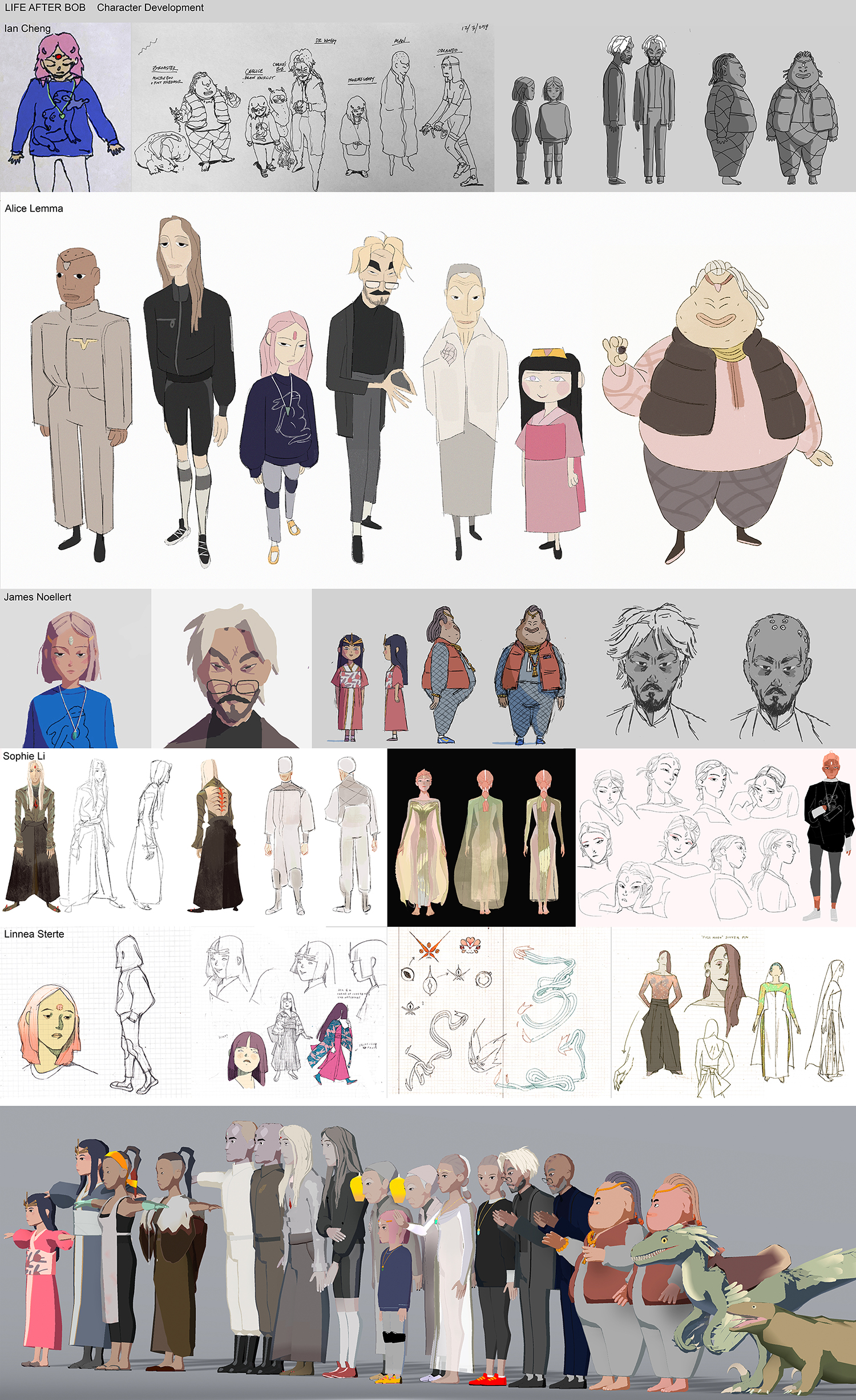
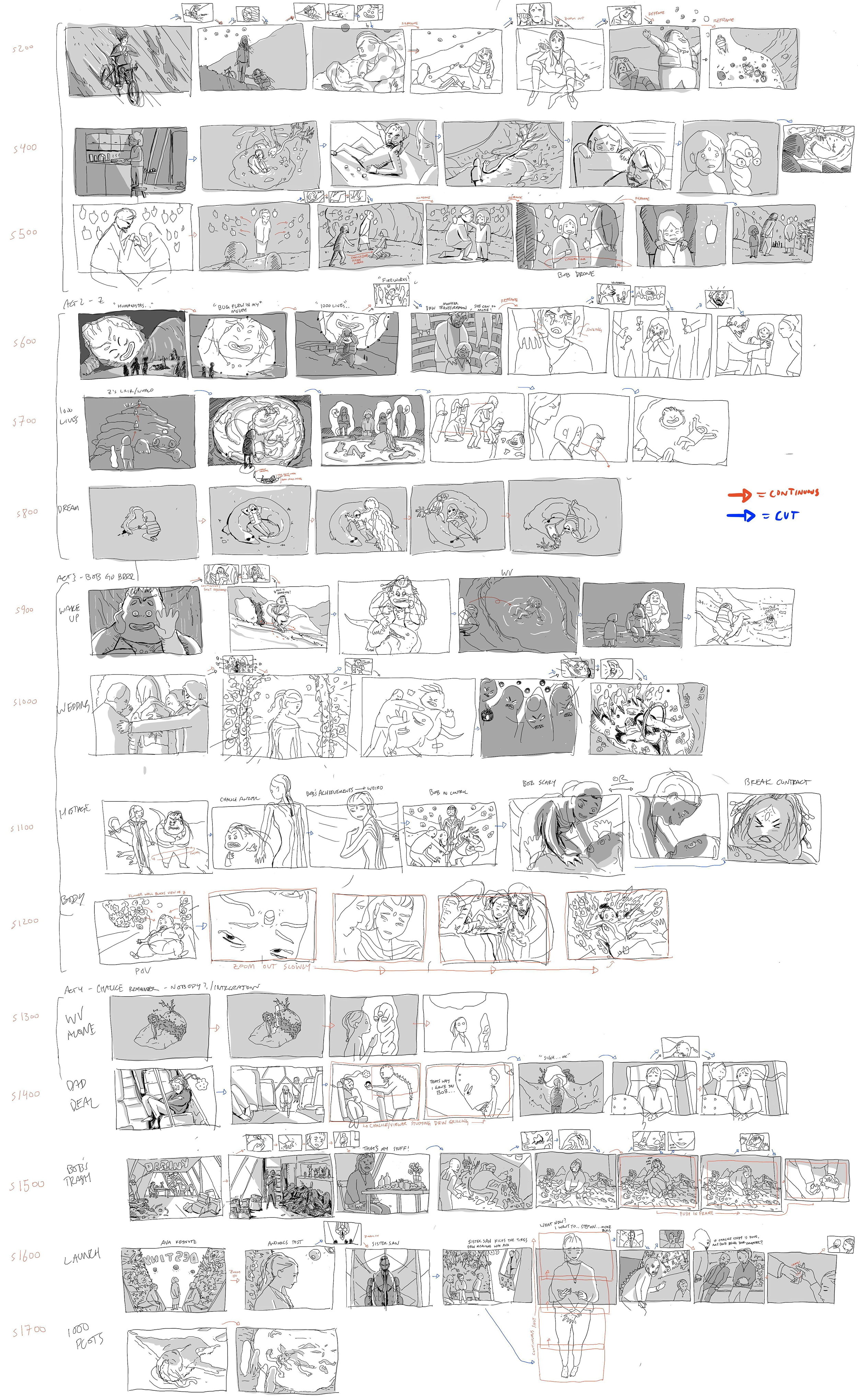
Concept art for Life After BOB: The Chalice Study, 2021.
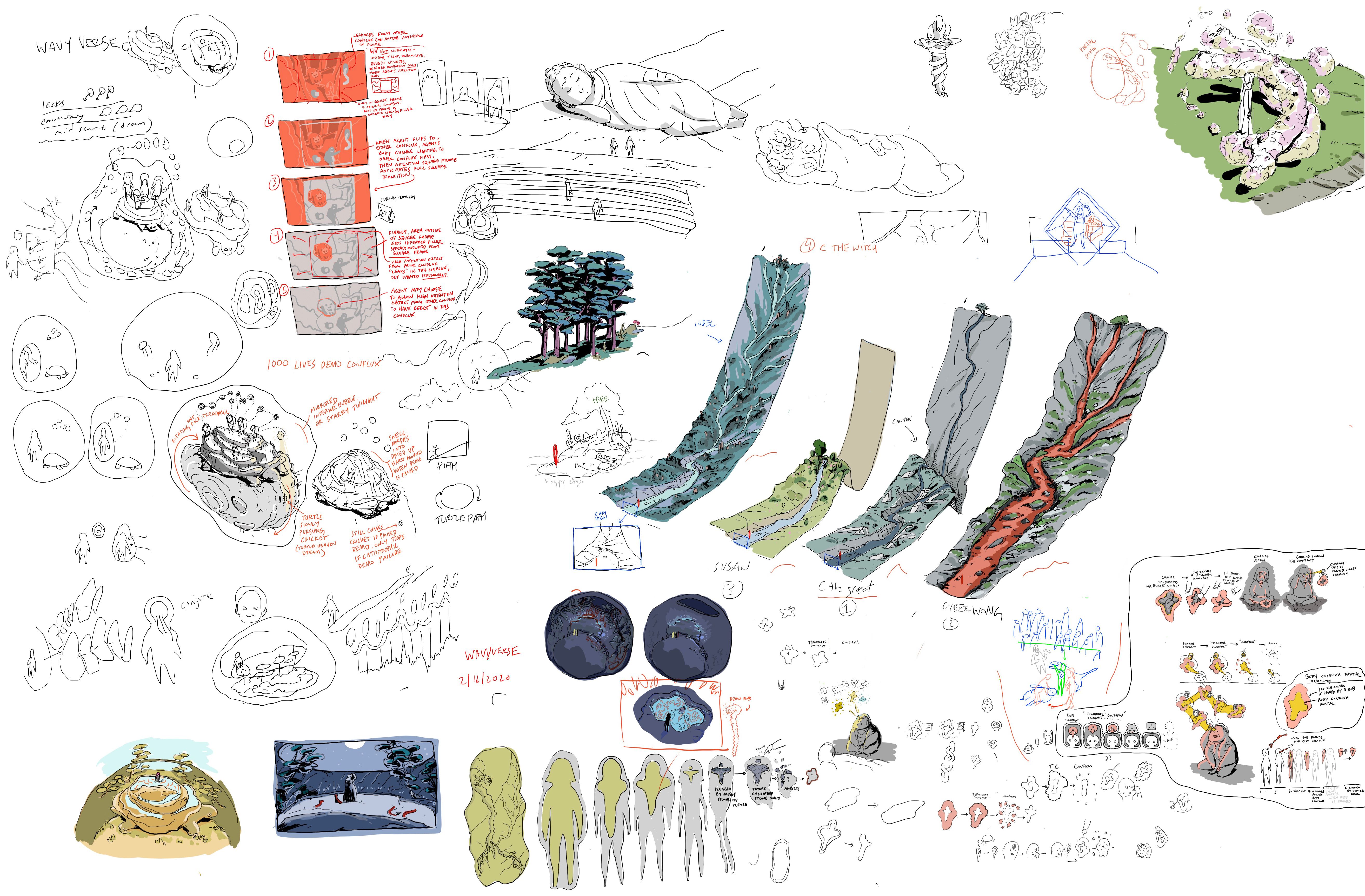
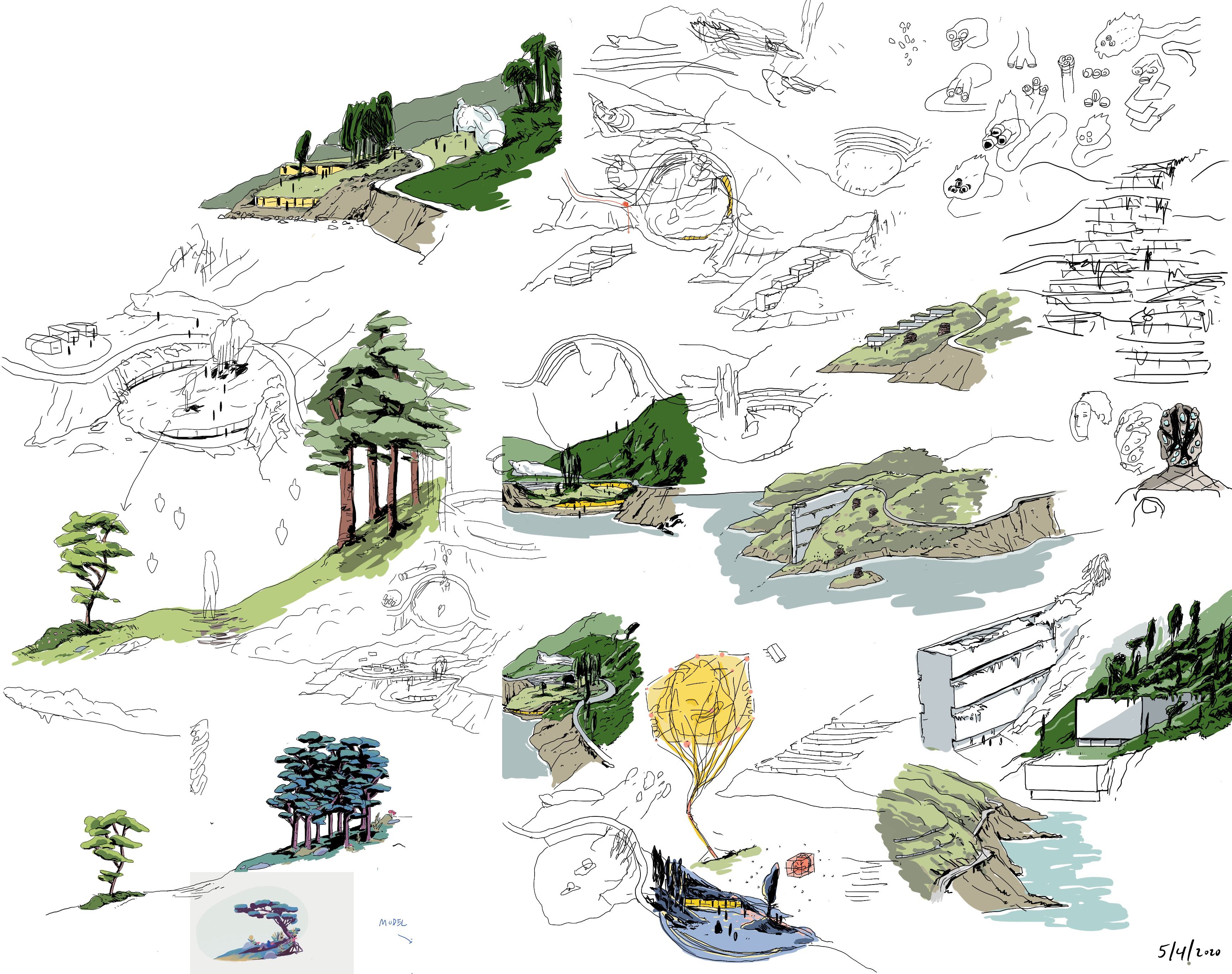
Concept art for Life After BOB: The Chalice Study, 2021.
AZ: When you mentioned “aliveness,” I wondered if teamwork can more often produce a more universal feeling than a work that is made by one person. It’s a different synergy. You have several collaborators, and you work closely with a producer, Veronica So.
IC: Yes. Veronica is the first person who reads everything. She’s who I trust to gut check: Does this feel right? Does this feel true? Does this motivation add up? Is what I’m doing what I truly want to be doing? Is it in touch with its most elemental core? Is it manifesting into something legible to a viewer? Are we both excited?
AZ: It’s your work, and you are running the team, but you’re not, say, a lone painter. You are a collaborator.
IC: Right. Recently, I came across an etymology of the word “world” as: “That which nourishes you.” My mind created an image of a water stream, cutting through darkness. The water grows and grows into a stable, continuous flowing river. Soon, new plant life begins to sprout around it. Animals are drawn to inhabit its banks. Eventually the dramas of the plant and animal life become the attraction, and the flowing river is just the backdrop. This river image led me to a more precise definition of “world”: A world is the web of relations that flourishes around a repeatable game. Often, when you think of a “world” you think of like, Middle Earth in Lord of The Rings. A geographically coherent territory, and all the drama that occurs between physically adjacent kingdoms. But today, a world is much more the network that forms around a non-physical game. In the case of Life After BOB, the game evolved into: Make an animated film using the Unity game engine remotely during COVID-19. Week to week, it was this game of chipping away at a cascading to-do list on the production timeline. Professionally, everyone had their production role and a north star to focus on. But I’ll never forget the basic feeling of being in Zoom rooms with twenty-plus people every Monday for a year, and all the one-on-one Zoom work sessions throughout the week. What made lockdown tolerable was getting to inhabit this shared world, this web of relationships that started from a specific game that I made up.
A world is the web of relations that flourishes around a repeatable game.︎A world is the web of relations that flourishes around a repeatable game.︎
AZ: Speaking of being in dialogue, so far you have referenced psychiatrists—Carl Jung and Eric Berne. Who else?
IC: I’m inspired a lot by film. I grew up in Los Angeles, and my mom would take me movie-hopping on the weekend when I was a kid. I’d see five or six movies sometimes on a Saturday. We would start in the morning, and then go until the night. I’m definitely a creature of narrative. I’ve seen a lot of movies. I have a lot of random IMDb knowledge. It’s something that’s in me, even though I’m not in Hollywood. I’m super inspired by Hayao Miyazaki. More so than ever now, because my daughter loves My Neighbor Totoro. I’ve seen it, like, 40 times in the last 30 days. It’s actually really cool to see it so many times. You start to see what wears on you, what really stays with you, and different things emerge. I didn’t realize until recently that the film starts off as a genre story about a haunted house. These two kids and their dad move into a new house in the countryside, and they’re preparing it for their mom, who has been in hospital for months, sick with some kind of bronchial problem. She needs the country air to rehabilitate. The neighborhood kid comes by and says, “Your house is haunted!” Miyazaki’s premise is that ghosts are real! But they’re not scary ghosts, they’re friendly ghosts. Spirits aren’t a bad thing in Japan, and only children can see and delight in them. This was such a beautiful spin. Totoro is a fat ghost or a spirit who can help you when you need it most, but least expect it. My daughter is two years old and enchanted by it. She makes me fast forward to when Totoro arrives.
AZ: I remember being non-judgmental about things like ghosts and monsters until I was told to be scared of them.
IC: Yes. I love how specific Miyazaki is about a character’s age and their psychology at that age. Each life stage has stupidities, but it also has superpowers. He has empathy for the perspective of children, and how they specifically see the world at that age. You never feel like it’s a movie pandering an idea of children. It’s a movie about being a child, with the range of emotional and psychological experience that a child might have. He doesn’t pull his punches when it comes to scary stuff. He will do things that should scare a child, such as a mom being sick. You don’t know if she’s ever going to come home. Maybe she never comes home. That’s so much scarier.
AZ: Terrifying.
IC: I also love the filmmaker Paul Thomas Anderson, because he has an alive, demonic exuberance, but it’s often applied to a very particular mundane place: The San Fernando Valley, which is where I grew up. He said he wanted to make the three-hour-long movie Magnolia as an epic for the San Fernando Valley. There are New York epics, Roman epics, but why not an epic about the little suburb that you’re from? Magnolia says to me that transcendent human drama can come from anywhere, even the Valley! I remember going to see it on opening weekend. I recognized all the locations: That’s the gas station my dad goes to, that’s the donut shop we go to, that’s Ventura Boulevard we took to go to school. Everything felt specific to my home, but heightened with crazy operatic energy. I felt so proud.
AZ: Did your parents see it?
IC: They did. They thought, Oh, this is so dark.
AZ: I knew it!
IC: They were like, This is so melodramatic. These people are crazy. That’s not like us. Asians would not act that way. And you know, there’s some truth to that, sure. Magnolia is showbiz-adjacent white drama, specific to Anderson’s own upbringing, on a content level. But the alchemy of his big art filmmaking energy—with the smallness of the San Fernando Valley—is such a vital and funny combo. I’m attracted to his instinct to present an impasse in an everyday small drama, and then elevate it (raining frogs?!) to get through it. It’s the same attraction I have to Miyazaki’s Totoro. Siblings coping with their mom being away sick, which then necessitates a fantastical fat spirit to manifest in their life. It’s a tension that connects the concrete to the transcendent. That’s just good art!
AZ: What about VR? Does it interest you?
IC: Hmm. I think there will be a day when VR will truly interest me. The words “virtual reality” are unrealized. Philip K. Dick said, “Reality is that which, even when you stop believing in it, doesn’t go away.” What he meant is that reality is all the chaotic, unprocessed things that you don’t want to see, or that you don’t have the perspective or map to even perceive. But it’s there, and eventually, you either have to confront it and make sense of it, or you die. That’s a hardcore definition of reality. Carl Jung said: “In the filth, it will be found.” He meant something quite similar. Where you’re most scared to look is where you’ll find the creative answers for how to deal with your troubles. Only then can you begin to overcome these troubles, and exercise the vital process of integrating the darkness of reality into yourself. So, when I hear “virtual reality,” I think: I don’t love it quite yet. But I will, the day that it can start to produce unexpected filth—if you see what I mean?
AZ: Yes!
IC: When VR or VR interfaces can start to self-generate enough chaos, unknown-ness, and weird social relations that don’t have any prior mapping—and be a space where you can reliably tap into that hellish complexity, as scary as that might be—Oh yeah, then I’ll be very interested in VR. And I think that day is coming. I think we can artificially produce filth.
Carl Jung said: “In the filth, it will be found.”︎Carl Jung said: “In the filth, it will be found.”︎
AZ: Speaking of darkness. People generally associate very generous feelings towards serendipity. But there is also the inevitable, which links to what you were saying about life scripts. You can find yourself sliding towards an awful thing happening. Others in this issue of Maquette argue that there is no such thing as serendipity, or randomness. It’s a very individual feeling, rather than a phenomenon. I think that serendipity can be quite creepy. Twin Peaks by David Lynch would be an example of worldbuilding with obscure systems related to the unconscious and dreams. Many of which are dark, although, always related to love. The viewers notice patterns, coincidences, and form their own narrative responses.
IC: Serendipity makes me think of luck. There are so many seemingly random or unexpected things happening in the world, and trickling down into our personal lives. Who knows when you might get COVID-19 again, and can’t catch a plane because of some new regulation. Little things just spiral out of control and snowball. But then, what luck—maybe it spirals in a way where you get to spend an unexpected time at home with your kids.
AZ: Exactly.
IC: I keep thinking that, in a world characterized as out of control and filled with so much unmanageable change, of course we would turn to ideas of serendipity and luck as orienting forces. Because you can’t count on intelligence, hard work, wealth, status, or power to actually steer the long-term future anymore. Everyone is humbled. People used to make five-to-ten-year plans. I don’t think anyone does anymore. Our information stream of world events, and how things are changing, and how accelerated technology is, is overwhelming. Nothing we could previously really count on can still be thought of as failsafe strengths. They are necessary, but not sufficient. It seems that you still need a coefficient of luck, to make it through life. I think of luck as an attractor, like a mathematical attractor. You can start to compound your sense of luck by moving in the direction of something with potential, even if it is still taking shape. The writer Venkatesh Rao sometimes writes about the possibility of a new temporal science, on how to steer into the unfolding future and increase your coefficient of luck.
I have two kids. A two-year-old daughter, and a one-year-old son. In a basic way, I have to make sure that my kids learn how to be strong and resilient amidst change. But I also think: How can I help them generate the most luck in their life? Luck is a very Chinese, superstitious framing. Another way to think of it is: How do I encourage them to move toward the unknown? There’s just more opportunity in the unknown. When I imagine them asking me, What should I do when I grow up? I’d want to encourage them to move in the direction of a frontier, a place that feels vital to the future, but is not yet crowded by pre-existing maps, prejudices, and competition. A frontier is risky, but it is also a zone of compounding luck. So when you ask about luck, I definitely think it’s real. Luck might not be a force of physics, but it is a quality found in a person. It is a metric of their orienting strategy towards the unfolding, unknown future. If you’re a parent, you want this quality for your kids. I want to cultivate luckiness in my kids as much as I want them to learn to read, to be in their body, to socialize, and to have a flexible palette. Maybe luckiness is the quality that emerges from the fit between living on some scary, un-systematized frontier and still managing to have courage, stay curious, and be in touch with yourself.
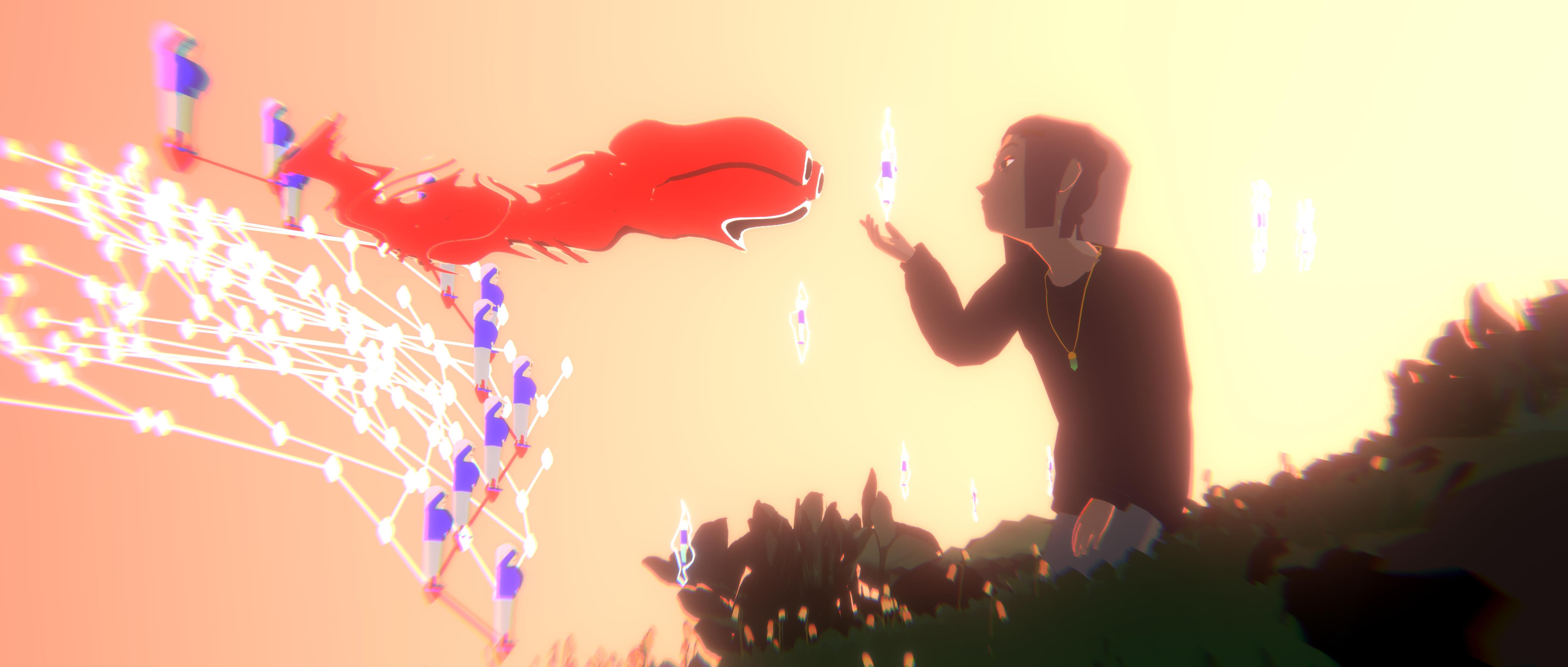
Still from Life After BOB: The Chalice Study, Ian Cheng, 2021. Real-time live animation, 48 min, color, sound.
For more information on Ian Cheng, visit his site.
Alex Zafiris is CCAM’s writer-in-residence, and the editor of Maquette. As a writer she has contributed to Bomb,The Paris Review Daily, The New York Times, Mixte (Paris), Observer, and Nowness; as an editor, she has worked at Romance Journal, Guernica, Immaterial, Osmos, Tokion, Paper, and the United Nations. For more information, visit her site.
︎Active Infinitive︎Dana Karwas in conversation with Keller Easterling︎Active Infinitive︎Dana Karwas in conversation with Keller Easterling
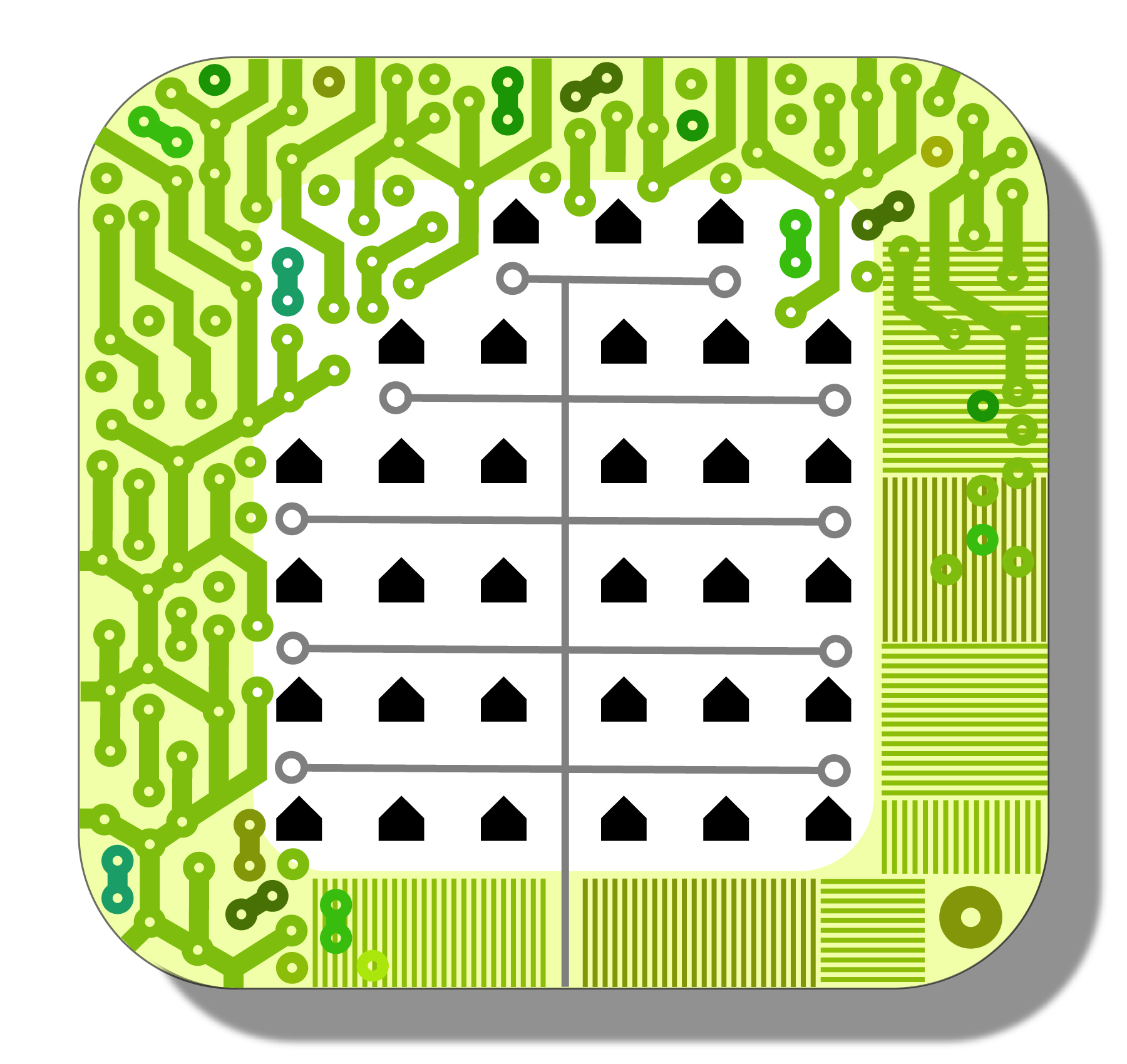
Subtraction Forest/Jungle, Keller Easterling, 2014. Sequence 1 of 8.
New broadband capacities from fiber optic cable in populous countries like Kenya serve a skyrocketing number of cell phones making digital telecommunications more robust. But spatial information systems are more robust when people access each other and multiply their exchanges. In Kenya the urban vessels that accompany digital technologies are often large highways or zone enclaves that decrease exchanges, inflate the distances between people or make cities with the topology of a closed loop. While roads are typically regarded as conduits of
progress and opportunity, in rural or wilderness areas, it might be more productive to dial down roads when dialing up broadband. Shrinking roads means preserving farm and wilderness while attracting the global networks of tourism
and university research. One can then hack a telecommunications network by changing a road as well as changing a bit of code.
Active Infinitive
Dana Karwas in conversation with Keller Easterling
I love orchestrating surprises. It’s a form of time travel: I’m creating a piece of the future that I’m a part of, but which is unleashed and accessed by others.
Many years ago, I briefly worked as a temp doing architectural drafting in New York City. I was given the task of updating redlines for a Las Vegas casino project. I confidently pretended to understand the firm's specific line-weight file, while slowly coming to the realization that I was a fully-fledged CAD specialist—pushing lines with a mouse, cutting them, splicing, adding weights, notating, repeat. It was a vacuum of creativity, especially for the under-skilled and pretentious architecture grad I was at the time.
A few days into this project, I moved onto the private gambling room, which was located above the larger, maze-like public slots area. This was meant for the high rollers and whales. It had a bar, varying levels, wood paneling, and an enormous gambling table at the center.
After weeks of staring at the representation of this room as a series of lines and perspectives, the absurd theatricality of it possessed me. I saw an architectural potential in the drawings. What if a person suddenly found the need to escape a bad situation? Perhaps they had made a series of Very Bad Decisions, or found themselves in a Dead-End Job. Using perfect line-weights, I made a notation for a trapdoor into the space under the table. I then went into the reflected ceiling plan of the floor below in a different drawing, and similarly notated it there, called it out, and gave it dimensions to fit an adult human. It was perfectly spec-ed onto the drawing. The sense of control this gave me—of future opportunity and chaos—was thrilling.
The next day, I made my own exit from the firm.
I’ve never visited the casino, but I sometimes wonder if the trapdoor made it into the final blueprints—inadvertently slipping through the final engineering review by people not thinking to notice such a thing might be there, or maybe consciously included by a designer, delighted to find such a surprise.
Throughout my studies and in developing my arts practice, Keller Easterling has been a constant reference and great source of inspiration. She has a specific way of bringing architecture into visibility from various fields of information, and implants spatial form/s into the imagination through her writing. Her work has entered the mainstream through a range of disciplines; from performance, or a set of instructions, even a laser disk!
Many know her as an architect, writer, and as the Enid Dwyer Professor and Director of the Master of Environmental Design (MED) Program at the Yale School of Architecture. However, it should also be known that she possesses the profound gift of idea generation for anyone who encounters her work. Her important and critical voice in the field allows us to see something recognizable as architecture that might otherwise go unnoticed.
Expecting nothing, I asked her to participate in this issue. When she said yes, I toted around her books (Medium Design: Knowing how to work on the world and Extrastatecraft: The Power of Infrastructure Space), sputtering her quotes to my students like a broken robot—
On latent space in design: How
do you represent an instruction that will play out in time?
On new technologies replacing the
old: It is a closed loop establishing a new smart that, by definition, recreates the old dumb.
After finishing my reread of Medium Design, I was overwhelmed with ideas. Hundreds of trapdoors were waiting to open! I had long forgotten about my casino trapdoor. Easterling’s writing released the memory, opening the latent space of the act. She also showed me how to describe the act of designing something for a body to move through in the future.
For our dialogue, I immediately turned to cinema. I realized that we shared a sentiment for an architecture that is driven by human scenarios; and also, a shared suspicion for the complacency of (monolithic) forms driving architectural discipline. Thinking on this issue’s theme, I became obsessed with a small moment from Jacques Tati’s 1967 film Playtime, in which architecture informs the action of the scene: A group of tourists sit on a bus. Adjacent to it is a modern office building. A window-washer is cleaning a large window, onto which the tourists and their bus is reflected. Suddenly, he rotates the window to open it, and the reflection of the bus tilts; the tourists scream in delight, as though in their reality, their bus had tilted along with the window.
This intersection of movement and a window reflection driving a narrative fascinated me, so I asked Easterling to watch the film again before we spoke. Our discussion exceeded all my hopes—not only does our style of thinking overlap (notably, a shared critique of the suburbs!), but her approach to activating forms reminded me of all the inherent possibilities of architecture also as art; how film can show different spaces; and architecture as an interdisciplinary practice, a community, a tool for emotion, and connection.
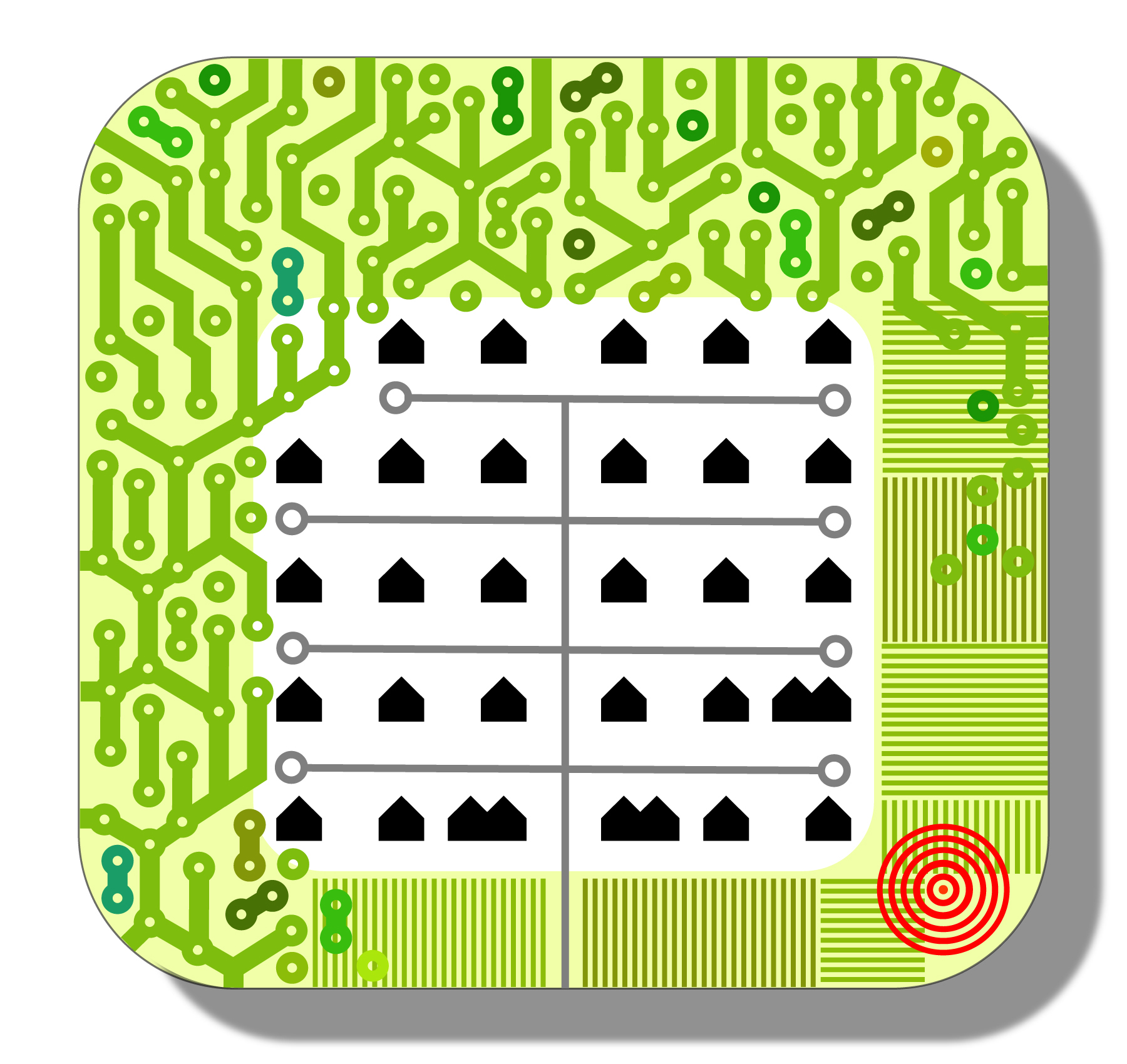
Subtraction
Forest/Jungle, Keller Easterling, 2014. Sequence 2 of 8.
Dana Karwas: Did you re-watch Playtime?
Keller Easterling: It’s just so charming and “alive.” Jacques Tati is attuned to the interactivity between things. Objects in space, some of them non-human and inorganic, are performing something in relation to each other. The bus window, the camera, the people, the tilting glass all have a repertoire of activities that can be in interplay. And he’s just watching it dance.
DK: I love that. It’s like listening to jazz. My young son laughs through the whole movie. Children like repetition. Every time we watch it, he will see something new: A surprise repetition loop. It makes me think of the opening that is being created for the viewer. That window scene struck me as a gateway to something else, an in-between space; what that could be, with the play of the camera. He loves the fake doorknob. We look for it in the restaurant shots: The glass door breaks, and then they keep holding the doorknob up, and opening and closing the door. I think of the body in action, a kind of embodiment of an architectural space that does not exist in mimicry.
I also think of selective attention—what we are paying attention to. Playtime is like the feature film version of the invisible gorilla experiment in psychology. There’s a group of people in a room throwing a basketball between each other, and viewers are asked to count how many times they pass it. Halfway through, a person in a gorilla costume walks by, pounding its chest. The subjects are then asked if they saw the gorilla, and half the time, hardly anyone saw it. When they watch the video again, everyone is shocked. I am very interested in our intuition around visibility. What are these spaces and objects highlighting? What are the connections right in front of us, that we might not necessarily see?
I was struck by your insight of these relative potentials between things that unfold over time. It reminded me of the theater, and the way that we stumble into serendipitous discovery, and how this can be spatially cultivated. And I’m wondering, in terms of connecting spatial culture: Is there a way to cultivate latent space?
KE: When you mentioned that we would be talking about serendipity, it raised many questions. On the one hand, you think of something serendipitous as being related to chance, but maybe that’s not why it’s so startling, or so funny. Maybe serendipity is the thrill of being aware of the potentials within a context, the way in which the arrangement makes some things possible, and some things impossible. There is already a dance between things. A tilting window is at a height that interrupts a range of vision. A finger can thread through the handle of a teacup. The height of a chair corresponds to where a knee bends, and it all fits under a table.
The psychologist James J. Gibson calls these potentials “affordances” that are in an ecology of interplay. So, while something serendipitous is not designed (you used the word cultivated, which is nice), you can put things together in different chemistries that have potentials. You can put Na+ and Cl- next to each other, and you might get salt. A designer is not just designing fixed objects and controlling them with geometry in a rigid aesthetic regime. Designing might just simply be entangling things that have the potential to combine, or nudging things into a richer entanglement.
Most good designers think this way. They are good at mixtures. They’re good at seeing what kinds of things mix, and how they mix; and their potentials for a serendipity that is maybe not so surprising after all.
There is already a dance between things.︎There is already a dance between things.︎
DK: I keep thinking about the body in the play of this as well. I read about your idea of canines, of designers being able to think like a dog, and thinking about our canine ability to identify a situation or a pattern. The theme for this issue took inspiration from this New York Times article about serendipity and the concept of super-encounterers. One of the researchers from the University of Missouri talked about different types of encounters: there’s a kind of non-encounter, where everything is set and they go about their day; the medium encounters, where an occasional thing will happen as a surprise or happy encounter; and then there is this wonderful term, which I loved, called the super-encounterer. He talks about the reporter Gay Talese, who in the 1960s declared that:
“‘New York is a city of things unnoticed’ and delegated himself to
be the one who noticed. Thus, he transformed the Isle of Manhattan into the
Isle of Serendip: he traced the perambulations of feral cats, cataloged
shoeshine purveyors, tracked down statistics related to the bathrooms at Yankee
Stadium and discovered a colony of ants at the top of the Empire State
Building. He published his findings in a little book titled New York: A Serendipiter’s Journey.”
Super-encounterers find the string, and are able to follow it. They are constantly seeking ways to activate the power within them. I think designers have a natural super-encounterer relationship to space, and are looking for and finding these patterns. I was enamored by these weird and enigmatic super-encounterers, and how it relates to design. Even resurrecting the flâneur in this context. The researcher in the article said it helped that the super-encounterers really believed they would find these interlocking connections and surprises, which helps close the cycle.
KE: That’s wonderful. I do remember something about that in The New York Times. The potential for connection is there, and that it is a matter of detecting it—a matter of reading the spatial language of a heavy information system.
DK: Yes. I keep coming back to that. I’m always thinking about: How does this play into the body, in relationship to its environment? What are all the possible layers and aspects of understanding of our own body in space?
There are scientific, neurological observation processes where labs are looking at what neurons do when people walk from point A to point B. And there is a significant history of metrics that can be put around the physical. But, there is also all of this unmeasurable stuff. What do we call this unmeasurable stuff? How does it relate to the body?
Subtraction
Forest/Jungle, Keller Easterling, 2014. Sequence 3 of 8.
In my class, “The Mechanical Artifact,” we put a student on a parabolic Zero-G research flight, where the body is put in zero gravity for 15 seconds at a time. It is somewhat extreme. It allows someone to be in an environment where their body is put under very different circumstances. Even though they are in a plane, they are floating. The class looks at how to design an architectural space or environment that would relate to the body in this kind of free-form fall, as a way to reorient our awareness.
If we don’t know what this new environment’s going to be in the future—for example, if we all end up in off-planet life—what will those relationships between the body and the space look like? If we go completely outside of our environment and look at that, and then come back down to this planet, is there something that we can extract from that? This would be some type of affordance, or a way of further understanding something we don’t even have language for yet. The body as an interpolation to the spaces, and the impact that they have.
This builds from my conversation with Sarah Oppenheimer for Maquette. We based our interview on something called the isovist, which is a new favorite term of mine. It is anything that can be perceived from the position you’re standing in. My isovist right now is: I’m looking forward, and I can see all the way out my window—all the way to a tree that’s probably 500 feet away. But that’s only within a certain frame. And then it’s cut off by a dresser and a bed in the house. I could imagine what your isovist is right now. I don’t know what’s in front of you or behind you, but it creates these beautiful spatial dimensions.
When I was reading about your concepts related to spatial potentials, I was also thinking: How do we measure those? How do we map them? Are they even mappable?
KE: I have seen isovist mappings, but I didn’t know there was a word for this. I’m thinking back to the flâneur, and about the untapped potentials of the human body. We generally are not thinking about things like the stretches and ranges of space that our eyes can see, or what our internal organs are like. I say this as a performer who first trained in theater before architecture. The potential of what the body can do and know is so stunted by conditioning. Medium Design begins with a straw man critique of modern Enlightenment habits of mind—the love of abstraction, ideational monotheism, the one and only and the Manichean struggle. The capacities of the human body are underexploited and under rehearsed. They are pounded into you when you’re a little kid, to know the right answer to things and be able to name things. It’s a nominative habit of mind, instead of an active infinitive habit of mind.
Subtraction
Forest/Jungle, Keller Easterling, 2014. Sequence 4 of 8.
I hadn’t really thought about the flâneur in such a long time. The flâneur is performing art in another active register within which optics are only a part. They are detecting active potentials or dispositions in a context.
DK: Like a detective. I hadn’t thought about the flâneur either until I read the serendipity articles. I thought, Wait a minute, how would this fit in? I started looking at images. I was showing my students the classic flâneur image of the 19th century gentleman walking the turtle through the streets of Paris:
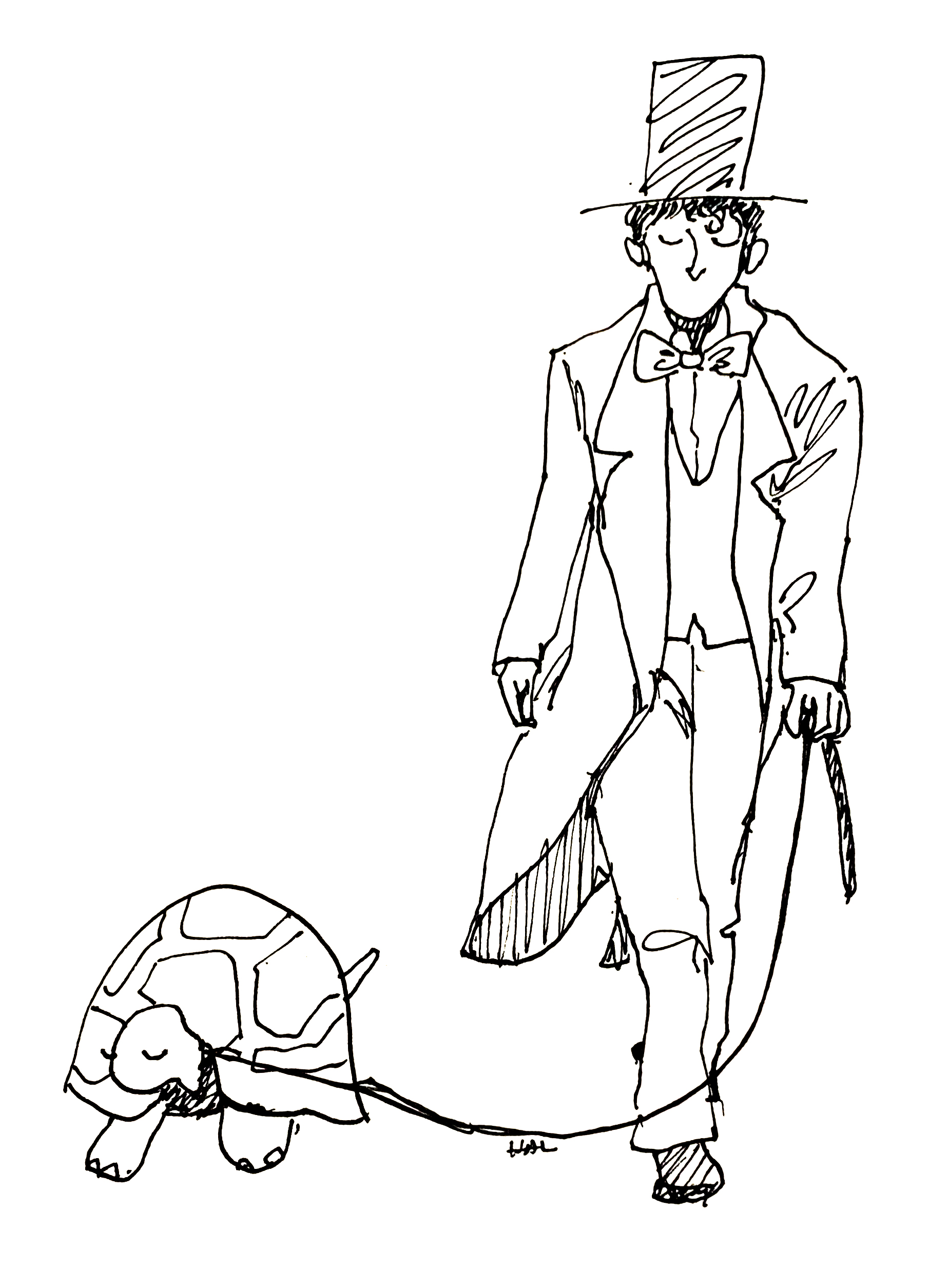
Image by Sarah Feng, 2022.
There’s so much more we need to know. The flâneur makes me think of disassociation, or almost removal. Removing oneself from the performance, and entering another performance, but sharing the same space. This ties into your idea of successive technology, the obsessive belief of replacing the old with the new, only to find that it is the exact same thing—a force, a pressure of measuring success within the endless updating of technology. A recycling of it. Is there a flâneur 2.0, in tech terms?
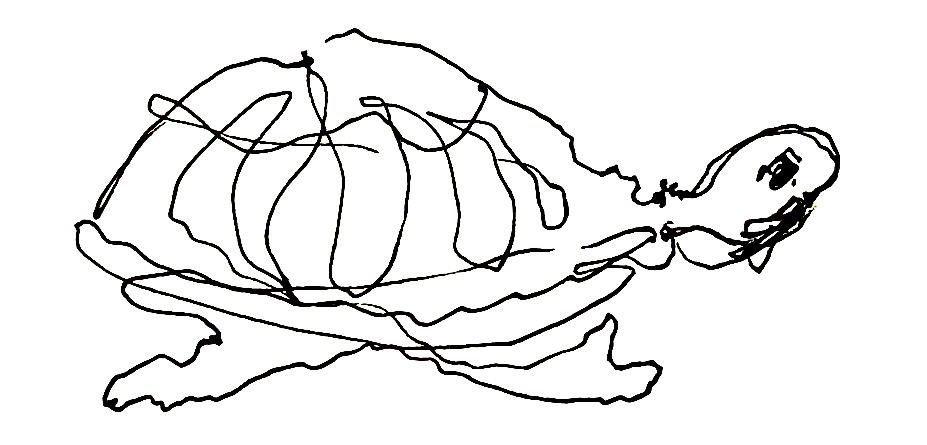
Image by Chloe Hou, 2022.
KE: As you talk about that, I think of, among many things, the novelist, dramatist, and cultural theorist Sylvia Wynter in an interview titled “The Re-enchantment of Humanism.” She thinks around and beyond the last five hundred years of Enlightenment mono-ideational thinking and monocultures. What might be the capacities of a re-enchanted human?
Enriched thinking is not only an advance. It is not only a modern move prompted by a new technology. It may even be the shedding of that modern habit and a sense of how to make more complex mixtures with existing, underexplored capacities of humans. In the fiction I write, there is a reference to “loud-brained humans”—aggressive, nominative beings who are only aware of their bodies if they are in extreme conditions.
DK: Yes, because it’s not new. The feedback is so desensitized, or sanitized. They’re looking for the extreme or the new. I’m trying to think of what the inversion would be, in the primitive or primal. The word ‘re-enchantment’ makes me wonder if there is some type of transcendence, or sound, like Tibetan sonic bowls. People are looking for that, but I think they’re looking in the wrong places. It also reminds me of the quest of exertion of the mountain hiker, or the tech executives who need to go climb Everest. This conquering of the space—it’s becoming a human need.
I’m curious to know more about your fiction.
KE: Well, you might not call them short stories. They are an experiment with mixing different narrative forms from different series. There are several series. One explores more-than-human powers—“Crooked,” “Atomized,” “Still,” “Tight,” “Thin,” “Loose,” “Layered.” They describe incredible powers that are accessible, but just under-developed. Then there are other series: fictional essays, cocktails, non-stories or stories without event, direct addresses, parallel voices, stories from another time, and dialogues. Hopefully mixing and interplay between the series generates something beyond their content. The texts are independent but integrated, and they share correspondences, repetitions, and hidden pictures.
Subtraction
Forest/Jungle, Keller Easterling, 2014. Sequence 5 of 8.
DK: I would be an eager reader, if those ever get released into the world. When you mentioned serialization, it reminded me of a term you used in Medium Design: “the unexpected bounce of aesthetic signals in culture.” You were referring to the explorations of the French philosopher Jacques Rancière. What is that, in your mind? What is that feeling?
︎The texts are independent
but integrated, and they share correspondences, repetitions, and hidden
pictures.
KE: Rancière makes a distinction between the aesthetics of the connoisseur who taxonomizes in art historical categories and the aesthetic practices that generate or enact a politics. He writes about the politics of aesthetics, or the way in which aesthetic signals bounce in culture. They might even be decoupled from their presumed or stated message. He gives the example of Madame Bovary, or A Sentimental Education. In both, a relatively conservative Gustave Flaubert wasn’t expressing liberatory thoughts, and yet, the book was received in that way. It inspired liberatory activities. I always give the example in class of Bob Dylan’s “Like a Rolling Stone.” You know, the lyrics are about Edie Sedgwick, a bratty rich girl. But it’s the sound of his voice, screaming, How does it fee-el? that ends up being theme music to a counterculture summer. You can’t know how things will land, but you can be aware of how they are landing and in a certain context.
This may link to the discussion of serendipity. I am not sure. Or is it a similar collision? There are thinkers like literary theorist Caroline Levine—who would land somewhere between structuralism and post-structuralism. They’re noting the affordances of forms. But they are still focused on the political potentials in their unpredictable collisions. There are unpredictable collisions about which you can still detect component chemistries.
DK: It’s an awareness of not losing control of the collisions. I don’t know why I thought of this, but when you mentioned post-structuralist and structuralist, I thought of where I grew up, in the suburbs of St. Louis. I thought it was the best place in the world until I went to architecture school. During my second year at the University of Kansas, I attended a film architecture class, and we were reading theorists like Gilles Deleuze and Sanford Kwinter. We watched the movie Koyaanisqatsi by Godfrey Reggio. When I went back home, I thought: Wait a minute, something is wrong with this place! And I gave my parents, who are not designers, a whole manifesto about why the suburbs are wrong, and why our house didn’t make sense. I completely lost it, with the ammunition from what I’d been reading. I was fired up! I suddenly saw something in a new light that I had been living inside of for a long time. That was complicated—and also funny.
Subtraction
Forest/Jungle, Keller Easterling, 2014. Sequence 6 of 8.
It led me to doing research on Thomas Kinkade, the self-styled “Painter of Light,” who made all those Christmas tree trinkets that light up underneath. He made these kitschy, mass-produced pastoral paintings of countryside cottages. He’s the most profitable American artist who is not recognized by the art world. He monetized his art, and opened little galleries inside shopping malls all across America. Some of the paintings have more value: If he painted it, for example, or if one of his team touched it up. This escalated into an empire. It sold a dream of another kind of landscape. There’s this suburban development in California—Taylor Woodrow built a subdivision called Hiddenbrooke based off of these paintings, that has about a hundred homes. Each one comes with the Kincaid paintings inside, and the most prominent one over the fireplace.
Reading all this, it all felt like a closed loop: this suburban art that turned into the suburb itself. It left me thinking that there is no room for an interplay of interactions. My response was to think up a project: A contract that new suburban homebuyers would sign, that would contain an unpredictability clause. A wolf or monster could be sent to the property at any given moment to terrorize your family for a day to provide some excitement! This type of clause could be built into the longevity of the home—what if that were the latent space of home?
KE: A Black Mirror scenario that is again, startling—not because it is sci-fi, but because it is and has always been. Maybe your story only makes palpable the ways in which people have to sign up to be the victims of racial discrimination and predatory lending. They sometimes have no choice but to sign up to be literally preyed upon. Medium Design is trying to train an ability to detect not only the felicitous collisions, but also the violent ones—the latent, unspoken potentials to erase, poison, and torment with imbalanced power dynamics, environmental pollution, data monopolies, and murderous policing. In your brilliant and dark scenario, it is as if even these factors have been monetized like points on your mortgage.
DK: Yes! Risk points, but completely inverted into some horror movie!
KE: I too, grew up in the suburbs. You go outside blinking in the naked sun, and there’s a tiny little house, set 60 feet away from a 60-foot-wide street, then another 60 feet of yellow front yard, and another tiny little house. It was all specially designed so that if a giant truck was going really fast and jumped off the road, it wouldn’t hit your house. All these traffic-engineered dimensions and turning radii, and nothing gets near enough to interact. It is terrifying.
DK: And the reveal of that, whether inhabitants know it or not. They don’t see it. I’ve always been fascinated by those in-between pockets that can be found in the suburbs. The only place I can think of where an encounter could occur is the parking lot of the big box grocery store. When people leave their car and walk into the store, there’s almost a free zone, or cease-fire of control, leading to unpredictability. They might bump into someone familiar, which doesn’t happen that frequently. I’ve always wanted to create more from the in-between space. Pushing for more interaction, trying to find a pocket inside of the system, at the gateway to the local Wegmans. Which has delicious pizza, by the way.
In Medium Design, you also mention “the switch,” which was such a treat to read about. Transportation switching, and the reorganizing of how we’re moving across space and time. Recently while in New York, I had this incredible switching moment. I was late for my train up to New Haven. I was on my way to the new Moynihan Train Hall at Penn Station. I got tangled in the spatial dynamics of the Hudson Yards, where there was this series of urban levels, and I kept having to level switch. I was running, walking, scooting, stepping, shifting. For the final minute, I scooted all the way through to the new station through a series of ramps, hopped off, folded up the scooter, and made the train. Foot to scooter, scooter to train, go! I was in a taxi at one point. It all happened so quickly and easily. It was enlightening, though a little stressful, the way it compressed time. I wasn’t quite happy with the experience, but it excited me to think about the way you’re writing about it.
KE: You were doing parkour through the transportation systems! The first time I ever wrote about switching was in Organization Space: Landscapes, Highways, and Houses in America. Then I did a project based on this idea that was actually applied to that area of the city and exhibited at the Queens Museum. They became ossified by real estate, but it had all the potential. As the social scientist and cybernetician Gregory Bateson said: “A switch is a thing that is not.” It is not a thing. It is a delta or the registration of a change. Just as serendipity is not something you can plan, but you can set up the potential for something to happen.
Subtraction Forest/Jungle, Keller Easterling, 2014. Sequence 7 of 8.
We have managed to segregate most transportation infrastructure. A highway interchange is not a place of changing, but a place of staying the same. The morphology is all about keeping the same speed to make a turn. In transposing intelligence from digital networks to physical networks, many of the things that could have introduced switching and therefore more redundancy, were removed. More chances to make connections were removed. Attempts to get rid of old technology and replace it with the new just make the whole assembly even dumber.
As a researcher, I think we have to get better at not only measuring the outcome of events, but also measuring the potentials for change in various scenarios. It is a crucial kind of creative modeling that is more than either data visualization or quantitative proof.
This business of medium design is a little bit like playing pool. You can’t know the answer to playing pool, but you can know something about what to do next. There is no right answer to managing transportation networks, but approaches that mix transportation of different capacities—high capacity transit with fleets of cars, bikes and pedestrians—offer one of those moments to take a shot.
︎Serendipity is not something you can plan, but you can set up the potential for something to happen.
DK: Up against all the data, quantifiable results, or metric—how does one get everybody to believe in that switch? How do master planners propose it? They’re rolling out an X amount of the undefined, within a plan. It’s the quantification obsession. At CCAM, there was an artist who was working with a group of scientists. They ended up not getting along, because a scientist wanted the artist to clearly show that they were using a quantum mechanics equation. The scientists wanted it to be specific, so that people could look at the art, and understand the equation. And the artist was like, You can’t. That’s not what this is about. I’m not trying to disagree. It got a little tense. It makes me think of this obsession of the “correct” and the “right” and how that relates to the sciences. It is complex, because there’s no metric for art, and I don’t know if there needs to be.
KE: Yes. There are many relationships and potentials to model, some of which can be quantified. But creative modeling of protocols that build more information-rich mixtures—in transportation or any other sector is essential and should have more authority in decision making. Innovation is not only the new technology, but the conception of protocols for the way things go together. Otherwise, we’re just more precisely measuring our doom.

Subtraction Forest/Jungle, Keller Easterling, 2014. Sequence 8 of 8.
For more information on Keller Easterling, visit her site.
Dana Karwas is an artist whose sculptures and research investigate new, human reference frames for dimensional information. Dana is Director of the Center for Collaborative Arts and Media (CCAM) at Yale and is a Critic at the Yale School of Architecture teaching courses related to mechanized perception, space architecture, and inverting our relationship to the cultural forms of our time. She holds an MPS from Interactive Telecommunications Program at NYU’s Tisch School of the Arts and has a Bachelor of Architecture from the University of Kansas. Her upcoming short film about the future of the anthroprocosmos, Terra Cosma, will premiere in New Haven, Connecticut in February 2023.
︎What I’m Working On︎Roxanne Harris︎What I’m Working On︎Roxanne Harris︎What I’m Working On︎Roxanne Harris
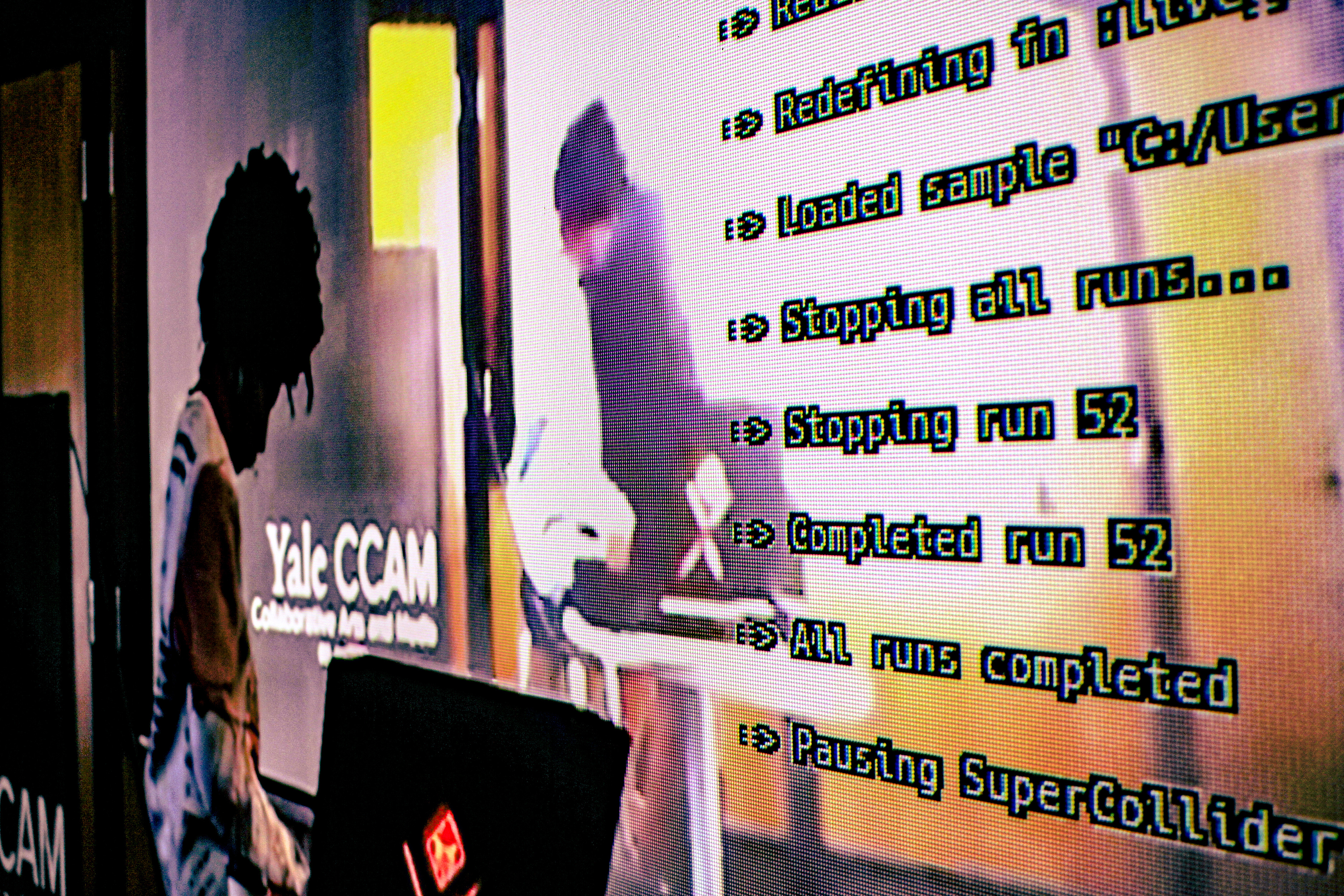
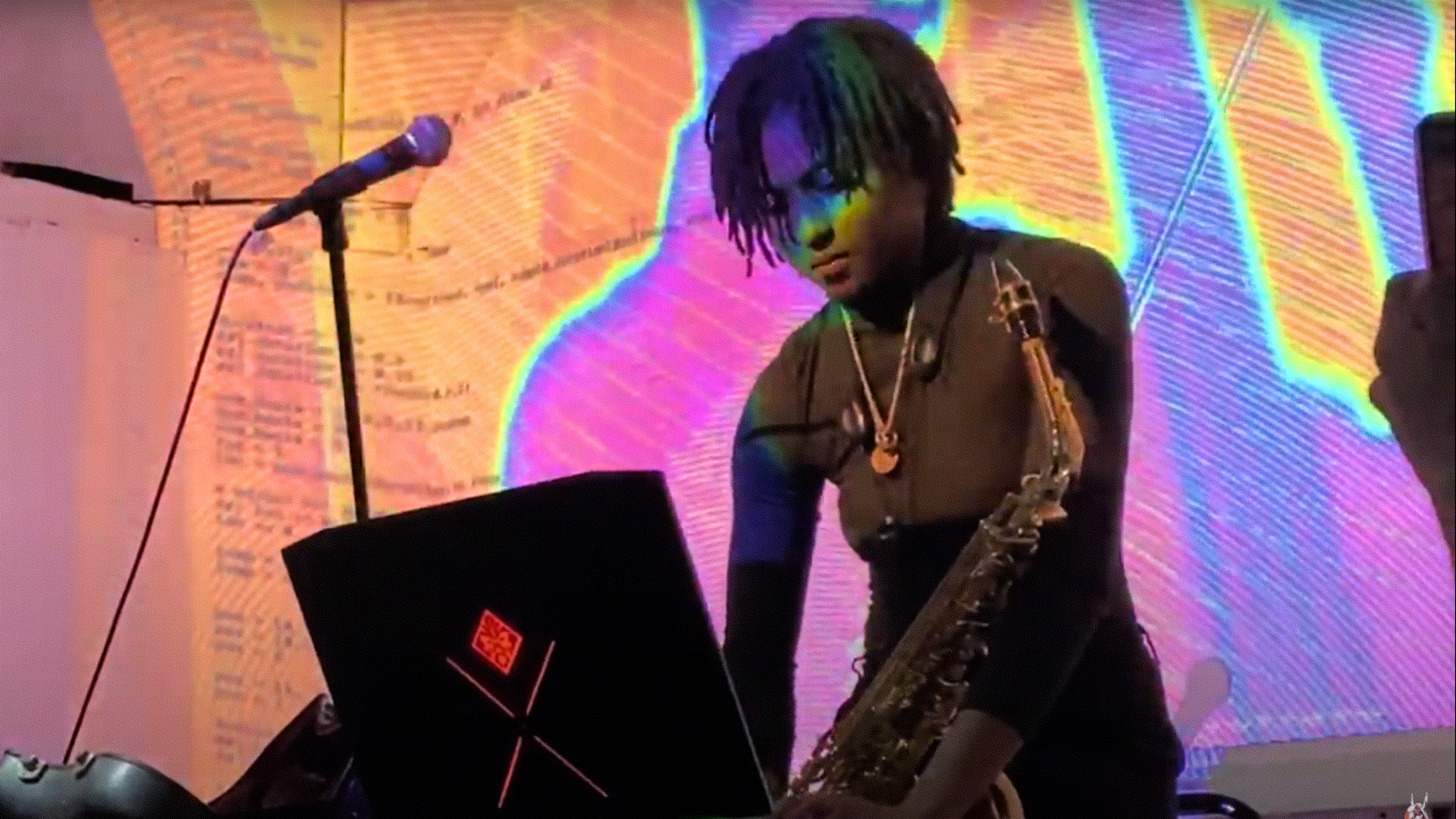
Roxanne Harris performing live coding with Sonic Pi. Image by Justin Berry, 2022.
What I’m Working On
Roxanne Harris
Live coding entered my life in September of last year, mainly due to the fact that I am doing Computer Science and Music as a double major. I needed to do two separate theses. Instead of doing twice the work, I wanted to find one topic that I could approach from different angles.
There are only two computer music people at Yale. One is Scott Petersen. He teaches algorithmic composition, algorithmic music, and heuristics. I took his class dealing with sound synthesis and sound design, and learned about the program SuperCollider. That’s when I got my first exposure to using code that would make music. At the time, I wasn’t aware that people used that as an aspect of performance. It felt really niche back then; it still does. I didn’t see a community around it, or if there was one, it wasn’t where I was at. When I was figuring out how to structure my thesis, I re-encountered it, and spent the whole last semester studying. I chose Sonic Pi as my environment of choice for music-making. It was very technical. Starting this semester, I thought: Let me just make music!
I grew up surrounded by music. My parents immigrated from Jamaica to Queens, New York. They brought over a lot of their CDs—reggae, reggaetón—with them. My dad has these speakers in the basement. In the third grade, a new marching band course was introduced. They brought in instruments to rent. I picked the saxophone. It was golden, had a good shape, and had the coolest sound. I almost couldn’t play it, because my hands were really, really small. I thought that it sounded the most human. It was the most expressive. The way that you can bend the notes, and the range of frequencies that it can occupy. In pop music, especially at that time, if a saxophone is featured, it has a very strong sound, a very distinct part. I liked how saxophonists were the main character of a song. It’s not that I need to be the center of attention, but I care about having a voice, being present, and being perceived clearly.
When I first brought it home, my parents thought I was crazy. They couldn’t blow into it, but somehow, I knew how. I had an intuition about it. I didn’t have to be taught.
I’m always influenced by what is around me. When I was younger and people asked what I wanted to do when I grew up, I’d say: I want to be a professional Formula One race car driver, a video game designer, a tester, a professional track star, and a professional musician. I thought that I could do it all, and I don’t think that’s impossible! Except for Formula One, I think I’m not going to be able to do that. That came from my dad. Video games, too, are a key point of relation with my family. When my hands were big enough to hold the controller, my older brother gave me one so that I could play. It’s one of the only ways we interact consistently. This has made me want to create more experiences that bring people together. In terms of computer science, video games planted that seed. There’s so much that goes into creating one—sound, storytelling, script. But to make it all happen, someone had to program it. For the longest time, I wanted to do computer science only to make video games. As I got older, it became less about video games and more about interactive, immersive experiences.
Over time, everything got fused closer and closer together. Everything I do co-exists, each part is integral, part of the other’s processes. I use programming as a method of controlling music, and I use musical terms, abstractions, and ideas to inform how it organizes the code. All this didn’t come together truly until my junior year. I took a class called “The Fundamentals of Music Technology” with Konrad Kaczmarek which was vital in expanding my idea of music, to the extent that I walk around and hear the ambient sound of the street, the light changing, a car going by. I started to think about how important it was to gain a new vocabulary, and have a new language to open up the strict different definitions of things, and learn words like “soundscape.”
Everything I do co-exists, each part is integral, part of the other’s processes.︎Everything I do co-exists, each part is integral, part of the other’s processes.︎
I’ve been really getting into thinking about aspects of performance other than the sound, such as working projections. This comes from dance videos, too—not just listening to music in a void. Things that are reactive and living, not just static images. Another effort aspect of preparing for a music performance is going through code that I wrote in practice, or even bringing in old code: Doing a lot of refactoring. Condensing ideas, reorganizing things, getting it to be a lot more. It’s about making it a lot more manageable, because a musical performance is a limited time. Reducing the lines of code and the effort needed is crucial: Whether I want to chop it up into eighths or sixteenths, or play on every quarter note, or offset things. I try to organize my code in a way that makes it as easy as possible for me to just have the idea, and then know what to do. Even if I don’t know what it’s going to sound like, I can express and experiment with the idea as fast as possible, then go on to the next idea. I optimize my code writing to allow me to be very expressive. To help me improvise, while knowing that I have some things that work. Being able to switch ideas seamlessly and keep going. That’s the code prep. There’s the source material prep, and there is the code prep.
The first and foremost thing I want to do is do the music. Even if the visuals don’t work, or something goes wrong, the music is the focus. I practice a lot on my own time, writing code, having new ideas for songs. I’m really into slicing and dicing existing songs. The most important thing is making sure that you have good source material. It will take you very far. I’m building a library to have on hand. Right now, I love Kendrick Lamar’s “DNA” track from his DAMN album, and Beyoncé’s “Pray You Catch Me” from Lemonade. I have some Chicago footwork music in there, like “Blue Moon Tree.” I want a library that’s ready to go at a moment’s notice, so that if I want to switch up a song or vibe—if I’m not feeling something, or just want to experiment—I can do it. I can either switch or combine songs, mix them up, and mix different parts.
I optimize my code writing to allow me to be very expressive.︎I optimize my code writing to allow me to be very expressive.︎
I listen to popular music: Hip hop, rap, R&B, real slow stuff, pop. I love to go out and dance, and know the music that’s playing. Sometimes I like old classics like Calvin Harris and EDM. Listening to music on different streaming platforms has different implications. Spotify is a lot more mainstream, because of the way that the algorithm works, the way the content is displayed, and whether I can save it. On SoundCloud, there’s a lot more variety. It’s closer to the metal, with people doing remixes, mash-ups, and weird, weird stuff. I already started that in high school. Back then, too, I started binge watching dance videos on YouTube. Anything and everything, not only hip hop, but also floor work, ballet, contemporary competitions, underground competitions, raw footage. A lot of my music discovery process was through that. I follow choreographers, too. This is my connection with dance—the association and memory that it creates with the music. Oftentimes, I would have the experience where I heard a song in a different context without the dance visuals, and I would not like it. Then I would see the video, and love it. Not only is this how I get my music, and the context in which I’m getting it, but it’s also re-emphasizing this idea of re-contextualized vision. As I grow more as an artist, I try to emphasize that aspect of recontextualization and deconstructing something, and building it back up.
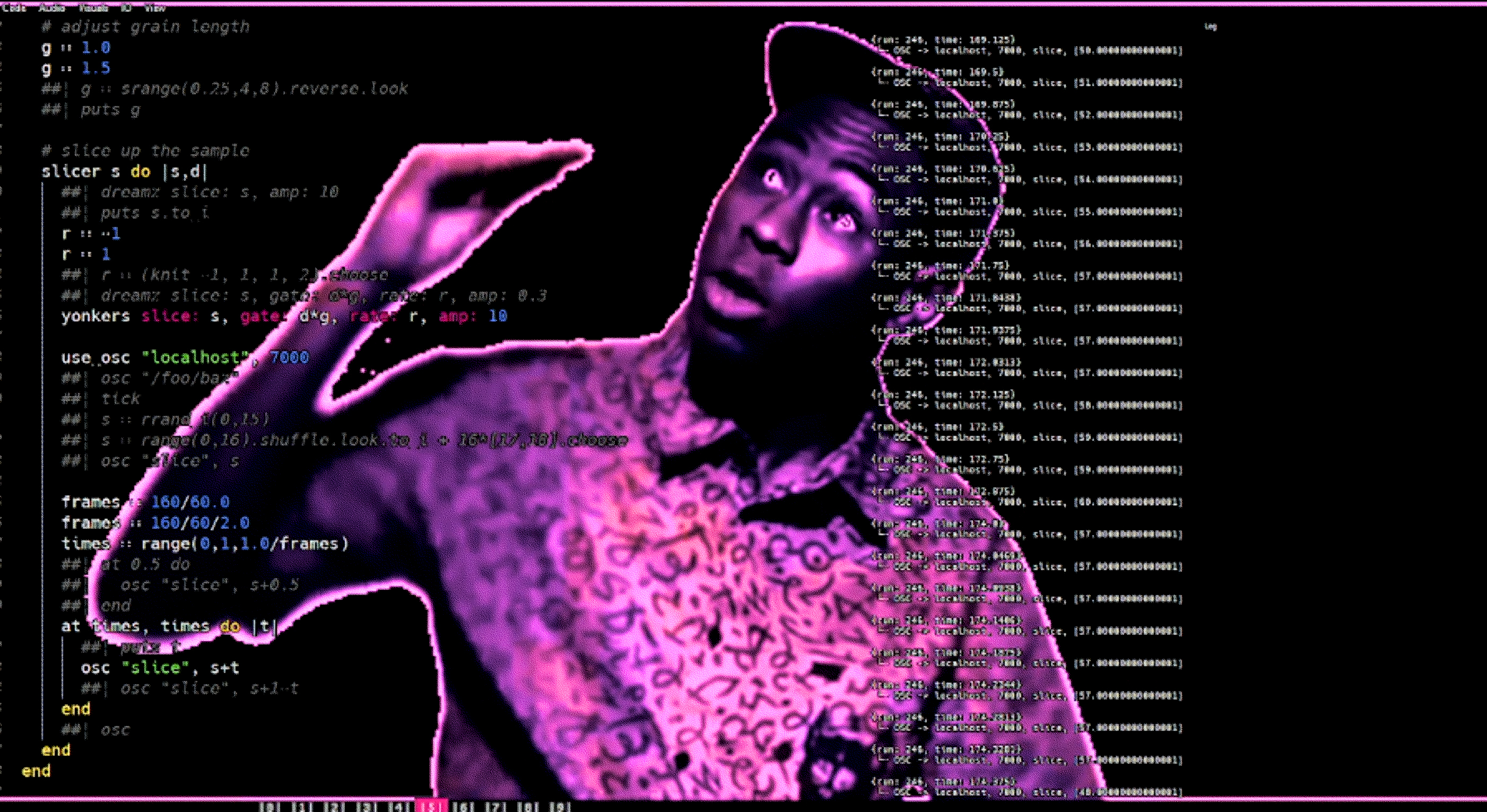
Still from Live Coding Practice Session w/ Sonic Pi, Roxanne Harris, 2022.
For my Computing and the Arts performance at CCAM in April, at the Motion Capture Leeds Studio, the music video I used was Kendrick Lamar’s “Element.” I chose that because it’s very lush, expressive, and playful. As well as Sonic Pi, I used Max/MSP, a visual programming language, to control the visuals. In terms of making things react to the sound—whether it’s the volume, a detail, or to trigger a sample, bass drum, or hi hat—I want something to happen. Sonic Pi can’t do all of that, so I established a communication with Max/MSP. I could skip around the music video in the same way I was skipping around the sound. I wanted to dynamically apply video effects based on the sound events. So, I’m skipping around the music video, I’m using commands I’m sending through Sonic Pi, and I am also sending for an RGB effect, which splits the red, green, and blue into different planes (if you’re ever worn 3D glasses, that’s what that looks like). I also used a pixelated effect, which randomly changes the resolution of the screen, making it weird and shaky.
I wanted to project all of this onto a six-panel projection in the Leeds Motion Capture Studio. The day of the performance, I wrote two patches. I wrote the entire Max/MSP patch, then I wrote a patch in Isadora, which is another visual programming language, more specialized for projection design. So I had three programs running: Sonic Pi for the music, Max/MSP for the visuals, and Isadora for the projection. In terms of getting Sonic Pi and Max talking over the network, I had to get the IP address of the Leeds Studio computer. I was still getting all this combined as the event was starting. People were walking in, the projectors were on, and I’m still in the process of connecting everything up. In a way, I perform twice. Setting up is part of the aesthetic. I was thinking, That’s great! And I was also like, Oh my God, I hope this works!

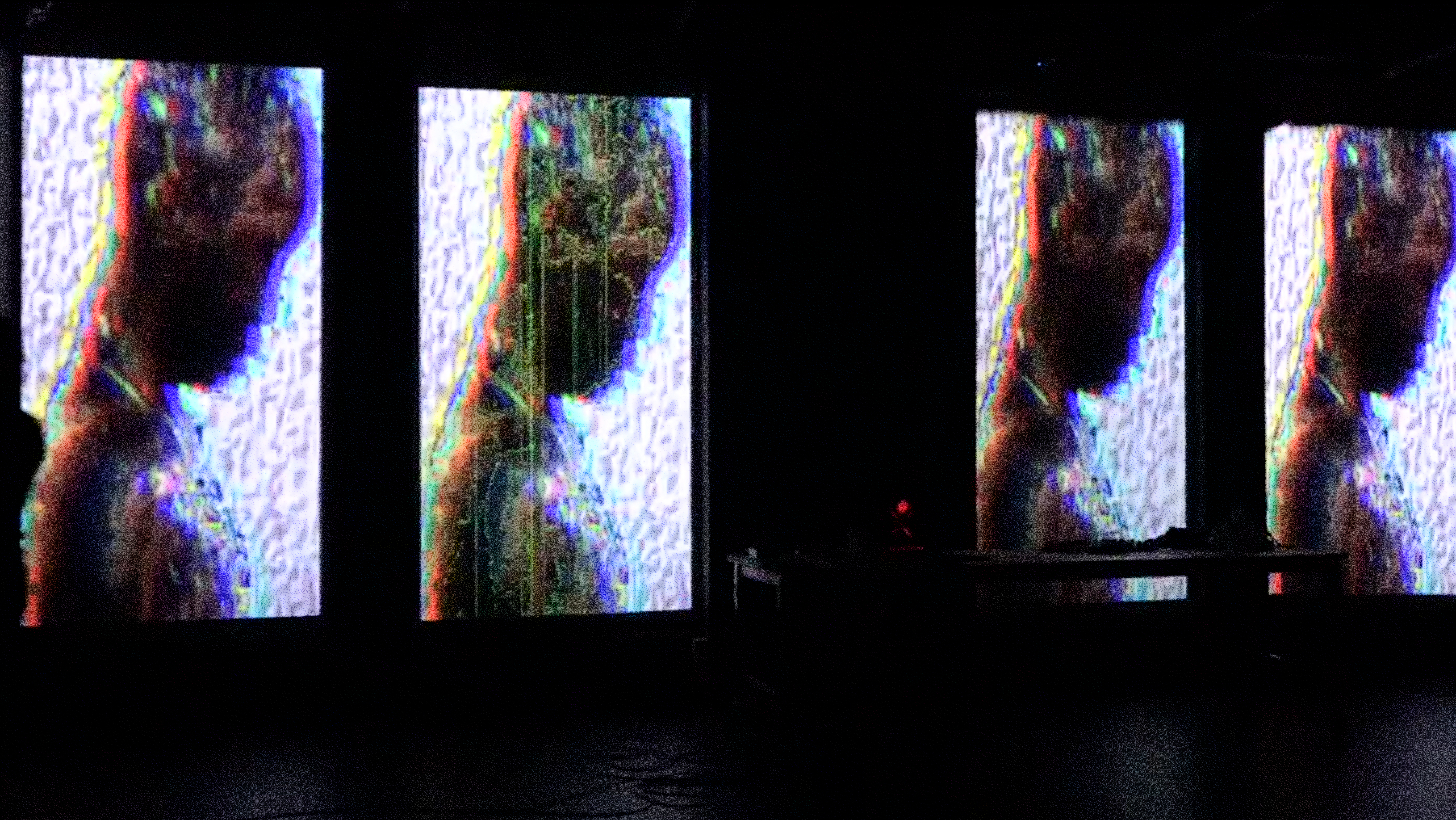
Stills from Live Coding w/ Sonic Pi @ CCAM Blended Reality Studio Fellow Showing, Roxanne Harris, 2022.
I realized that later on that I had left my charger for the computer in a classroom. I had to bike really fast to go get it, come back, plug it in, and still be adjusting code. It was really hectic. Even in the video of the performance, you can hear the battery-low sound. And I’m making gestures toward Konrad Kaczmarek, asking him to plug it in. Then I change the music, and just leave—and I let that run like a live process. I go over to the back, get my charger, come back, plug it in, keep going, rolling with it. People are telling me that they loved that, I guess because it was all part of the aesthetic.
As an artist, I want people to dance. I want people to feel something. I like to have people in motion. Doing something of that nature requires a little bit more prep than I was able to do for this one. For the Thursday performance on May 5th, I definitely want to play dance music, things that will make people dance. I don’t mind the exhibition-type things and the soundscape stuff, but I want to be in the dance scene. In the future, I see myself playing, live deejaying and live coding at places with freestyle competitions. I want to collaborate with dancers and movement artists in those spaces to make cool stuff.

Still from alsoknownasrox + s4y | Emergent Pathways w/ BKVoltage Lab @ Starr Bar, Roxanne Harris, 2022.
I’m not devoid of any anxieties. There’s a degree of acceptance in that: When you’re improvising, anything can really happen. You’re dealing with so many different programs that you have to be ready for the unexpected. That has given me a lot of peace and power. In performances, sometimes there are pauses. People think that’s part of it, but it’s really me making an error in the code. I’m stopping, and I have to pick back up and keep going, push through. I think this is really helpful and liberating. To be able to do that affirms that I show off my skills. Everything I’m doing is truly improvised, and coming from me. It feels very me. I’ve definitely regained a lot of agency in my creative practice and artistically through this process. There’s nothing like it, during a performance, when you’re improvising and you land on something really, really good and you let that play. You just rock out. That—in and of itself—that little part that you made up, could be a whole song, it could be someone’s whole thing. And you came up with it, through your process. There’s nothing like that feeling.
For more information about Roxanne Harris, who performs as alsoknownasrox, visit her site and listen to her playlist.
︎What I’m Working On︎Madeline Pages︎What I’m Working On︎Madeline Pages︎What I’m Working On︎Madeline Pages
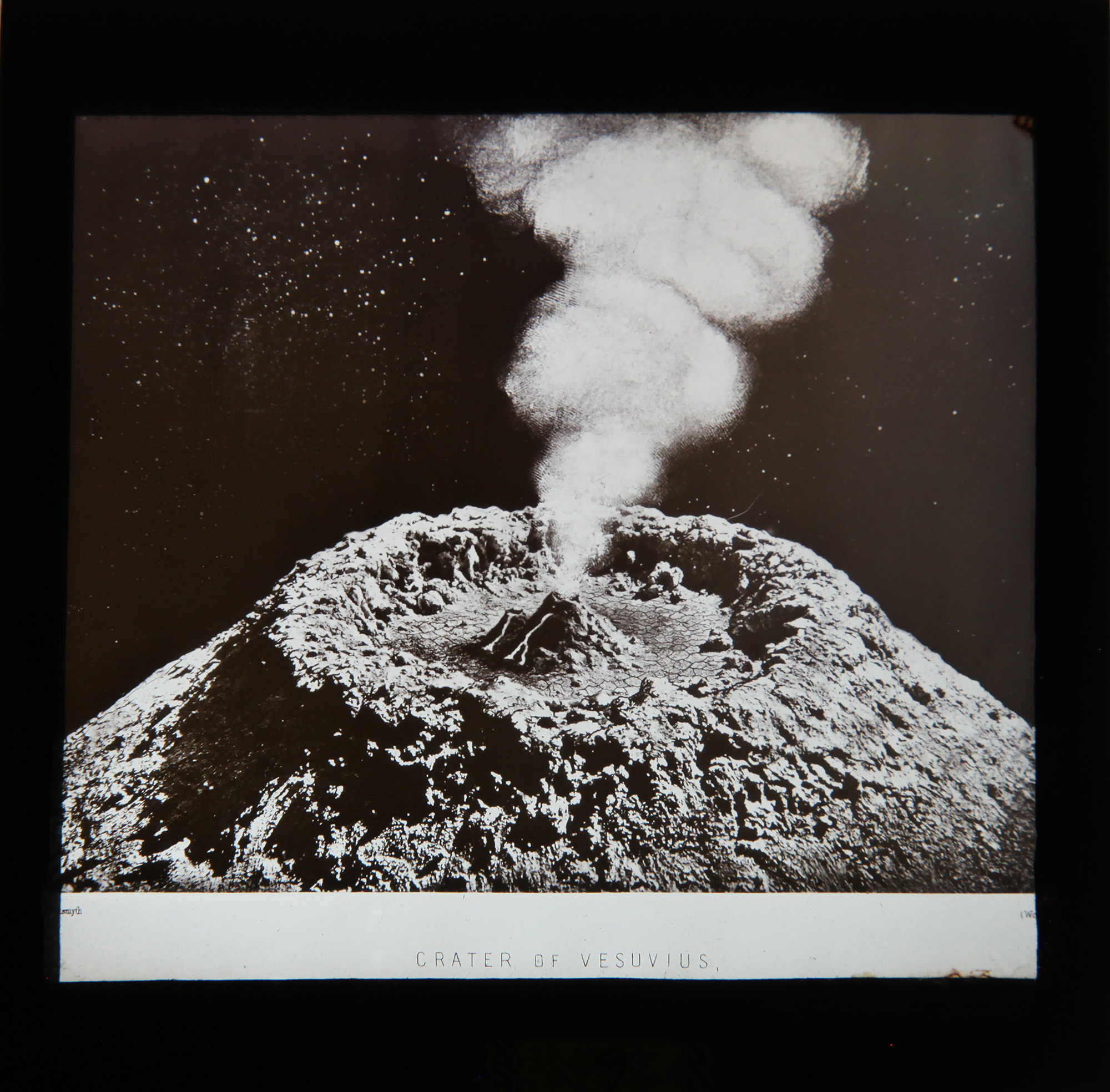
Crater of Vesuvius, James Nasmyth, originally published in 1874 and reproduced here on a lantern slide. Photograph by Alexi Baker, 2021. Courtesy of Baker, Division of History of Science and Technology, Yale Peabody Museum.
What I’m Working On
Madeline Pages
For the past six months, I have been meditating on historical models and images of outer space, such as orreries, astrolabes, and star maps. I want to understand what draws us to examine the solar system and recreate what we see in earthly objects. If you visit the storage facilities of the Peabody Museum on Yale’s West Campus, you can get a glimpse of just how many different kinds of tools and artifacts (some dating as far back as 3,000 BC) exist to look—and because we have looked—up at the sky.
With the support of CCAM director Dana Karwas, I designed an independent study curriculum for the Fall 2021 semester titled “Astronomical Artifacts and Performances” centered on this exploration. The course combined historical research on astronomy and astrophysics from ancient Egypt to the present with investigations of art objects and performances influenced or inspired by the broad theme of outer space. As a theater artist and scholar, this scientific turn was completely new to me, and I set out with the simple goal of broadening my horizons and learning more about a topic that is almost unavoidable these days. Richard Branson, Jeff Bezos, or Elon Musk seem to appear constantly in the news, and I was seeing the influence of the revived attention on NASA and commercial space projects all around me in popular culture and art. For a couple of years now I have been questioning why outer space is so captivating. When faced with something I don’t understand, such as the desire to colonize other planets or commercialize space travel for the benefit of the ultra-rich, I find my way in by reading events through the language of performance. What is exciting and special to me about the medium of performance is its extreme contemporariness, its nowness. The closest we can get to that nowness when studying historical time periods is through communion, so to speak, with physical objects and artifacts, which have an aura, to use Walter Benjamin’s term, of their past use in ritual, in experiment, or in artistic production.
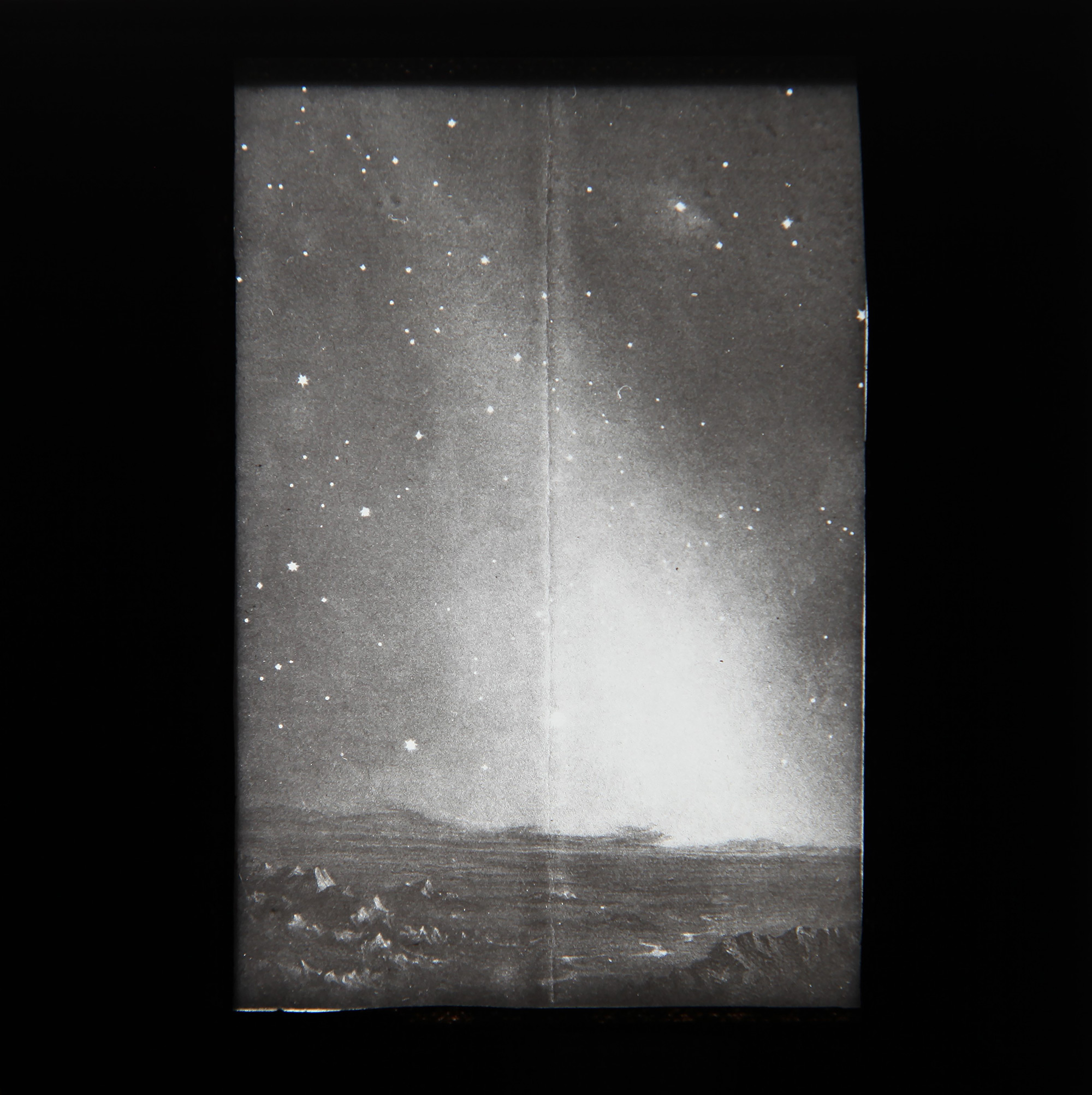 A depiction of the Milky Way visible in the night sky from Earth, reproduced on a lantern slide. Photograph by Alexi Baker, 2021. Courtesy of Baker, Division of History of Science and Technology, Yale Peabody Museum.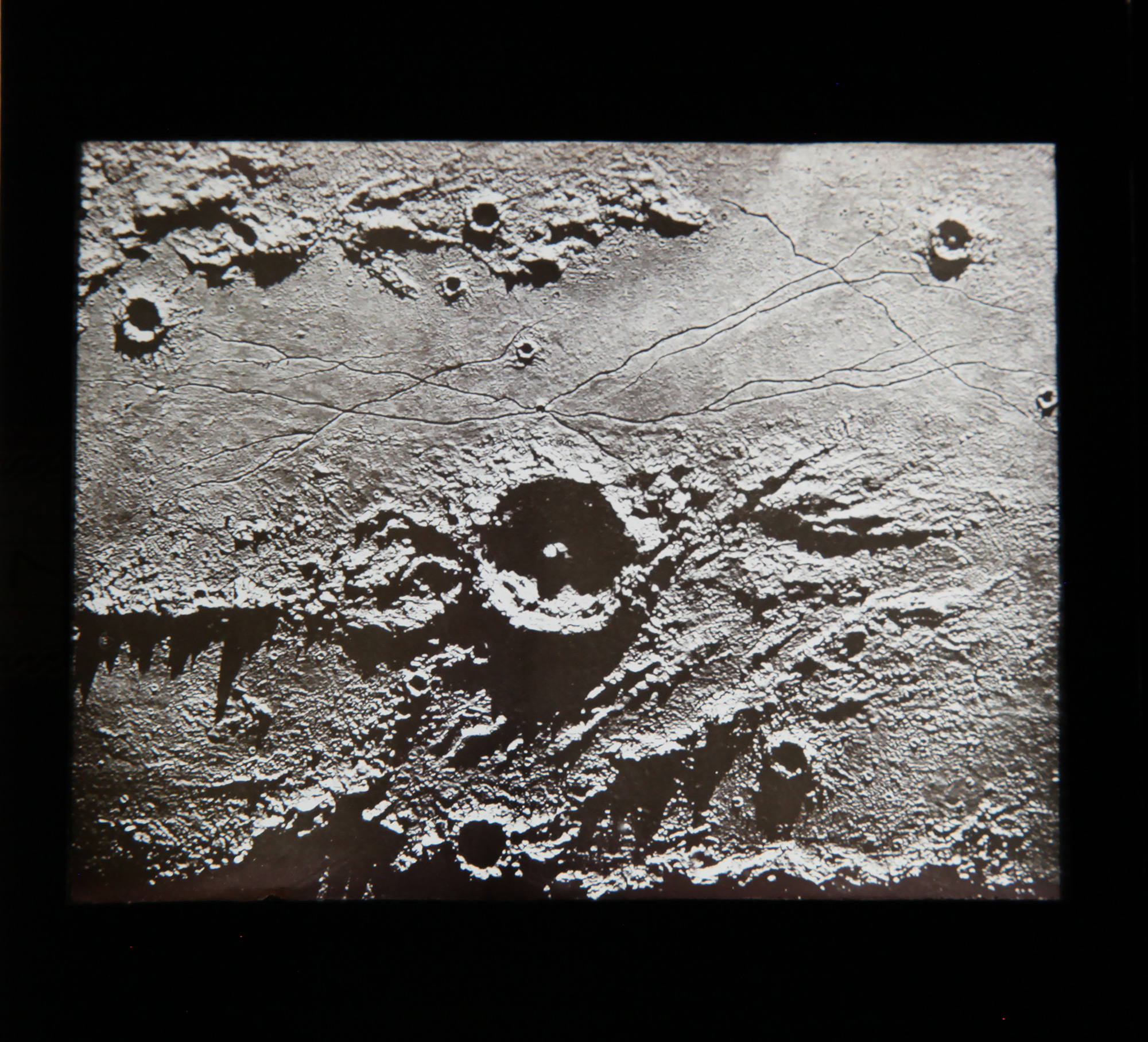
Triesnecker, James Nasmyth, originally published in 1874 and reproduced here on a lantern slide. Photograph by Alexi Baker, 2021. Courtesy of Baker, Division of History of Science and Technology, Yale Peabody Museum.
For “Astronomical Artifacts and Performances,” I wanted to go back to ancient astronomical traditions and trace a history of tools and artifacts (many examples of which can be found in Yale’s archives and museums) and ritualized practices of observing the stars through to present dreams of space travel tourism and colonization. In the process, it was important to me to embrace CCAM’s goal of fomenting interdisciplinary collaborations across campus, therefore much of my research was conducted by doing in-person visits to view artifacts housed at Yale, or interviews with other Yale artists and scholars. I am indebted to the conversation, expertise, questions, and suggestions of my many interlocutors that has shaped and transformed this work. During the Fall 2021 semester, I visited the archives of the Yale Art Gallery with Wurtele Study Center Programs and Outreach Manager Roksana Filipowska to look at Chinese bronze mirrors from the third century with mysterious reflective properties. I spoke with Yale Professor of Dance Studies Emily Coates about her dance research at Dartmouth University’s historical observatory. From Professor John Darnell and Alberto Urcia in the Near Eastern Languages & Civilizations Department, I learned about ancient Egyptian calendars, star charts, and cosmological rituals. It was Urcia who suggested that all my theories, discussions, and the objects I was seeing were connected to ideas of perception and shifting perspective. Then I met with Alexi Baker, the Collections Manager for History of Science and Technology Division at the Peabody, to explore the Museum’s storage facilities and look at some of the aforementioned perceptive instruments for viewing and modelling the stars and planets.
What is exciting and special to me about the medium of performance is its extreme contemporariness, its nowness.︎
As a symbolic culmination of my research on human space travel and the study of the universe, I am in the process of building a sculptural piece—my very own space object, and first attempt at creating a work of visual art—that incorporates bits of each of the interactions I have had with these experts. Orbiting Projector Prototype, created in collaboration with projection designer Hannah Tran, is inspired by mobiles and historical models of the solar system like orreries—mechanical moving models of the planets’ positions that were most widely used in the 18th century—and makes use of images from the Peabody’s collection of historical lantern slides. Two small projectors will hang from the ceiling in rotating baskets, projecting images of the Moon and other stellar and planetary phenomena around the space. When the timing is just right, both projectors will shine on opposite sides of a translucent screen mounted on a rotating platform between them, and the will images blend into one or become distorted to create new visions of familiar celestial bodies. In this way, I wanted to visually represent how conceptions of the stars and planets beyond Earth are affected by shifts in perspective and different tools of perception. When it comes the wider universe we’re floating in, our view is narrow and distinct. We cannot see where we are from where we stand, but we can imagine how our planet might appear from afar.
Since ancient times, the mysteries of the universe have been addressed in what we now call science fiction. For ancient astronomers, particularly those in early Egyptian civilization, there was no distinction between astronomy and cosmology, religion and science. Scientifically-advanced observations of the movements of the stars were married to the stories of the gods. When the 17th century German astronomer Johannes Kepler was arguing that the Earth is not static but constantly rotating, he wrote a fictional account of a trip to the Moon in the form of the short novel Somnium (also referred to as The Dream). On this journey, Kepler’s interstellar travelers experience and describe views of Earth from the Moon. By transporting his readers to the surface of the Moon, and allowing them to consider the Earth from a new perspective, Kepler more convincingly demonstrated planetary rotation and how it affects our understanding of the solar system. His story, written and addended over the course of two decades (between 1609-1630) and sent to press mere months before Kepler’s death, is sometimes considered the first work of science fiction.

Aspect of an Eclipse of the Sun by the Earth, as It Would Appear as Seen from the Moon, James Nasmyth, originally published in 1874 and reproduced here on a lantern slide. Photograph by Alexi Baker, 2021. Courtesy of Baker, Division of History of Science and Technology, Yale Peabody Museum.
In my opinion, the most captivating images Tran and I selected for Orbiting Projector Prototype come from the work of 19th century amateur British astronomer, James Nasmyth. What appear to be highly detailed photographs of the surface of the Moon are, I learned, photographs of 3D reconstructions sculpted by Nasmyth in the mid-1800s. These reconstructions were in turn based on observations he made of the Moon from Earth using a telescope he designed himself. The Nasmyth images incorporated into Orbiting Projector Prototype are triply affected by shifts in perspective. They are images of how the lunar surface and sky might appear if someone was on the Moon (and this is nearly a century before humans landed there). To me, these images are as striking as the photographs and video that were sent back from Apollo 11. They evoke the sense of mystery and ethereality that Nasmyth might have felt looking through his telescope. They are, essentially, works of science fiction.
“Astronomical Artifacts and Performances” is the latest iteration of an obsession. Humans’ interaction with outer space, the Moon, stars, and other bodies that lie beyond Earth’s atmosphere, has overwhelmed my imagination. For nearly two years, I have spent a lot of time working and waiting for connections to emerge, like the projections merging in my installation, or planets aligning. What I call perspective play—how we can play with positioning to alter perspective—comes up again and again. I started with a hypothesis about the study of outer space as being a particularly rich site for examining the psychological break—so to speak—between the artistic, creative act of envisioning and the scientific act of theorizing. I have been gravitating towards two quotes that really address what I mean by this. One is from science and science fiction writer Arthur C. Clarke’s The Challenge of the Spaceship (1946, later incorporated into the book-length treatise published in 1959), a highly influential and controversial essay delivered shortly after the Second World War, which saw the decimation of Europe, Japan, and North Africa by the new military technologies of rockets and atomic weapons. Clarke’s essay argues for the positive uses of these technologies for the eventual future of human space travel, which he later portrayed in his screenwriting for 2001: A Space Odyssey:
“…the vision must come before the achievement and the truly creative mind must hold the balance between the two.”
The other is from Annie Collins Goodyear’s forward to an exhibition catalogue comprising science fiction-inspired works by mid-century Latin American visual artists, which appeared at the Bowdoin College Museum of Art in 2015:
“The shattering of the limitation of earth’s gravitational field by cosmonauts and astronauts signaled not only a technological victory but also a victory of the imagination.”
In both quotes, the imagination, or vision, of what lies beyond Earth’s atmosphere is identified as a first step and an intrinsic element of our understanding and exploration of outer space. I think that most of the today’s popular conceptions of the universe come as much from Stanley Kubrick or George Lucas as they do from Carl Sagan or Neil DeGrasse Tyson. Bezos and Musk, who have themselves been empowered by a love of science fiction space narratives like Star Trek, obviously grasped the importance of having and selling a clear vision of human life in space before either had even a single successful rocket test launch. This is the art of the New Space industry.
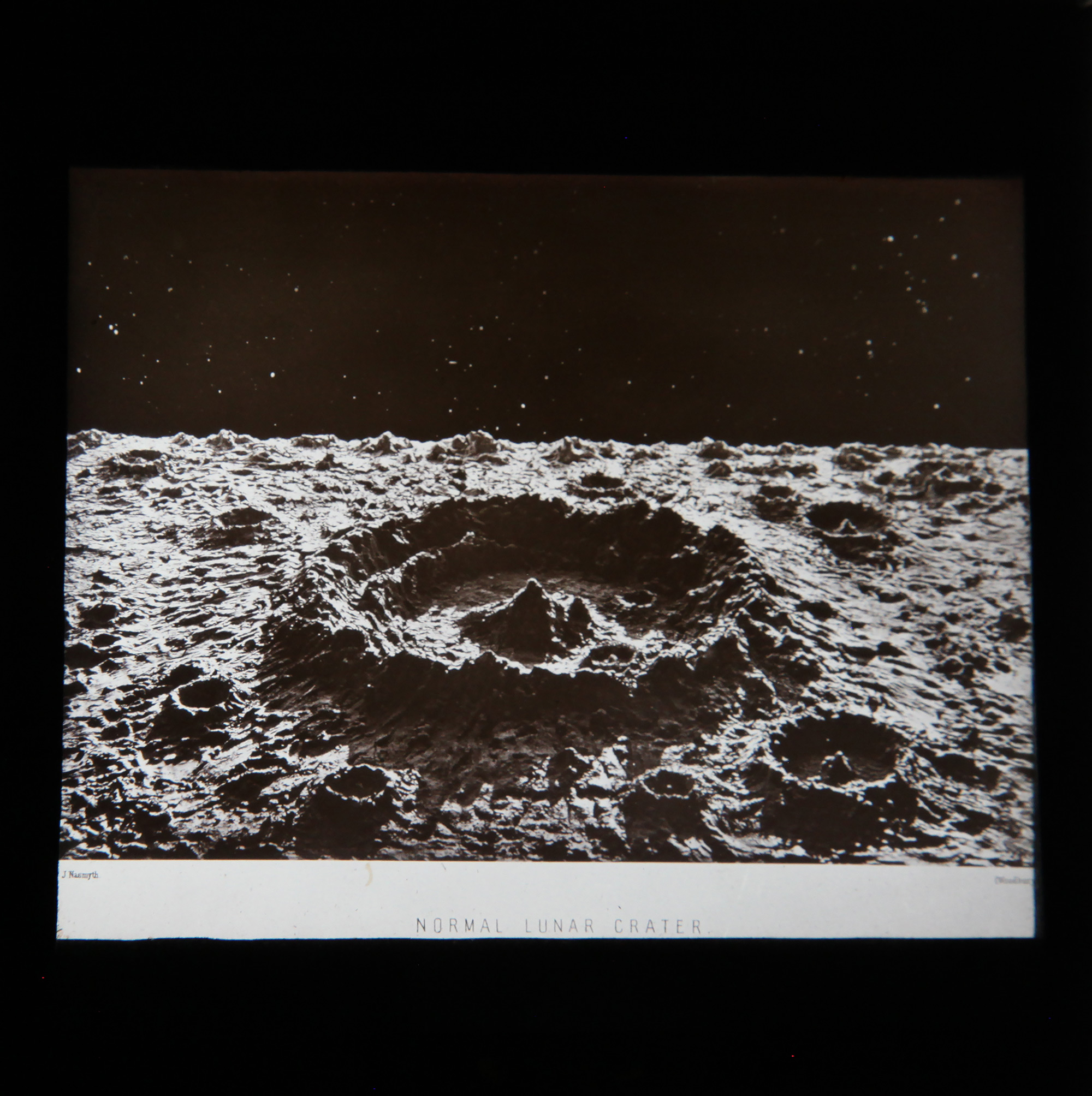 Normal Lunar Crater, James Nasmyth, originally published in 1874 and reproduced here on a lantern slide. Photograph by Alexi Baker, 2021.Courtesy of Baker, Division of History of Science and Technology, Yale Peabody Museum.
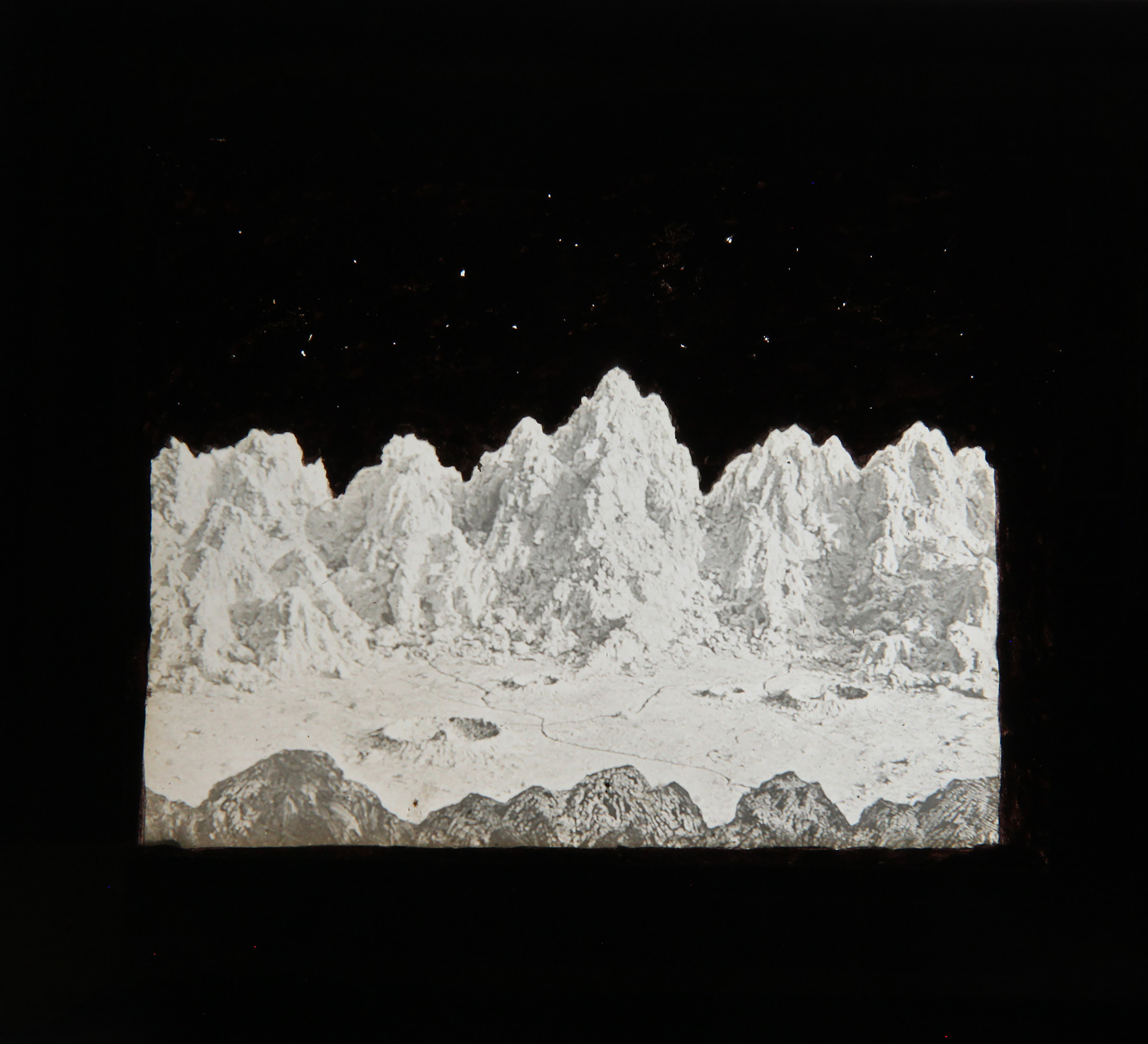 Group of Lunar Mountains. Ideal Lunar Landscape, James Nasmyth, originally published in 1874 and reproduced here on a lantern slide. Photograph by Alexi Baker, 2021.Courtesy of Baker, Division of History of Science and Technology, Yale Peabody Museum.
Humans’ interaction with outer space, the Moon, stars, and other bodies that lie beyond Earth’s atmosphere, has overwhelmed my imagination.︎
We’re talking more and more about outer space at CCAM these days. From podcast interviews with astronauts and aerospace engineers to students taking Zero-G flights for Karwas’ space architecture course “The Mechanical Eye: Ultra Space,” CCAM is seeking out collaborations with experts in the field. I think it is important that artists, and particularly performance artists who are invested in our social and cultural future also take part in these collaborations. The way things are going, commercial space projects will not long remain niche or a fad of the ultra-rich. This is a multi-billion-dollar industry with government and military support that is vying for power over the future of the planet(s). Artists aren’t heroes, but their voices can influence the form that these conversations take and invite in other non-experts. I’m glad that CCAM is a place that can bring different kinds of thinkers and makers together in this way. I hope with my own work to capture the imagination of CCAM associates and start a conversation.
Madeline Pages is a dramaturg and MFA Candidate at the David Geffen School of Drama at Yale. Her article “Theatre of Isolation” recently appeared in The Journal of American Drama and Theatre (Fall 2021). She is also collaborating on a new opera I AM ALAN TURING, composed by Matthew Suttor and inspired by the life and theories of mathematician Alan Turing.
︎What I’m Working On︎Dana Karwas ︎What I’m Working On︎Dana Karwas ︎What I’m Working On︎Dana Karwas
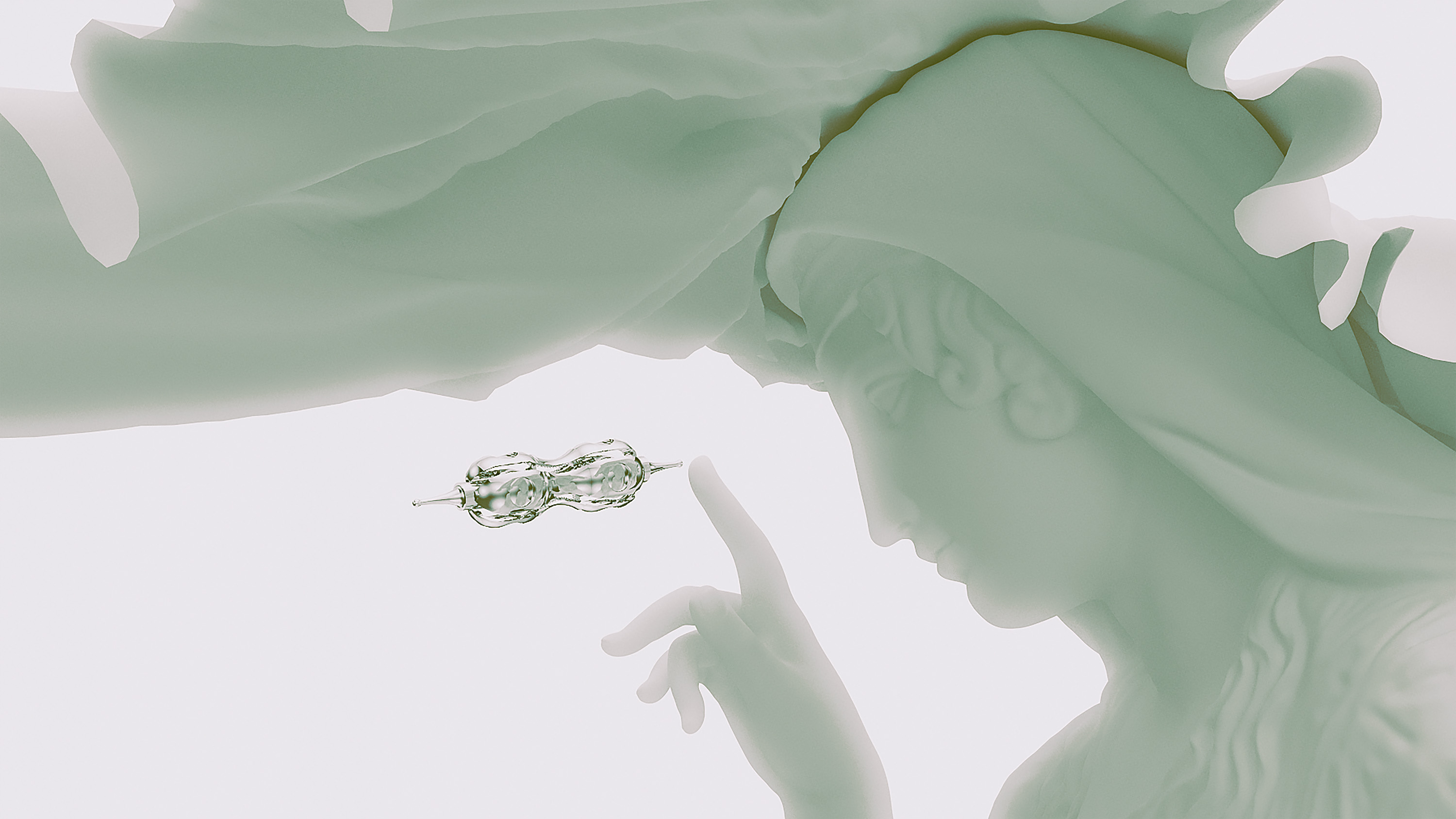
Image by Aleksa Milojevic, Amelia Gates, and Samantha Hrusovsky, 2022
What I’m Working On
Dana Karwas
INT. ZERO-G AIRCRAFT HANGAR, PORTSMOUTH INTERNATIONAL AIRPORT—DAY.
DANA KARWAS and ARIEL EKBLAW, professors of the THE MECHANICAL ARTIFACT: ULTRA SPACE class at the Yale School of Architecture, present the TERRA COSMA SPACE SUIT designed by THE STUDENTS, aka YALE-O-NAUTS, to a group of entranced ZERO-G AGENTS. They are preparing for an hour-long test flight to evaluate the choreography, poetics, and engineering of the suit. Multiple, colorful components are laid out on a table: An amulet, a moss-clad silicone headpiece, a Spiderman chest mechanism, Velcro pockets, leather belts, leather straps, climbing rope, carabiners, fabric, inflatable arm sleeves, woven skirts, a needle with thread, braided fabric. EMILY JUDSON ’22, the primary flier, will change into the suit on board. WAI HIN WONG ’24, the secondary flier, will assist her on the plane. VIGNESH HARI KRISHNAN ’22 is the back-up flier and ground support.
DANA
The skirt has two layers. It also snaps together with Velcro, so that this fabric, and the lower woven layer, will flow a little bit. We’re looking to get maximum flowiness.
(to EMILY)
Can you rotate it a little bit? Now you’ll see that the front has some components attached to it. This is a mechanism.
(to WAI HIN)
I’m going to have you jump up with the mechanism. It’s sewn on here, here, and here with a piece of silicone padding between. Why don’t you step in.
WAI HIN
You can pull it—
SNAP!
—it will pull it up. And
it can be expanded. Then when you press this...
ARIEL
Can you speak up a little bit?
WAI HIN
Oh—yes. When you
pull it up the garment, there’s a button for the release, the
force. When you press it, it will expand, because there is a fan.
ARIEL
Speak up a little bit.
WAI HIN
Okay, sorry, sorry, sorry. This, right here.
(gestures to the chest mechanism)
DANA
It expands.
WAI HIN
Theoretically, it would expand. Yes.
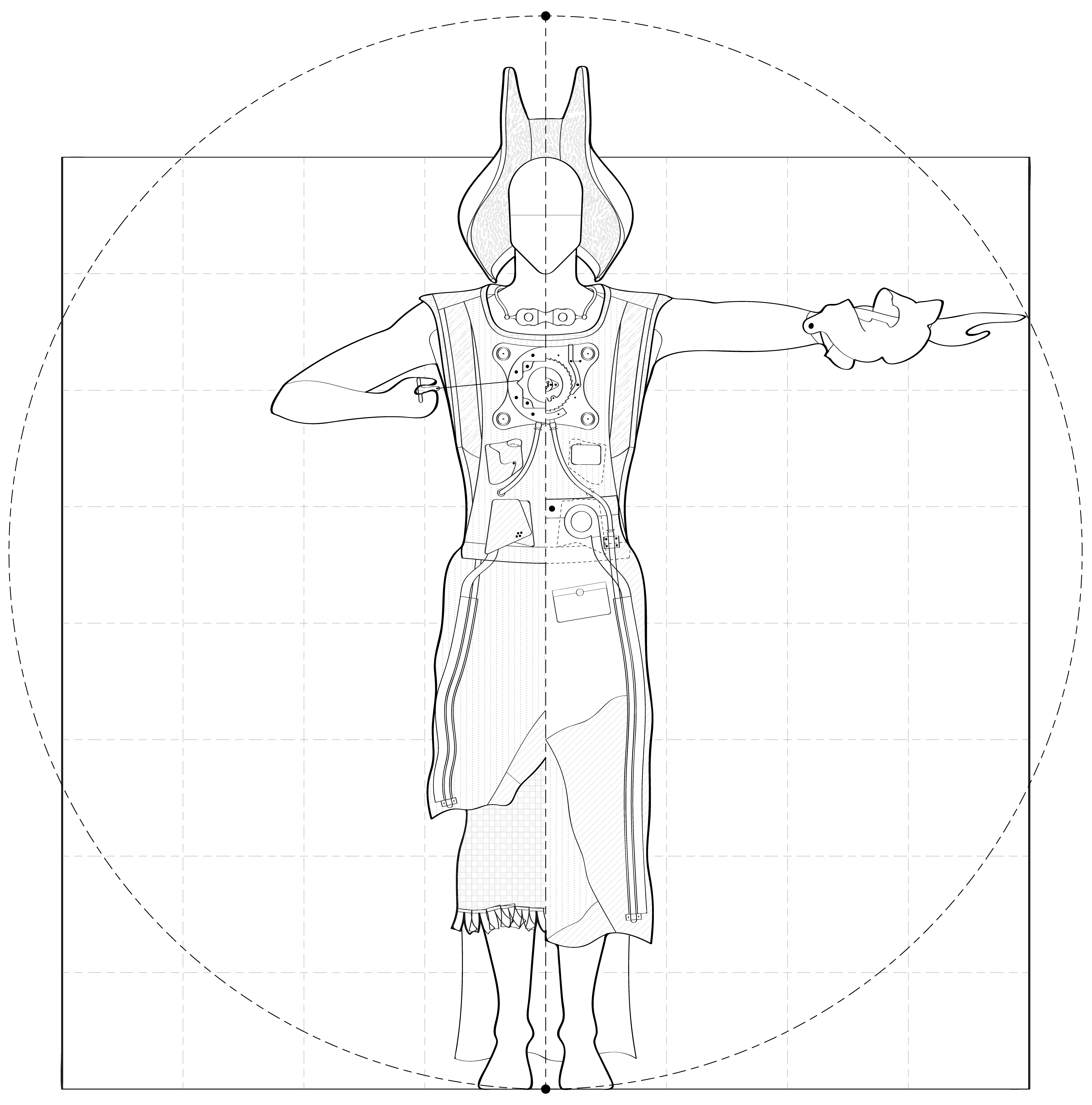
Image by Wai Hin Wong, 2022
ARIEL
Show them where you expect the expansion to happen. Because what they want to look for is what to pay attention to in-flight, if something goes wrong.
WAI HIN
Okay.
ARIEL
Show them where the suit is expanding.
WAI HIN
When you press—
ZERO-G AGENT 1
Wait: So the fan is supposed to be
blowing air down into those pockets?
ARIEL
Yes. Yeah.
(pauses)
Same pockets as the...
ZERO-G AGENT 1
So–this is a... motor?
WAI HIN
Yeah.
Everyone laughs.
DANA
It’s just a really sophisticated motor….
ARIEL
We’re not really expecting a dramatic effect. But yes, it basically makes it easier for that string actuation mechanism to happen in those channels, that are basically the duct tape channels.
ZERO-G AGENT 2
Are you planning on trying to expand it during the flight?
ARIEL
It might take a little time, so it might be that they learn after WAI HIN wants to turn it on during hyper-g, and then give it the inflation so that it can form during zero g and kind of catalyze as they go.
ZERO-G AGENT 2
Those are the batteries right here?
(points)
WAI HIN
Yeah.
ZERO-G AGENT 2
Two batteries, one for each?
DANA
Yeah, one for each fan.
ZERO-G AGENT 2
What kind of batteries are they?
WAI HIN
Two A...
ZERO-G AGENT 2
Double A batteries? Okay.
DANA
Yes.
ZERO-G AGENT 2
I’m just thinking. Because: You’ve got fans in there, which would normally keep the batteries nice and cool, and you’ve put them in pockets. So, I’m not sure how your airflow is going to work. Have you tested that? I mean, do you have enough air actually moving through the fan? I see it ducting out, but I don’t know where you’re pulling the air from. Because they seem pretty tightly tucked into those pockets.
ARIEL
The fan is only in these two pockets, with these open flaps...
ZERO-G AGENT 2
Oh, that’s—okay.
DANA
Yes.
ZERO-G AGENT 2
They’re covered, too, but they're not contained...
(pauses)
But. Gosh. Okay, so if they were—those are just battery packs. Got it.
ARIEL
Yes.
DANA
And then there’s a leather belt that is worn here, that EMILY is holding. Two amulet pieces are tied on, and there’s a belt. EMILY, can we see the belt?
EMILY
Yes. The bigger belt?
DANA
This goes around her waist. And this going to come out and float in one of the drop sequences, and this will be tied on here. And this will be tied to EMILY around the waist. And the idea is: It will spin and open, but it’s all attached.
ZERO-G AGENT 3
When you say open. How does it open?
WAI HIN
When it spins, in
flight, it creates the force—
ARIEL
The force will open the mechanism.
WAI HIN
—to open the mechanism.
DANA
Yes, a little bit. Hold on. Let me put this... wait… we don’t want that to fall out. Yes. We might have to take that one out.
CLUNK! The mechanism falls out.
ARIEL
The goal is, with the centripetal force, that it does not become all loose like that. The parts are not supposed to...
CLUNK!
(to DANA)
I think that was because he’s using his hands to kind of jam it.
ZERO-G AGENT 3
But that’s the amulet in the open configuration?
ARIEL
That’s the open configuration, yeah.
DANA
Copy.
ZERO-G AGENT 3
Pick it up, have it untied. Let it go. Spin it, and it pops open.
DANA
Copy.
ARIEL
Yes. And spin gently.
ZERO-G AGENT 4
Are you wearing this over your flight suit, or under it?
ARIEL
I think: No flight suit. It’s just leggings and undergarments underneath this.
ZERO-G AGENT 4
I’m not sure that...
ARIEL
Yeah, this is custom.
DANA
Yes. And then the last component is the—
ARIEL
Head piece.
DANA
—the head piece, which has moss attached to silicone. This will be worn for some of the drops by the flier. It attaches over her shoulders like a backpack. And the idea is that it would be next to the flier with climbing rope and a carabiner, so that it will never escape. And she won't have to wear it—
ARIEL
—constantly. It’s heavy.
DANA
It’s a little heavy.
ARIEL
And we didn’t want for her to have to worry about that, with the hyper-g. It will be tethered itself, so she can position herself in front of it for some photography, but she doesn’t have to be navigating it on her shoulders in between transitions. So: Tethered with the rope, carabiner to a
foot strap. And then available for her to slip her arms into.
(to EMILY)
If you wish, if you feel comfortable during a zero g with the coach’s help. But—
ZERO-G AGENT 2
I will say: Save that one for the end.
ARIEL
Yeah.
ZERO-G AGENT 2
After you’ve acclimated to being in zero g, but also because it’s going to massively throw off your center of gravity, to have this big weight up here.
(gestures to the headpiece)
And we’ve seen people’s ears not like that at all, once they’ve finally gotten used to knowing where they are. And then to put something on that really makes your head move in a different way than what you think it should—and that’s a lot of weight. How heavy is it? Do you know?
VIGNESH
It’s four gallons of silicone.
ZERO-G AGENT 2
(teasing)
(teasing)
That’s not a weight. So—
VIGNESH
(smiling)
(smiling)
Four pounds, mostly. About four pounds.
ZERO-G AGENT 2
That’s a lot more than four pounds!
VIGNESH
(laughing)
(laughing)
Ten pounds?
ARIEL
That’s why we don't want it anchored on her, because it’s too heavy. We’ll just have it tethered.
ZERO-G AGENT 2
Let me see. I’m just—like—so that everybody is aware of—relative to the percentage of her body weight, this is going to be an addition on her. I say definitely don’t do it in the hyper-g. Just do it at the end, I would say, if you feel comfortable doing it. So that if you do have any motion discomfort from it, we’re at the end anyways, and you didn’t lose any of your other time. It’ll be the most provocative behavior, motion-sickness-wise.
Everyone laughs.
ARIEL
And there should be room for it in the storage container.
(to EMILY and WAI HIN)
So, if you want, you can leave it in the storage container for the first half of the flight and then take it out at a straight level break where it’s easy to walk, position it, clip it in, and then experiment with it at the end. Okay. The summary is: Suit with a couple of mechanisms, the belts and this amulet necklace, and then this headpiece.
ZERO-G AGENT 2
You have that on as a necklace as well?
ARIEL
This is going to be attached somewhere, and floating out like that.
Image by Aleksa Milojevic, Amelia Gates, and Samantha Hrusovsky, 2022
ZERO-G AGENT 2
I’m worried about how fragile they are. If you come down there, somebody hits... There’s going to be a problem for you, if you come down on your side or something. Is that going to break?
ARIEL
They’re pretty... they’re pretty durable. You can feel it. It's pretty strong, pretty potent resin. It’s not PLA.
ZERO-G AGENT 2
Okay. Yeah.
ARIEL
I’m not too worried about that one breaking. This one when it’s open, is a little bit more—
ZERO-G AGENT 2
Just watch the pointy ends.
ARIEL
Yeah.
ZERO-G AGENT 2
Because you don’t want to—
(he touches the headpiece)
That one’s pretty solid.
ZERO-G AGENT 1
Yeah, I can see that.
ZERO-G AGENT 2
And if it does, we’ll put it away.
ZERO-G AGENT 1
Yeah, if you fall on it.
ZERO-G AGENT 2
Just be aware of it when you’re moving. And that’s going to be on the whole time? Or are you only going to put on the belt when you’re ready to do the actuation?
DANA
This could be on the whole time. We have a pocket for the little one.
ZERO-G AGENT 2
Okay.
DANA
And this one’s attached.
ZERO-G AGENT 2
It just stays.
DANA
Yeah. Well, I don’t know if we’re going to have her spin that, but this one’s more... we only have one piece.
ZERO-G AGENT 2
Who’s wearing this, is it you that’s wearing it?
(looks at EMILY, who nods)
Okay. And how heavy is—
(He lifts it)
Oh, that’s not bad.
ARIEL
And it’s on the chest up high, not on the back. And we’ve added some padded silicone to make sure that that doesn’t...
ZERO-G AGENT 2
That was a nice touch. And this thing?
DANA
Oh, this thing.
ZERO-G AGENT 2
The thing that you’re doing as well.
ARIEL
Arm sleeves.
DANA
Yeah. These are the arm sleeves.
(to EMILY)
You want to demonstrate? I think that’s straight.
ZERO-G AGENT 3
So I’m still waiting for the pressure.
DANA
This is a reconfigured life vest.
ZERO-G AGENT 2
I recognize it. That’s why I was so interested in knowing what it was.
DANA
It’s being repurposed for this flight. It will live on EMILY's arm, and she will blow it up in flight, and it will expand. And then there’s a release.
ZERO-G AGENT 3
No more pressurized container, right?
ARIEL
Are you guys still using the pressurized cylinders at all?
DANA
No.
ARIEL
Great, I’m happy.
ZERO-G AGENT 2
You practiced that, blowing it up and releasing it?
DANA
Hold on. Who was blowing on it before? You know it the best!
Everyone laughs.
ZERO-G AGENT 2
I know how to inflate and deflate them! I’m just asking if you guys know how to do this, if you’re going to be the one on the flight.
VIGNESH
Blow inside and then press the thing—
ZERO-G AGENT 2
Press the thing on the inside.
DANA
Yeah.
ZERO-G AGENT 2
Yeah, we have those too, so.
DANA
So this time it’s actually being used, hopefully.
ZERO-G
We have to actually do them every year, we have to inflate them, and know how to push your pinky inside to deflate.
DANA
Okay.
ZERO-G AGENT 2
There’s a lot going on though. So you have a lot of—
ARIEL
Yeah, a lot of moving parts.
![]()
Image by Wai Hin Wong, 2022
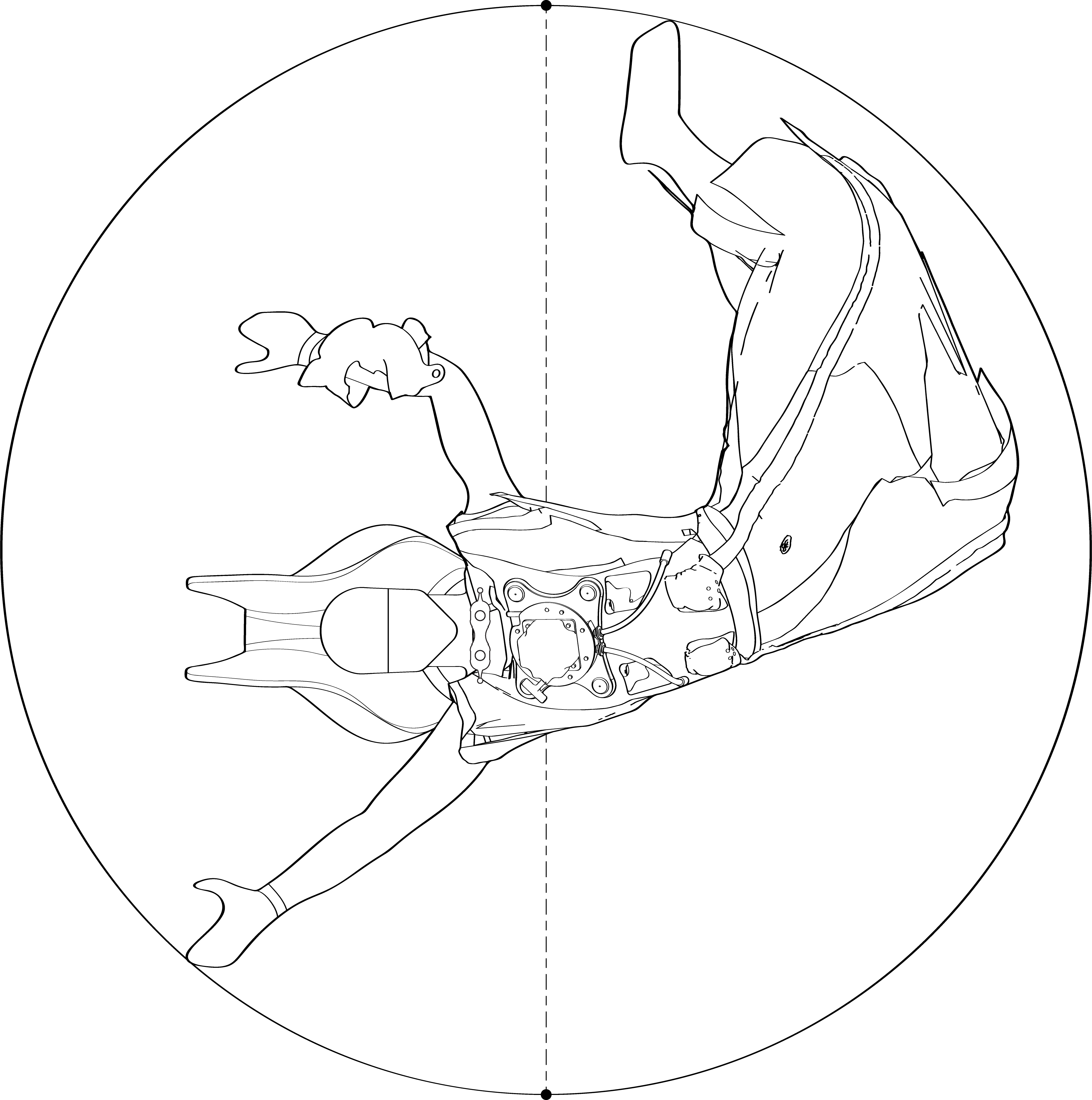
Image by Wai Hin Wong, 2022
Dr. Ariel Ekblaw
directs the MIT Space Exploration Initiative, a
team of 50+ students, faculty and staff building and flying advanced technology
for space exploration; Ariel is also the founding CEO of Aurelia Institute, a
hybrid space architecture research institute and venture incubation studio.
Through this connected ecosystem, she strives to bring humanity’s space
exploration future to life. Ekblaw graduated with a B.S. in Physics,
Mathematics and Philosophy from Yale University and designed a novel space
architecture habitat for her MIT PhD in autonomously self-assembling space
structures. Her research work and the labs she leads build towards future
habitats and space stations in orbit around the Earth, Moon, and Mars. Ariel is
the author/editor of Into
the Anthropocosmos: A Whole Space Catalog from the MIT Space Exploration
Initiative (MIT Press 2021). She serves on the NASA Lunar
Surface Innovation Consortium (LSIC) Executive Committee, guiding and shaping
the coming decade of burgeoning activity on the moon. Ariel has had the rare
honor and pleasure of working directly on space hardware that now operates on
the surface of Mars and is leading MIT’s return to the moon. Ariel’s work has
been featured in WIRED (March 2020
cover story), MIT Technology Review, Harvard Business Review, The Wall
Street Journal, the BBC, CNN, NPR, PRI’s Science Friday, IEEE and AIAA
proceedings, and more.
Dana Karwas is an artist whose sculptures and
research investigate new, human reference frames for dimensional information.
Dana is Director of the Center for Collaborative Arts and Media (CCAM) at Yale
and is a Critic at the Yale School of Architecture teaching courses related to
mechanized perception, space architecture, and inverting our relationship to
the cultural forms of our time. She holds an MPS from Interactive
Telecommunications Program at NYU’s Tisch School of the Arts and has a Bachelor
of Architecture from the University of Kansas. Her upcoming short film about
the future of the anthropocosmos, Terra
Cosma, will premiere in New Haven, Connecticut in February 2023.
︎The Creativity Lab︎Matthew Suttor︎The
Creativity Lab︎Matthew Suttor
Creativity Lab Rendering #5, Sewon Roy Kim, 2022.
The Creativity Lab
A space for play
Matthew Suttor
I am establishing a new experimental art laboratory at CCAM. I am calling it the Creativity Lab, which is a preposterous name, but at the same time, freeing. The lab will be open to students, staff, and faculty from any discipline dedicated to observing the creative process through applied practice-based research and artmaking. We plan to explore big ideas: What is creative thinking? Can creativity be taught? And why do we so often get stuck?
What led me to found a lab? Over the twenty-two years I have been teaching students at Yale how to compose music, I have become increasingly curious about creative thinking: Am I teaching creativity, or is this just creative teaching? But where do I even begin to address these questions?
We might start with Albert Einstein, who offered what he believed to be “the essential feature in productive thought”: Combinatory play. In a 1945 response to a colleague’s inquiry about his mathematical process, Einstein wrote that before language and symbols comes a state that he described as combinatory play, whereby elements in thought can be “‘voluntarily’ reproduced and combined.” I understand combinatory play as a free-associative process, like Einstein—thinking without thinking—while playing his violin. As a teacher, I know that when students rush to get to achieve finished results before a period of play, the results are often awkward. In this cognitive mode, Einstein intuited connections and bridges between things, such as mass and energy, where others saw only chasms.
Einstein was a super-observer, offering another lead in our investigation of creativity. Here, I believe, we have an opportunity to reexamine the near-meaningless terms and catchphrases we use to engage in creative thinking such as brainstorming, thinking outside the box, and—case in point for this edition of Maquette—serendipity. Serendipity has come to mean a happy accident, whereas the original meaning of the term, coined by Horace Walpole in 1754, identified those with superpowers of observation—a learnable skill rather than dumb luck. And thanks to Einstein, combinatory play offers us insight into how we might practice observation.
What does the Creativity Lab look like physically? As a radical reimagining of a lab in a university, the Creativity Lab is a combination of seminar room, performance space, gallery, and laboratory. In this sense, the lab is an architectural expression of combinatory play. Along with creative and research projects, my pedagogical approach will be to offer modular programs instead of semester-long courses to support learning that might be difficult to find in other programs, departments, and schools. At the Creativity Lab, you might discover a bridge where there would otherwise be a chasm.
Einstein intuited connections and bridges between things, such as mass and energy, where others saw only chasms.︎
Here are two examples of projects I am currently working on at CCAM that are born of the arts-science collaborations of the sort that the Creativity Lab might develop:
The first is an opera about Alan Turing, titled I AM ALAN TURING. The project brings together music, drama, and computer science. The libretto for the opera is being devised by a group of collaborators, one of whom happens to be an AI. In the opera, any character may or may not be Alan Turing. In this way, the opera itself is a giant Turing Test.
The second project maps collective animal behavior, such as fish schooling and flocking birds, onto musical parameters. The collective animal behavior project brings together music, biodiversity science, and data science, drawing researchers from the Max Planck - Yale Center for Biodiversity Movement and Global Change with composers and visual artists to investigate threatened ecosystems through the sonification and visualization of data.
In addition, the Creativity Lab is ideally positioned to launch a longitudinal study of creativity through such arts-science projects at Yale. While it’s not surprising to ask questions about the creative process in the arts, I am particularly interested in specific populations in the sciences, including graduate students, post-doctoral students, and early-career scientists. What does creative thinking mean to them? How do they get themselves unstuck? Have they experienced combinatory play as Einstein describes it?
But why involve scientists at all in an experimental art lab? Artist residencies in scientific labs are nothing new, such as the artist-in-residence at the Yale Quantum Institute. Let’s flip that model around. I propose scientists come to us, the artists, to investigate their ideas. CCAM, as Yale’s media lab for everyone, is an ideal meeting place for the arts and sciences. Cognition, after all, comes from the Latin co- (“together”) + gnoscere (“to know”). The Creativity Lab might be a place to get us out of our silos and encourage a symbiotic relationship between our various workplaces and disciplines. The beauty of CCAM is that it is an archipelago of collaborative initiatives; labs that have outcomes but are not outcome-driven.
I propose scientists come to us, the artists, to investigate their ideas.︎I propose scientists come to us, the artists, to investigate their ideas.︎
When CCAM Director Dana Karwas and I first spoke about the Creativity Lab, we mulled over the idea of having it situated in the computer room at CCAM. Except: This is a drab, windowless room. Karwas then suggested that we ask Sewon Roy Kim, a student at the School of Architecture, to create a conceptual rendering of the lab. I sent him photographs of student whiteboard exercises around combinatory play from past classes to give him some context, and Kim chose to focus on one from 2016, in which the name Shakespeare appeared. In response, he produced images like theatrical sets, with “Shakespeare” splayed across the floor. I was stunned; the renderings reminded me of the first Shakespeare play I composed the score for A Midsummer Night’s Dream, way back in New Zealand, during the summer of 1991. The production was outdoors, and the set looked like a skateboarding halfpipe. A connection from then to now, dreamed up by someone I barely knew. A happy coincidence? No—this is precisely the kind of discovery through observation that Horace Walpole intended to capture through his invention of the word serendipity.
There are, of course, many astonishing books that offer immediately useful tools already in the public sphere written by leading scientists, such as Chatter: The Voice in Our Head, Why It Matters, and How to Harness It by Ethan Kross, the experimental psychologist at the University of Michigan. There is also a staggering amount of work in cognitive science, neuroscience, and data science done in research labs that will take years to reach the public. The Creativity Lab can be that play space to make their work more widely accessible to the benefit of all. We need a place at Yale to test out their ideas on thinking through artmaking.
In his 1939 essay “The Usefulness of Useless Knowledge,” the educator and founder of the Institute for Advanced Study, Abraham Flexner, argued for a place where “the pursuit of these useless satisfactions proves unexpectedly the source from which undreamed-of utility is derived.” Given the level of distraction, anxiety, and competition in our daily lives—not to mention enormous societal and environmental changes—it is imperative to have a place to explore ideas without those ideas sanctioned as “useful.” The Creativity Lab might be a place to work outside of your discipline, to take risks. A lab for the arts and sciences to unite with nothing more than curiosity in mind. The Creativity Lab, then, might then be a saving intervention for some; for others, a place to start.
Matthew Suttor has taught at Yale University since 1999, first in the Department of Music and since 2002 at the School of Drama, where he is Professor in the Practice and Director of the Beechman Center for Theatrical Sound and Music. He is also affiliate faculty and advisory board chair at CCAM. A Fulbright Scholar, Suttor received a doctorate in composition from Columbia University. He often combines technology with acoustic forces; he has composed operas, dance works, theater scores, chamber music, sacred pieces, sound installations, and music for film and television.
Sewon Roy Kim is a cross-disciplinary designer and a CCAM heavy-user. He is currently a Master of Architecture student at Yale University, continuing his research on ambient entanglements in-between virtual and physical spheres. His recent work is being exhibited at the Guggenheim Bilbao Motion Show (4/8-9/18.) For more information, visit his site.
︎Fragments of Fate: William S. Burroughs and his Cut-ups︎Alex Zafiris︎Fragments of Fate: William S. Burroughs and his Cut-ups︎Alex Zafiris
William S. Burroughs in Paris, Brion Gysin, 1959. The Miles Archive. Courtesy October Gallery, London.
Fragments of Fate: William S. Burroughs and his Cut-ups
Alex Zafiris
In 1954, three years after William S. Burroughs shot and killed his wife Joan Vollmer in Mexico City and got away with it, he went to hide out in Tangier. This was a hard stop on a previously listless, petty-crime filled life which, after the event of this sudden, nonsensical tragedy, flipped into nothingness. His step-daughter and son were taken from him. He prowled around Colombia and Peru in search of yagé, now more commonly known as ayahuasca, with the hopes of some kind of head-cleansing, hallucinogenic re-birth. He found it.
He was not yet a postmodernist icon. He had published the shrewd, autobiographical Junky a year before, on the persuasion of his friend Allen Ginsberg, who was convinced of Burroughs’ literary abilities from their extensive letter writing. Ace Books, a science fiction publisher in New York, had demanded continuous edits which he scratched out on his travels. Considered cheap pulp, it was finally printed as a “Two in One,” paired in a single volume with a popular noir novel, Narcotic Agent by Maurice Helbrant. Afraid of his parents’ reaction, Burroughs used the pseudonym William Lee. The book sparked minor attention, then disappeared.
Tangier was a place where a trust-funded, addicted white American could live as he pleased. His homosexuality was less of a social transgression, perhaps even a merit in the ex-pat social circles which included expulsed CIA agents, undercover gossip columnists, Francis Bacon, Tennessee Williams, and Paul and Jane Bowles. He stayed for four years, getting high (the police nicknamed him “Morphine Minnie”), sleeping with young local boys, performing entertaining “routines” for friends, and writing everything down. He met many of the louche characters later transposed into his fiction. He began to piece together these dissolute fragments of comedy, heartbreak, and dreams, but was derailed by his junk obsession. His parents arranged for him to dry out at a clinic in London; when he returned, his mind was bright and porous. He began to speak of spirituality, God, and learned of maktoub, Arabic for “it is written,” or “it is destined.”
Jack Kerouac, Alan Ansen, Peter Orlovsky, and Ginsberg arrived ashore with the intent to help him shape these scattered texts that piled high everywhere in his hotel room. Together, they gradually began to create Naked Lunch, although they all ended up rejecting the paranoid neon hum the work produced. They disbanded bitterly, and he kept writing, racing through a jaunt to Copenhagen and Denmark, landscapes so contrasted to Tangier that he fled back, only to find that whatever had been there for him had slipped his grasp. Faced with his own void, he spent days in wretched turmoil, attempting to sublimate emerging memories of childhood sexual abuse, and vowing to re-enter psychoanalysis. He located a Freudian analyst in Paris, crammed hundreds of loose manuscript pages into a suitcase, and left.
︎He began to speak of spirituality, God, and learned of maktoub, Arabic for “it is written,” or “it is destined.”
Ginsberg, Orlovsky, and Gregory Corso were already there, settled in at a fleapit no-name hotel at 9, rue Gît-le-Coeur on the Left Bank. Most of the guests were young Americans, in exile from their country, living in near poverty to exist freely. Burroughs reconciled with his friends and made new ones, a much more artistic crowd whose connections introduced him to Marcel Duchamp, Man Ray, and Céline, but also landed him back on junk. By now, Ginsberg was famous for Howl, but the term “beatnik” was already derogatory, and hurled at them often. Maurice Girodias, who ran Olympia Press, was covertly publishing banned books—Lolita, Story of O, The Ginger Man—but refused to touch Naked Lunch. On the strength of his newfound notoriety, Ginsberg persuaded the Chicago Review (of the University of Chicago) to run an excerpt of it in their spring 1958 issue. The reader response was an explosion of fascination and hate. The second chapter followed in the fall issue, and more was planned for the winter, but members of staff resigned, and the University shut everything down. Resources were pooled, and all the obstructed work was printed in a new independent journal, Big Table. But the U.S. Post Office refused to distribute it on grounds of obscenity, and a highly publicized court date was set. Seduced by the controversy, Girodias changed his mind, asking for the complete text in order to release the novel immediately. In his rat-infested hovel, a strung out Burroughs pulled his suitcase out from under his bed and—again, with the help of friends—flung together what would become Naked Lunch.
Room 25 of the hotel was occupied by another Tangier runaway, the Canadian artist Brion Gysin. He too had been relentlessly rejected from countries, organizations, and groups (most devastatingly, from the French Surrealists, prompted by a sour André Breton), and spent his time painting and reading. An interest in the supernatural and the occult streamed through his ideas, an impulse for mythology, code, and scripture; he told outrageous, exaggerated stories. He and Burroughs had met before in Morocco, but were uninterested. Thrown together again by chance, both of them now shunted onto different paths, they found each other. Gysin was practicing calligraphy, pulling and shaping imaginary language into patterns on a canvas, shifting towards a physicality of the written word. Burroughs would sit in the corner and watch him work, either high or desperately trying to get clean again; being on junk shrink-wrapped his world, gave him an easy set of rules to follow and a sense of power, until it turned and took him hostage.
This constant bowing in and out of reality had refracted through him since he was very young. His mother was a superstitious woman, as were the Irish help she employed at their St. Louis home. As a child, he had believed in magic, and had experienced charming hallucinations, but at night, he had been terrified of the dark, suffering recurring nightmares. His older brother, Mortimer Jr., was staid and square, forever dispatched by their parents to bail him out—including from jail in Mexico City for murder. While Ginsberg and company were sufficiently drawn to notions of the subconscious, queerness, and collective thought, nobody aligned with Burroughs as Gysin did on the subject of unexplainable forces. Both men were simultaneously outraged and motivated by their outsiderness. Their pursuit of the paranormal and desire to intercept the social matrix of conformity was unsentimental, merciless, and coldly hilarious, even leading to an interest in Scientology. At one point, Burroughs became convinced that an “ugly spirit” had possessed and led him, on that terrible day, to suggest that Vollmer put a glass on her head for him to shoot, only to miss. A feeble attempt to abdicate responsibility, but characteristic of a haunted, anguished search for the unsayable and unresolvable. He could never reconcile with this event—though he would occasionally attempt to explain it—and nobody will ever forget it.
William S. Burroughs in Paris, Brion Gysin, 1959. The Miles Archive. Courtesy October Gallery, London.
It was October 1959. Burroughs was now feeling a push from the publication and uproar Naked Lunch was receiving. He had begun The Soft Machine, the first of what would become the Nova Express science fiction trilogy. These initial pages also came from the suitcase, coffee-stained and cigarette-burned from late nights in Tangier. Gysin showed him an accidental discovery: While slicing up mounts for artworks on his table, he had pressed too deeply and knifed off paragraphs of the New York Herald Tribune that lay underneath. Seeing these newspaper fragments isolated, he pushed them together in a different order, randomly creating new sentences and words. The effect—back then, and equally if you try it now—has a chilling efficacy. Snippets of bad news, disastrous events, political scandal and entertainment run together with an alarming sense of truth and urgency. Age-old, calcified turns of phrase are broken apart, neutered, and meaning flashes with new threat. Right away, Burroughs saw how this reflected the texture of own perceptions and experiences. His obsession with junk—the ecstatic feel of it and the violent, juxtaposing despair of it—was his direct contact with the systems of addiction that create the illusion of control. He wrote to Ginsberg: Junk is one of the most potent instruments of EVIL LAW. Drugs, sex, money, and power create dependency, and function to repress and manipulate the masses. Without these, or faced with the threat of losing them, withdrawal sets in. (In 1975, he would tell Studs Terkel: “I was struck by some pictures of Nixon during the Watergate. He looked just like a sick addict. The power falling away from him.”)
Weeks of experimentation followed, using his own work and different texts (running from magazines to re-typed passages from other writers such as Aldous Huxley), trying smaller and larger cuts, fold-ins, and bringing in friends to play along. Corso left abruptly, concluding that it was nothing but “machine-poetry.” Fights began to break out again. But Burroughs reminded everyone, as he would for the rest of his life, that “The Waste Land was the first great cut-up collage,” noting T.S. Eliot’s references to lines from dozens of other texts, both of his time and ancient, running from the Bible, Geoffrey Chaucer, Lord Byron, W.B. Yeats; laying them side by side, clashing their voices, muting their imagery, disrupting their sound, all to construct a tone and feel of a bleak and overcrowded modern existence, frazzled and directionless after the war, a bitter re-birth. (Much later, Burroughs would meet Samuel Beckett, who accused him of stealing other people’s words, to which he responded: “Well, the formula of one physicist is after all available to anyone in the profession.”) Over in New York, Jonas Mekas had gotten his hands on a copy of Big Table. Electrified, he wrote in his diary, “Burroughs is the first (to my knowledge) to write absolument moderne. All the techniques of modern writing here are perfectly integrated. [James] Joyce is already dissolved. Hence the unhampered spontaneous flow, the unpredictability of form, freshness, aliveness—the nakedness of Burroughs.”

His intense astuteness about the world came not just from a brilliant, outcast mind but from an insider’s view of the bourgeois life. His grandfather had patented an adding machine which became extremely successful. His uncle was Ivy Lee, the public relations pioneer who worked for the Rockefellers. He studied English at Harvard, but his stifled queerness ate away at him. He always had an unnerving, intimidating vibe. Women did not take to him, other than the freer types he met later in New York. But people were intrigued. His reputation, even before writing, was of a strong-minded, take-no-prisoners character with very traditional Southern elegance and manners. This contrast allowed him to infiltrate his areas of interest—the small-time crooks, thieves, conmen, the lost and forgotten people of society—and report back. He saw that their hopelessness had frozen and hardened into rage and self-abuse, and he understood exactly why, what forces kept them there. His lifelong hatred of the police stemmed from witnessing their indulgent cruelty towards the vulnerable—not because his own pleasures were mostly illegal. At the same time, there is a steely-eyed amusement in these pursuits, an addict’s rationale. He was not a savior. He was deeply aware that politeness and hipness can also be forms of power and control. This mix of above-and-below ground, of privilege and poverty, violence and protection, narcissism and care, results in what Mary McCarthy called an eagle-eye view, a kind of “statelessness.” Of Naked Lunch, she wrote: “The book is alive, like a basketful of crabs, and common sense cannot get hold of it to extract a moral.”
The cut-ups brought this expansive field of vision to a much higher level. Despite—or as he might have argued—because of his junk obsession, Burroughs’ antennae were highly tuned. They were a perfect technology to corrupt the rhythm, syntax, metaphor, and tone of socialized narrative and speech, using only a pair of scissors and sleight of hand. They not only fortified his voice, but expanded his ideas on invisible influences. He kept diaries full of thoughts regarding coincidence, serendipity, and fate, and created scrapbooks of collages. In his 1965 Paris Review interview, almost in a foreshadowing of open-source A.I. language models such as GPT-3, he explains: “Any narrative passage, or any passage, say, of poetic images is subject to any number of variations, all of which may be interesting and valid in their own right. A page of Rimbaud cut up and rearranged will give you quite new images. Rimbaud images—real Rimbaud images—but new ones.”
Cut-up of “The Unfated” in Gerstner-Programm, Alex Zafiris, 2022.
The Soft Machine (1961) led to The Ticket That Exploded (1962) and Nova Express (1964), the most noir, compulsive, and smutty science fiction trilogy ever published, with long passages of cut-ups. At once beautiful, shocking, and inscrutable, Burroughs blows up the future as a wretched landscape of brutality and baseness, run by savvy pushers and criminals let loose with a terrible freedom. The writing echoes the chaos and logic of dreams, pricking the subconscious of every reader with oblique, distant recognition, forcing them to become an anxious presence within the text itself. From The Soft Machine (an euphemism for “the body”):
“His plan called for total exposure—Wise up
all the marks everywhere—Show them the rigged wheel—Storm the Reality Studio
and retake the universe—The plan shifted and reformed as reports came in from
his electric patrols sniffing quivering down streets of the earth—the reality
film giving and buckling like a bulkhead under pressure—burned metal smell of
interplanetary war in the raw noon streets swept by screaming glass blizzards
of enemy flak.”
Burroughs still feels very alive. His voice, persona, and influence continue to flow through modern life. With him emerged a new, dissonant cultural power. Words were no longer texts, they were images, sounds, signs, tools to pry open new worlds. His cut-up method is interdisciplinary: Early adopters were Bob Dylan, The Beatles, David Bowie, Lou Reed, and later, Kurt Cobain, Sonic Youth, Thom Yorke, Laurie Anderson, Throbbing Gristle, and Gus van Sant. He collaborated with Keith Haring, George Condo, Jim Jarmusch, and David Cronenberg; he also became an artist later in life. He became a queer icon. Patti Smith claims that he was responsible for the entire punk rock movement. Writers he has influenced include Kathy Acker, Lidia Yuknavitch, Angela Carter, J.G. Ballard, and William Gibson. Junky, as well as Naked Lunch, continue to be essential reading.
︎They were a perfect
technology to corrupt the rhythm, syntax, metaphor, and tone of socialized
narrative and speech, using only a pair of scissors and sleight of hand.
Towards the end of his life, he was a celebrity, a living legend, a hipster in a suit. He never truly kicked junk. In an interview with the BBC in 1982, the host John Walters asks him about the method, whether serendipitous, random occurrences held meaning, or were a kind of message, such as seeing an advertising logo that triggers an old memory. He answers, “These juxtapositions between what you are thinking if you’re walking down the street and what you see—that was exactly what I was introducing [with the method]. You see: Life is a cut-up. Every time you walk down the street or look out the window, your consciousness is cut by random factors. And then you begin to realize that they are not so random, that this is saying something to you.” Walters then brings up Arthur Koerstler’s theory that coincidence is actually revealing a hidden web of reality. “Absolutely,” replies Burroughs. “There’s no such thing as coincidence.”
You can try your own cut-ups with online generators here and here.
Alex Zafiris is CCAM’s writer-in-residence, and the editor of Maquette. As a writer she has contributed to Bomb, The Paris Review Daily, The New York Times, Mixte (Paris), Observer, and Nowness; as an editor, she has worked at Romance Journal, Guernica, Immaterial, Osmos, Tokion, Paper, and the United Nations. For more information, visit her site.
︎A Flash of Newness︎Jace Clayton a.k.a. DJ /rupture︎A Flash of Newness︎Jace Clayton a.k.a. DJ /rupture

Tingle, Hayal Pozanti, 2018. Acrylic on canvas, 41” x 121”.
All images courtesy of the artist and Jessica Silverman, San Francisco.
A Flash of Newness
Serendipity in the Digital Domain
Jace Clayton a.k.a. DJ /rupture
Computers can’t generate random numbers. Computers compute: It’s a wonderful, basic thing. That’s what they do. They are calculators, they’re abacuses. Computers are good at generating pseudo random numbers: Look at this chip, look at this timing. But they can’t actually guess. Whatever a computer actually is, something about the irrational or the unknowable—and here I think of Mallarmé’s A Throw Of The Dice Will Never Abolish Chance—is always going be outside their purview.
In order to add that element of the random, or of entropy, or of newness—what is the random, if not a flash of newness?—computers need to go back into the world. They are obviously part of it, but in order to approach something like serendipity they need to sample what we understand as reality. It feels very important to start wrapping our heads around what the digital is, what it can do, and what it can’t do.
Detail of Tingle, Hayal Pozanti, 2018. Acrylic on canvas, 41” x 121”.
I’m co-teaching the Yale School of Art Critical Practice Seminar with Sarah Oppenheimer. She and I met towards the end of 2019. We first crossed paths at a site visit for Cleveland’s Front International Triennial, in Oberlin College’s electronic music studio. She was asking these very pointed, fascinating questions—it’s always great when you come across someone whose lines of inquiry resonate with yours; we were talking about phase oscillation, something she’s been working with spatially, and something that I’d been thinking about because of my work with modular synthesizers. Later, when we discussed the possibility of teaching the seminar, she saw it as an opportunity to collaborate via pedagogy, or pedagogy as collaboration: What would that look like? So here we are! Broadly speaking, instead of focusing on the hermeneutics of completed pieces of art, we’re looking at the poetics. This idea of poiesis, the act of creation, and all the tools and technical concepts. Mainly: What does it actually take to make something? What if we have that as the site of our class? This is very interesting to both of us. Ours is the only official interdisciplinary course for everyone in the four disciplines of the school, and it’s a requirement for all first year students.
Back in October, we brought the seminar to the Leeds Motion Capture Studio at CCAM. In our first class, we had talked about indexicality, and direct mark-making: Physical traces in the material world. We’re linking that through all these different types of image, or representation. So it made sense for us to bring the students into motion capture. We’d already talked about Renaissance perspective, and now we’re inside this Cartesian space. Importantly: It was a chance to play. I myself had never been inside a motion capture studio; all I knew was that there were going to be opportunities for data sonification. When Oppenheimer and I had an introductory conversation with CCAM director Dana Karwas, Dana was explaining the setup and mentioned, Oh, we can put sensors on all 60 students, and have them move as one meta-organism. I immediately said, Yes, great.
These students are already deep inside a very specific route of professionalization at one of the world’s top art schools. There is so much pressure. I see my job as a teacher to knock them off balance a little bit. To remind them that, yes, their art is awesome—but what about the mistakes? What about the messiness? What about collaborative spaces? What about error? What about something that’s not public-facing, especially in this very rare time of graduate school? I wanted us to get into a zone where we’re all complete beginners, and no one except Oppenheimer had had any engagement with motion capture in any sense. The spirit of that was: There is no right or wrong. All the normative quality judgments are simply not there.
Detail of Tingle, Hayal Pozanti, 2018. Acrylic on canvas, 41” x 121”.
When thinking about art-making, or considering the humanities and the digital humanities, an important question is: How do we create a future that doesn’t resemble the past? That’s why I feel that randomness, newness, and serendipity are all part of the same thing. We’re very aware of some of the rules; and a lot of these rules are constraining our behavior in ways that we don’t know yet. For me, being able to talk about randomness—or its flipside, serendipity—is about that. How can change happen? Can change happen?
It was a way to think about entering into the digital, and how the digital allows for the world to be interpreted as data.︎
In 2019, I had an exhibit up in the Nassauischer Kunstverein Wiesbaden in Germany. That piece was partially an exploration of these issues. The title of it was “White Noise as a Call to Responsibility.” I was thinking a lot about white noise machines, the ones you see at therapists’ offices and doctors’ offices; these little white plastic cylinders that just generate fan-sound noise, so that your conversation won’t be overheard. Their use crystallizes the notion that your problems are yours, that your problems are private matters for which you may consult with a professional, but those problems need to be buffered from the outside world. And white noise does the buffering.
But what happens when we realize that so many of our problems are shared, public concerns? That’s one definition of the political: Politics begins when we treat problems that impact us individually with the understanding that they are public problems.
The white noise machine has a very specific history. It was invented in the sixties. First, it was used as a sleeping aid, and then it quickly became popular with the rise of therapy in the States. I was also thinking of white noise in electronic music. The most famous and iconic drum machine is the Roland TR-808. (You know, Kanye West’s 808s and Heartbreak.) It’s almost synonymous with bass. The 808 signature sound has an amazing back story. The Japanese inventor Ikutaro Kaketashi knew that white noise from analog transistors had a really nice quality that you could then sculpt into the ts-ts-ts-ts-ts-ts sound, and use to synthesize the sound of hi-hats and cymbals and drums. But Kaketashi wanted to find the best-sounding white noise. He was listening to all these different kinds. Finally, he found a box of 12,000 discarded, faulty transistors. They’d been made for some sort of electronic application, like radio or TV. But they didn’t work, they weren’t up to spec. Yet to his ears, they had the best-sounding white noise. So he only made 12,000 units of this drum machine, and sold them all. He couldn’t make more, because the original transistors were defective. Nowadays, an original Roland TR-808 goes on sale for thousands of dollars. It’s a collector’s item.
Detail of Tingle, Hayal Pozanti, 2018. Acrylic on canvas, 41” x 121”.
That, to me, is a beautiful moment in the history of randomness. It was the early eighties. Computerized drum machines were finally getting into the hands of the music-making public. These little micro doses of ts-ts-ts-ts-ts-ts in dance music were happening at this very interesting cultural-technical climate. For the first time in human history, people were dancing to completely mechanical rhythms. Music had never been so precisely metronomic prior to this, then suddenly we’re inside the grid. It was also a time of sexual freedom and drug experimentation, with the play of identity that happens in club spaces—that’s all there. But I was really fascinated in how white noise specifically was used. It’s often to indicate the swing of the track, the human push-pull of subjective time. This idea of the kick drum, the four-four: That’s the temporal grid. That’s unchanging. And then the ts-ts-ts-ts-ts-ts, that white noise sound, will often have these moments of rhythmic play, which on a dancefloor, assert a kind of collective fluidity in relation to the machinic grid.
I was really fascinated in how white noise specifically was used. It’s often to indicate the swing of the track, the human push-pull of subjective time.︎
“White Noise as a Call to Responsibility” ran across two rooms. It was a multimedia installation, with a large audio component alongside some companion sculptures and paintings. The sound was a bunch of analog electronics making rhythmic patterns out of white noise. Another part was a chorus of white noise machines. I was using the exhibition form as a way to engage with some of these ideas about randomness and white noise. Thinking of all that, in totality, I realized: That’s part of what makes electronic dance music so engaging. It’s playing with different scales of temporality, and different scales of precision and anarchy, or chaos and serendipity.
Jace Clayton is an artist and writer based in New York, also known for his work as DJ /rupture. He is the author of Uproot: Travels in 21st Century Music and Digital Culture (Farrar, Straus and Giroux) and was awarded a 2020 Andy Warhol Foundation Art Writers Grant to support Behold the Monkey, his upcoming book on contemporary art, faith, and social media. Clayton is currently Assistant Professor of Visual Arts at Columbia University and Interim Director of the Sound Arts Program. Clayton has performed in over three dozen countries, both solo and as director of large ensemble performances. Since 2018 his work has been exhibited internationally. Most recently, he composed an original soundtrack for Riotsville USA, a film which debuted at Sundance in January 2022.
Hayal Pozanti (b. 1983, Istanbul, Turkey) has a BA from Sabanci University and received an MFA in Painting and Printmaking from the Yale School of Art in 2011. She has been awarded large-scale public projects and commissions by the New York Public Library, the Public Art Fund in New York, and Cleveland’s Clinic and Case Western Reserve University. She has enjoyed institutional solo shows at the Aldrich Contemporary Art Museum and the Brooklyn Academy of Music. Her work is in the permanent collections of the Eli & Edythe Broad Art Museum, the JP Morgan Chase Art Collection, the Los Angeles County Museum of Art, the New York Presbyterian Hospital, the San Jose Museum of Art, Stanford Hospital, and the UCLA Grunwald Center for the Graphic Arts at the Hammer Museum. Pozanti enjoyed her last solo exhibition “Lingering” in 2022 at her gallery, Jessica Silverman in San Francisco. She lives and works in Manchester, VT.
︎Memory Crystal︎Anežka Minaříková︎Memory Crystal︎Anežka Minaříková
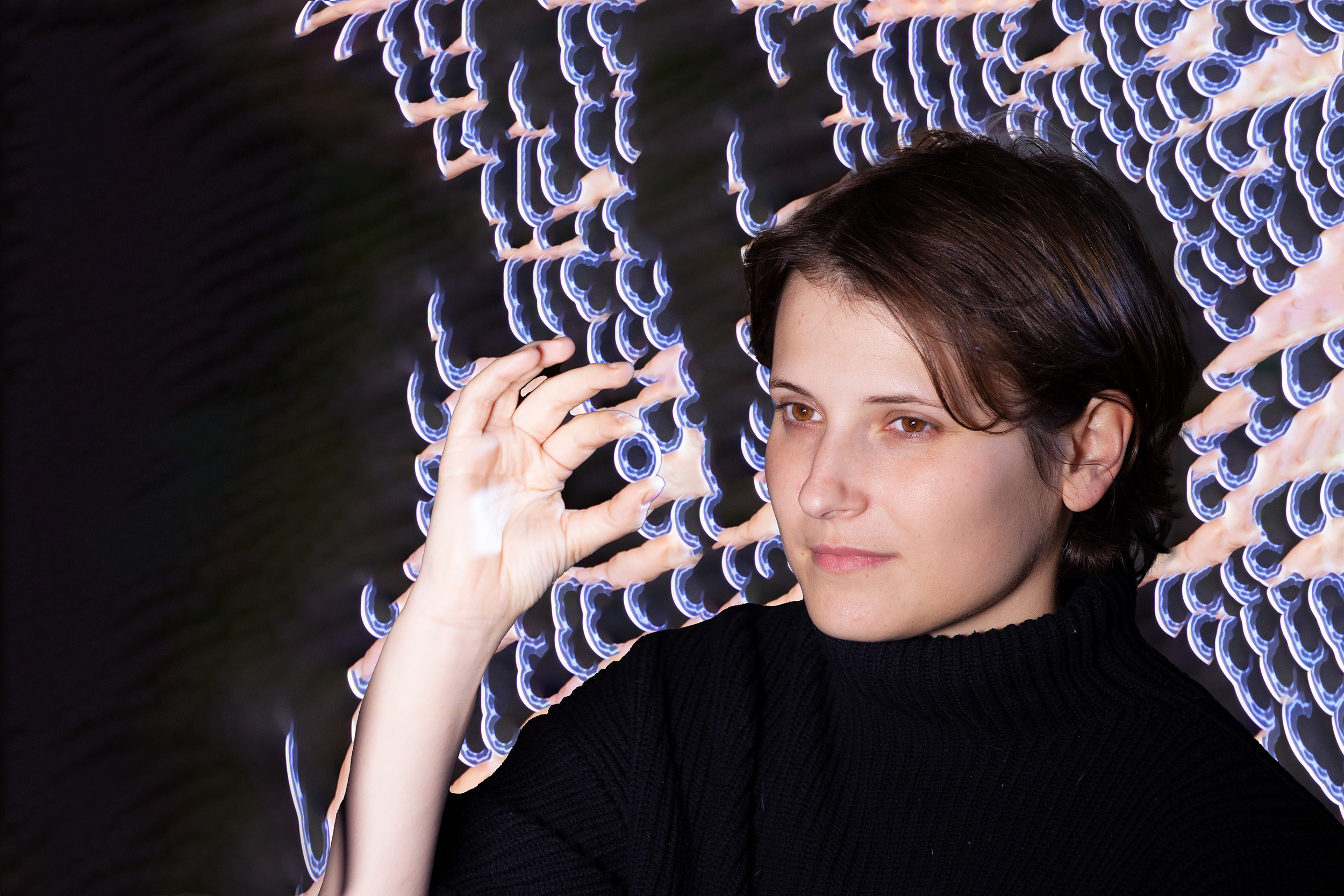
My grandmother, Květoslava Mlčáková, loves to sing. My mother told me that when she was a child, my grandmother would dance around the living room with a portable magnetophone, microphone in her hand, singing from the top of her lungs. My mother and uncle thought it was annoying, since they had to participate in these frequent musical escapades. They still make fun of her for it.
I have a very different memory of my grandmother singing. Actually, she sang the first song that I remember. A nursery rhyme. It goes like this:
Kousavý pavouček vylezl na okap
Pak přišel déšt a pavoučka splách
Když vyšlo slunce a osušilo svět
Kousavý pavouček vyzezl zase zpět
Kousavý pavouček vylezl na okap
Pak přišel déšt a pavoučka splách
Když vyšlo slunce a osušilo svět
Kousavý pavouček vyzezl zase zpět
Pak přišel déšt a pavoučka splách
Když vyšlo slunce a osušilo svět
Kousavý pavouček vyzezl zase zpět
Kousavý pavouček vylezl na okap
Pak přišel déšt a pavoučka splách
Když vyšlo slunce a osušilo svět
Kousavý pavouček vyzezl zase zpět
It tells about a spider, the rain, and the sun. The spider is crawling up a gutter, but it starts raining, and he falls. Fortunately, the sun returns, and he soon climbs up again. The cycle continues. When my grandmother sang it to me, her fingers would crawl up my arm. I believed that there was a real spider, but I was not afraid. I forced her to sing it to me over and over again.
We have since travelled more than twenty-five times around the sun, and I have travelled thousands of miles away from my family. I miss them and think about them often. We speak only through mobile devices. I talk to my grandmother every day on Facebook Messenger. She sends me documentation of her day, her dog, and the titles of the shows she is watching. It made me think of our song, and later, as I lay in bed, I tried to look it up online. I always thought that it was a traditional Czech folk nursery song. But I found nothing.
I sent a message to my grandma: Where does your song come from?
She replied: It is from a movie with Meryl Streep that I watched a long time ago.
In the 1986 movie Heartburn, Streep sings Itsy Bitsy Spider to her child on a plane. It is a traditional Western folk nursery song. It turns out that my grandmother saw this film dubbed in Czech—and the song was translated, too. She liked it a lot, remembered it, adjusted some lyrics, then sang it to me.
I asked her to send me a message recording of a song through her phone. She made multiple attempts, laughing at first. Then all of a sudden, she was singing to me again. Listening to her, I was overwhelmed with emotions. I could feel her sitting next to me—her disembodied voice.
When I was studying graphic design at the Yale School of Art, I spoke with Paul Elliman, who is a Senior Critic there. A lot of his practice focuses on sound, technology, and language. I don’t know him very well, but I found myself telling him about my fear and guilt of not being in the Roudnice nad Labem with my grandmother as she gets older. It was an intimate topic to discuss with a stranger, but he said that he feels the same way about his family. He told me some fascinating stories of people’s various attempts to live forever by preserving the sound of a voice. He explained that a sound wave never disappears. That it travels through space for eternity. This is technically true, but it becomes indistinguishable with other atoms and particles and we cannot retrieve it or hear it as humans.
To be able to hear sounds of the past again, we need technology. This is not a new idea. Elliman told me that in 1860, the French printer and typesetter Édouard-Léon Scott de Martinville recorded the folk song “Au Clair de la Lune" using his invention: The phonautograph. It created sketches of sounds waves on black paper. Almost a hundred and fifty years later, these phonautograms were converted into digital audio by scientists at Lawrence Berkeley National Laboratory in Berkeley, California. Another more recent example is the The Golden Record that was sent out of our solar system abroad the Voyager 1 and Voyager 2 spacecraft in 1977. This phonograph record was curated by a team led by Carl Sagan, intended for any intelligent extraterrestrial form who may find it, to learn about the diverse life on Earth. It includes a multitude of sample sounds from earth—including Kiss, Mother and Child, Wind, Rain, Surf, and Wild Dog—greetings in many languages, and also, 90 minutes of music, including Chuck Berry’s “Johnny B. Goode.”
He explained that a sound wave never disappears. That it travels through space for eternity.︎
After talking to Elliman and learning all this, I decided to search for a contemporary medium that could carry my grandmother’s song forever across time and space.
Technology is a huge part of my life. I was fortunate enough to receive my first computer quite early, around nine or 10 years old. It was my favorite thing. I played games all the time; I loved the duality of it, building new worlds. It was very generative, and it helped me to learn English, especially playing Doom, Tomb Raider, and Sims.
I think it’s the reason I became a graphic designer. At first, I thought I would be a programmer, but then I took a class when I was 12 and realized that my brain is not wired to think in code. I was always thinking in shapes. It was really fun to make art with my computer. Designing feels similar—like I’m playing a simulation game—because of the software, and the way you control it, it almost feels like a game interface. You never know what you’ll end up with.
During my time at Yale, I was really trying to verbalize my interest in technology. I have this love for it that comes from my childhood; I use computers every day. That process, too, evolves and changes. Equally, doing the work about technology is something different. It’s a part of our life, and it just comes to me naturally. I think about: How does it work? Who does it work for? Does it work for us? Or does it work for somebody else? Stories about technology are everywhere; you can trace them back to conflict and war.
Designing feels similar—like I’m playing a simulation game—because of the software.︎
Elliman loves personal stories, and I was encouraged to continue this idea I had in my head. He understood my fear of my grandmother dying, and wanting to preserve her voice. My first thought about data storage was that they die too after some years, and they and their servers need to be constantly upgraded and saved again… but then through my research I read about the Superman Memory Crystal, a project run by Professor Peter Kazansky at the University of Southampton in the UK. The company is called Serendipity Photonics Group. Their work focuses on creating optical data storage that lasts for billions of years. They engrave it onto fused quartz or silica glass, which is a glass composed of almost pure silica (silicon dioxide, SiO2) in an amorphous (non-crystalline) form. This ends up as small disks, and can hold 360 terabytes, and survive extreme temperatures. The team is right at the beginning of this experiment—they have lasered the Magna Carta, the Holy Bible, and the Universal Declaration of Human Rights. A few years ago, they collaborated with SpaceX, and gave Elon Musk a crystal that contained the three books of the Isaac Asimov Foundation Trilogy, which was launched into orbit in his Tesla.
I asked myself: Why not my grandmother’s song? Who really decides?
So I sent them a proposal with idea and the Facebook Messenger recording. I sent it to Professor Kazansky, and I didn’t hear anything for three months, but eventually he responded, saying that they would like to do it. Then the pandemic happened. Months later, I received an email telling me that they had recorded the song. Wow! Okay! They sent me some strange images of the data and some numbers, but I didn’t understand what it meant, and I asked them. Before I knew it, I was beamed by Skype into this conference room, totally unprepared. But they were so excited about it, saying that it was the first song they were able to engrave, that they usually engrave text and pictures, but songs are very hard. They explained that this was a milestone. My grandmother’s song!
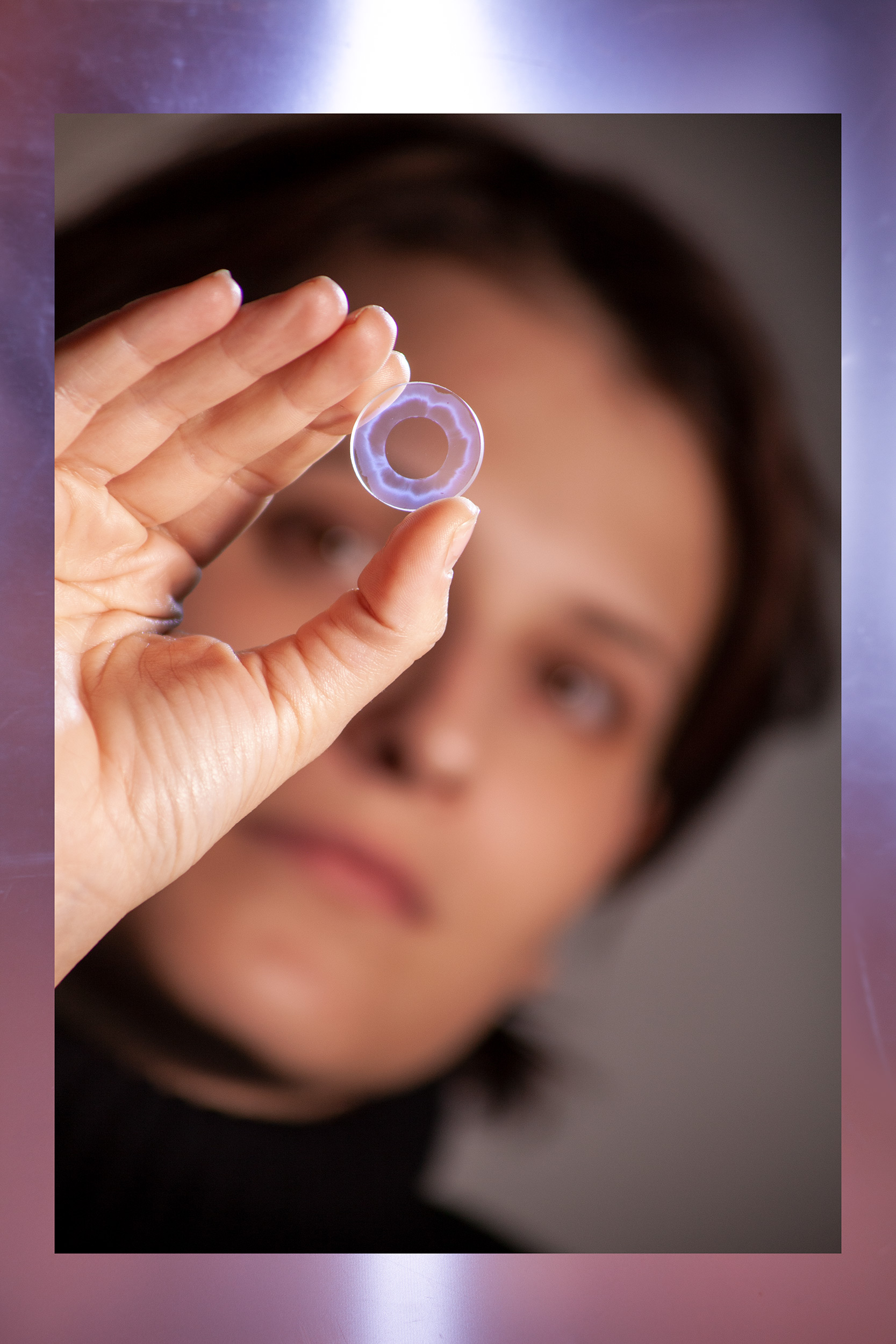
They explained the process: it takes 10 seconds to engrave with a very fast laser. To ensure that it is done properly, they need to read it manually with a microscope, which takes three days—like taking pictures of each part, and stitching them together. They sent me an image of a close-up of the crystal containing only six seconds of the song. It was taken by a microscope, and shows arrays of multi colored dots (voxel) of different sizes; these are read in order reconstruct the data. It is extraordinary, to see how this technology is so advanced, but so time-consuming.
They were just so excited, and I was elated.
Then, of course, I said, Can we talk about the design?
Nobody had mentioned it, except that they put instructions inside each disk, explaining how it should be read. I got really stuck for quite some time, thinking about it. At first, I thought I would keep the disk clean, without anything. Then I considered having the data on it, but it is already visible. I spoke to Elliman about it, and decided that I wanted to make it kind of open, and poetic—not like a scientific diagram, not calculated. In one of his emails, he attached an image of the sun’s corona, which according to the NASA website, is “the outermost part of the Sun’s atmosphere. The corona is usually hidden by the bright light of the Sun’s surface. That makes it difficult to see without using special instruments. However, the corona can be viewed during a total solar eclipse.” At first, I did not connect the dots. But when I looked at it again, I realized that I had seen it before. August 11, 1997: I was six years old. My younger sister was three, and we watched the total solar eclipse together with our grandparents. I remember we had a special instrument, a piece of glass of some type to prevent eye damage. I am not sure if we managed to observe it clearly because of the clouds, but I remember seeing images later that day on TV. Due to its trajectory, this was one of the most-viewed solar eclipses ever; because of that, I was able to find a clear photograph of it from that exact day with a visible corona surrounding the invisible sun. Total solar eclipses usually last about seven minutes or less, a short timespan to capture the moment before it is gone. Then it becomes a memory. I have not seen another eclipse since that summer day that I spent with my grandparents. I decided to send this image to the scientists to engrave it onto the memory crystal; it was created using the Schiller phenomenon, which is common in labradorite and moonstone. The effect makes the stone look like it has been lit from the inside.
Professor Kazansky is captivated with the idea of eternity. He is already thinking of the future of these crystals: digital gems, worn as jewelry. He really likes this notion of something being forever. I was lucky to meet this person. He is open-minded and interested in collaborating with artists. It really was a surprise; we really found each other.
It was created using the Schiller phenomenon, which is common in labradorite and moonstone.︎
When I finally received the crystal, it came in a plastic box. I was surprised by its size: very small and light, but feels solid, indestructible.
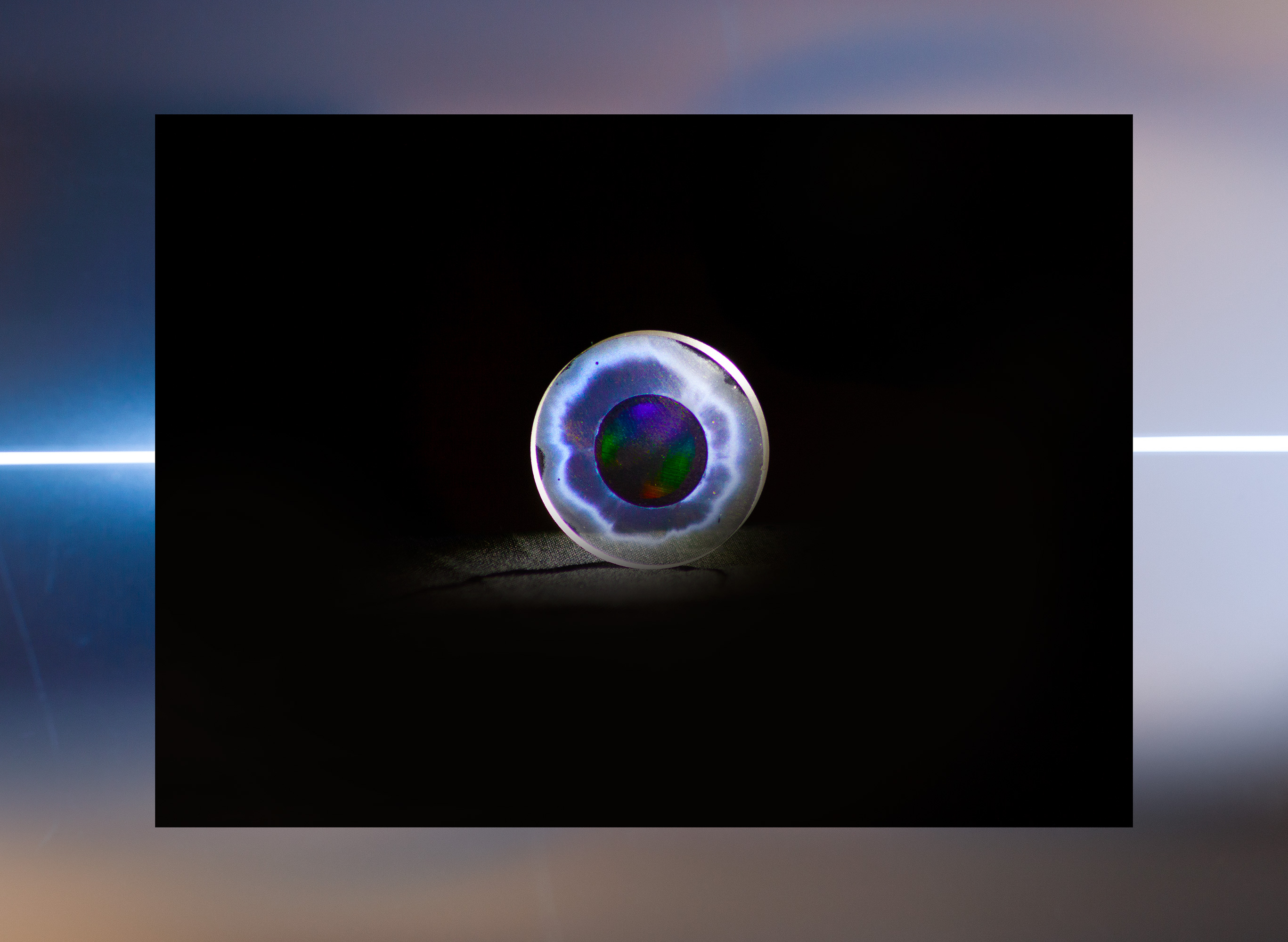
Photographer Monique Atherton describes her process for this story
You don’t take a photograph, you make it. —Ansel Adams
The immediacy of the photographic medium is deceptive. Even though the physical act of pressing down a shutter to capture an image generally takes a fraction of a second, there are many aspects of creating a photograph that are not visible to the viewer. The hours (and in some cases, years) of learning the technical settings of a camera and deciding what to use and when; the planning and setup; the focus and teamwork during a shoot; selecting an image to show; and the post-production of the final images tend to go unnoticed. The photographs for this article are no exception and it took five people and a total of about ten hours to make the images you see.
Photographing a crystal that changes with the light was fun and challenging. In addition to macro shots of the crystal, it was also important to photograph Anežka with the crystal given her personal connection to it. For the shoot which was held in my living room, I used my Canon 5D Mark II and a 300 millimeter zoom lens. This lens enabled me to get close ups of the crystal (which is only one inch in diameter) as well as shots of Anežka with the crystal. We used several backdrops including a light diffuser sheet from the inside of an LED television which also refracts light. For lighting, I used several different lights including LED panel lights, a ring light, several flashlights, cell phone flashlights and a high-powered bike light which we taped off to create a more direct light stream to “activate” the crystal—something that took a lot of coordination. Depending on which angle you viewed the crystal from you would see different aspects and details. Both of our partners were critical to helping us activate the crystal and they spent a significant amount of time holding flashlights in different angles while Anežka held or positioned the crystal and while I made the pictures.

I like options, so I shoot a lot of pictures then go back and pick out the best ones. For this shoot, I had about 550 selects to choose from. About a day after the shoot, I spent some time going through and selecting the top fifty images and then the next day, I made my selects and made some edits in Photoshop and shared them with Alex and Anežka for final selection.
The focus of Anežka Minaříková’s work is experiments that explore the wide range of graphic design. She emphasizes the interconnection of the digital and physical worlds, professional research and communication with the general public. She is interested in the active involvement of technology in the creative process through collaboration with innovators from different fields. She holds a Bachelor’s degree from the Academy of Arts, Architecture, and Design in Prague (Graphic Design and New Media) and an MFA degree from Yale University School of Art. She was a recipient of CCAM Studio Fellowship and Yale Prison Education Initiative, a Yale School of Art Teaching Fellowship.
Using photography as a launching point and incorporating installation, sculpture and performance, Monique Atherton explores intense personal moments as she seeks to uncover unspoken desires and tensions between herself and the people she meets. Her latest body of work, “The Portrait,” explores the way we perform for the camera and the ways photography is used to construct identities, made its debut with Seager Gallery at Photo London in September of 2021. Atherton was an artist-in-residence at the Wassaic Project and recipient of the 2018 Connecticut Emerging Artist Fellowship. Her self-published book “First Avenue” was shortlisted for the 2017 Kassel Book Dummy Award. She received her MFA in Photography from the Yale School of Art in 2016.
︎Through Line︎Lisa Kereszi︎Through Line︎Lisa Kereszi

Empty Sign with Arrow, Pocono Mountains, Pennsylvania, 2005.
Through Line
Lisa Kereszi
What is it about an empty billboard? And an arrow? And the two of them together, screaming Look at me and my emptiness, fill the space, fill the void. Your ad here! Photography sometimes feels more like fishing than hunting: Watching, waiting, sitting, staring. Sometimes with a lure, sometimes with a net.
Late Winter/early Spring of 2005. I am on a travel magazine assignment to photograph points along a budget road trip route due west of New York City in the Pocono Mountains. Hailing from Southeastern Pennsylvania, my family would visit up there when I was a child—as well as my parents and their parents before me—and I recognize the names on the signs I pass once again, but about 25 years later: Delaware Water Gap, Stroudsburg, Mt. Airy Lodge, Lake Wallenpaupack, Claws and Paws! Am I traversing the same exact roads as an adult? I like to imagine this is the case.
Setting: A wooded, two-lane country road, the kind that I once read is more dangerous than the engineered highway. Spotted: A telephone pole, with block letters spray-painted SERENDIPITY. I slow down, go to turn around to double back, finding a muddy, desolate turn-off. And there’s SAD ROBERT painted on a cliff’s face, an elegy, I suppose, to the rotted corpse of a cow below. A cow that somehow made it to this ill-fated dirt pull-off in the woods, no farmland in sight, the cliffside a giant grave marker for old Bessie, or for sad, sad, dead Robert.

Serendipity Telephone Pole, Pocono Mountains, Pennsylvania, 2005.
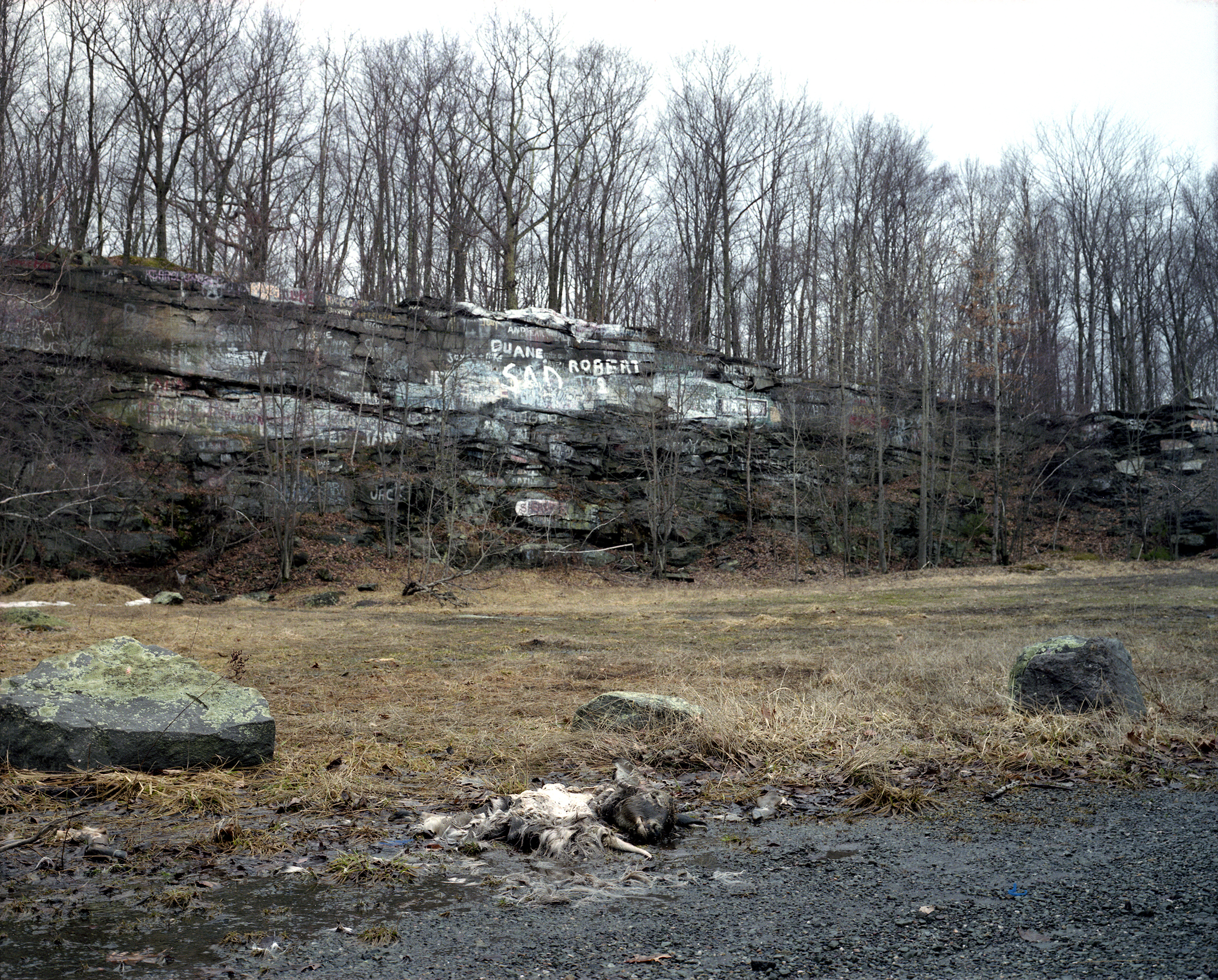
Dead Cow and Graffiti Cliff, Pocono Mountains, Pennsylvania, 2005.
Already significantly creeped out and primed for anything to happen, I go back to the serendipity pole, and suddenly see the dead deer by the side of the road, its fate the intersection of the poor thing’s body and a speeding car. The animal’s remains came to be all nested in this straw-like dead grass, its tan fur perfectly camouflaged. Together, these visual elements come into focus in an expert visual rhyme. All of it crowned by the elephant in the room: A red and white cross, a roadside memorial to a loved one, a human mammal, somehow also killed at this exact same spot.

Deer with Memorial Cross, Pocono Mountains, Pennsylvania, 2005.
Late Winter/early Spring 2022. Our brains are always trying to create order from the first moments. A newborn’s eyes look for patterns in a human face. Last breaths are taken with a search for the meaning of life, and a wish for an eternal one in heaven. Such it is with art—specifically photography—a medium that, by design, seeks to make visual sense of things by putting four corners and four borders around the visible world. That decisive moment (Images à la Sauvette, actually) coined by Henri Cartier-Bresson, is more than just the aesthetic convergence of line and form, and time and space; it is also a psychic transformation of the chaotic world into some harmonious, beautiful order.
Though sometimes, creepily so. That is where serendipity comes in. More than coincidence, the serendipitous moment feels, well… fated, somehow, even to those of us who do not believe in greater powers than ye. What Garry Winogrand described as his reason for making pictures (“I photograph to see what the world looks like in photographs”) is maybe also a desire to create an order. To contain the world’s movements, and to create relationships in the intersecting lives of strangers.
Together, these visual elements come into focus in an expert visual rhyme.︎Together, these visual elements come into focus in an expert visual rhyme.︎
Already primed for déjà vu, at another blip down the road I come across a fellow predator, but in the form of a big, half-sunken, plastic beast, out behind an abandoned sports bar for the Winter. First lured into the gravel lot by the hand-painted signage out front (which turns out to not be quite anything), I swing my station wagon around to move on, and whoomp, there it is. I am rewarded (by the universe) with this thing, a sinking (or surfacing?) fake white shark in a meandering, cold, cold, grey lake.

Plastic Shark in Lake, Pocono Mountains, Pennsylvania, 2005.
In the days that follow, I lose my voice, explaining myself in scratchy sounds, straining to be understood on the Motel 6 desk phone. I remember something about movie posters. And carnival glass. I take a photo of the Rolling Stones album, Sticky Fingers, adorned with a palm frond cross, and think of how my mom scratched the word filth into that album cover when I was a kid, thus only making me want to see what was inside even more.
I remember the diner, the scene of these plated leftovers, on the placemat, in the booth. Today this picture stands out to me, not just because of my old teacher, Stephen Shore’s Uncommon Places meal pictures, but also for the woman with the long hair in the next booth over. Somehow, I think I “recognize” her from an image by fellow photographer Curran Hatleberg: His burger joint picture, the one of the girl with the band-aid. But that photo hadn’t been made yet in 2005, so I couldn’t have seen it first back then. I surmise that we both, as photographers, were reacting to the William Eggleston picture of the girl with the red hair in the light at the snack bar. Shore thought so, too, because that pairing of photos is not just in my own slide lecture on the subject of influence, but also in his new memoir on the craft of photography, Modern Instances. This is proof of the hive mind of photography! This interweaving of subject matter exists in the “ongoing moment”—that writer Geoff Dyer spoke of in his book of essays of the same name—rather than that old-fashioned, decisive one we already knew about. To take it a step further, my diner patron’s hair is straw-colored, like the dead grass along the roadside, and like the dead deer laid out on it. This is serendipity, photo-nerd-style. Something bigger than ourselves shows up again and again in images. Sometimes as visual rhyme, alone or in a series of stanzas. Color, shape, form, line, repeating in otherwise unrelated pictures. And work made by different photographers at different times and places (in this case, three) can touch the same nerve.
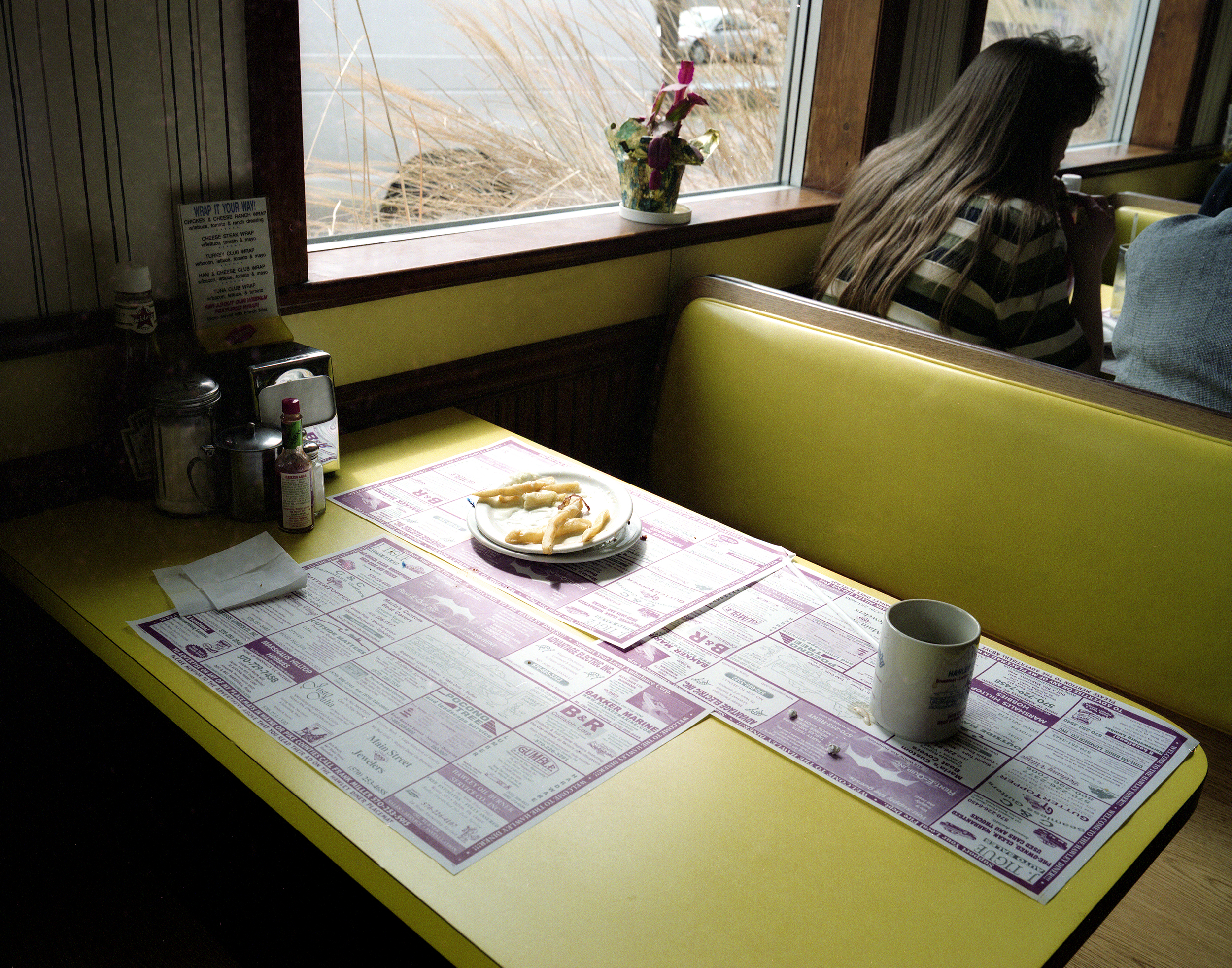
Leftovers at Diner, Pocono Mountains, Hawley, Pennsylvania, 2005.
Is there something “responsible” for putting me there in the right place, right time, camera loaded, and able to quickly take note, focus, and press the shutter?
Is it serendipity? For putting that line cook there in that diner, who told me not to take her picture, because she was “in witness protection,” and me, only after I left, making the connection about who she was? (If my guess was right, she had ratted on her girlfriend for a string of murders; this girlfriend was finally picked up at a bar that my dad hung out at on more than one occasion. This bar was somehow right next door to an artist colony I would once stay at, 12 years ago.) Serendipity? Is that what made me take that wrong turn, or that right one, that made me end up here?

Line Cook at Diner, Pocono Mountains, Hawley, Pennsylvania, 2005.
What brought me here in the first place? Am I the chicken or the egg?
There’s the serendipity of my great-grandmother, Anna, coming here, all alone, by herself, at 16, and meeting George, who came with his entire family. For all I know, my grandfather was conceived in Mount Pocono. I’m connected to this place and these people, though separated by time and space. Pictures connect the viewer through time and space with the photographer. Or maybe all this coincidence is making me a victim of having something like pareidolia—seeing faces in patterns—when no order is really there.
Something bigger than ourselves shows up again and again in images.︎
Thinking back to that cold week when I made these pictures, I conflated all my trips to that part of the world—the gateway to the Pennsylvania rust belt, next to where my ancestors had settled in the Lehigh Valley. Was it this road trip in 2005 that I went to photograph the heart-shaped hot tubs (no, it was not), and which time was it that I saw Lincoln’s blood on a pillowcase, spirited away by his doctor and somehow ending up here, in a tiny regional “museum”? And which time was it that I lost the directions, but somehow found my way down a long maze of driveways and bumpy dirt roads to the gentleman farmer photographer’s homestead, deep in the valley amid lush green soybean fields? (Not sure…) Was it this time, or the trip to Nonie’s funeral when I forgot to pack black dress pants and had to wear jeans—or that cousin’s wedding, the marriage already on its way to becoming unraveled? (Decidedly no.) Which was the time I raced south through a Western-like, scraggy landscape to get to the hospital when Mom Mom started her decline? The time when that girl rear-ended me a block away from where my grandfather grew up? Where he had walked by St. Michael’s cemetery, where Walker Evans took the famous photo of the cross, the workers’ rowhomes, and the steel stacks beyond? (It felt like it was this trip, but it was later.) I really have trouble picking it all apart now, these threads that are connected through me, like synapses in a brain.
All flattened together is my psychic memory of this place, where we used to go for mountain weekends, where my mom did, too, going fishing and picking fossils with her dad, next to the coal mine and steel mill towns where all those ancestors settled over a hundred years ago. We came then for leisure, but first for escape.

Claw Machine: Play Till You Win, Pocono Mountains, Pennsylvania, 2005.
Push the button, play ’til you win, maybe the claw machine won’t take all your money.
Lisa Kereszi was appointed Lecturer in photography at Yale in 2004, Critic and Director of Undergraduate Studies in Art in 2013, and Senior Critic in 2019. She graduated from Bard College with a B.A. in photography and a minor in literature/creative writing in 1995, and in 2000 she received an M.F.A. in photography from the Yale School of Art. Her work is in many private and public collections including the Whitney Museum of American Art, New Museum of Contemporary Art, Brooklyn Museum of Art, Metropolitan Museum of Art, and the Yale University Art Gallery, among others. She is represented by Yancey Richardson Gallery in New York, where she had several solo shows, most recently in 2019. She has several books in print, including the 2004 Governors Island exhibition catalog, 2008’s Fantasies, 2009’s Fun and Games, 2012’s Joe’s Junk Yard, 2014’s The More I Learn About Women, with three upcoming photo books about family, objects, and mourning due out in 2023/24.
︎The Camera on the Roof︎Damian Loeb︎The Camera on the Roof︎Damian Loeb
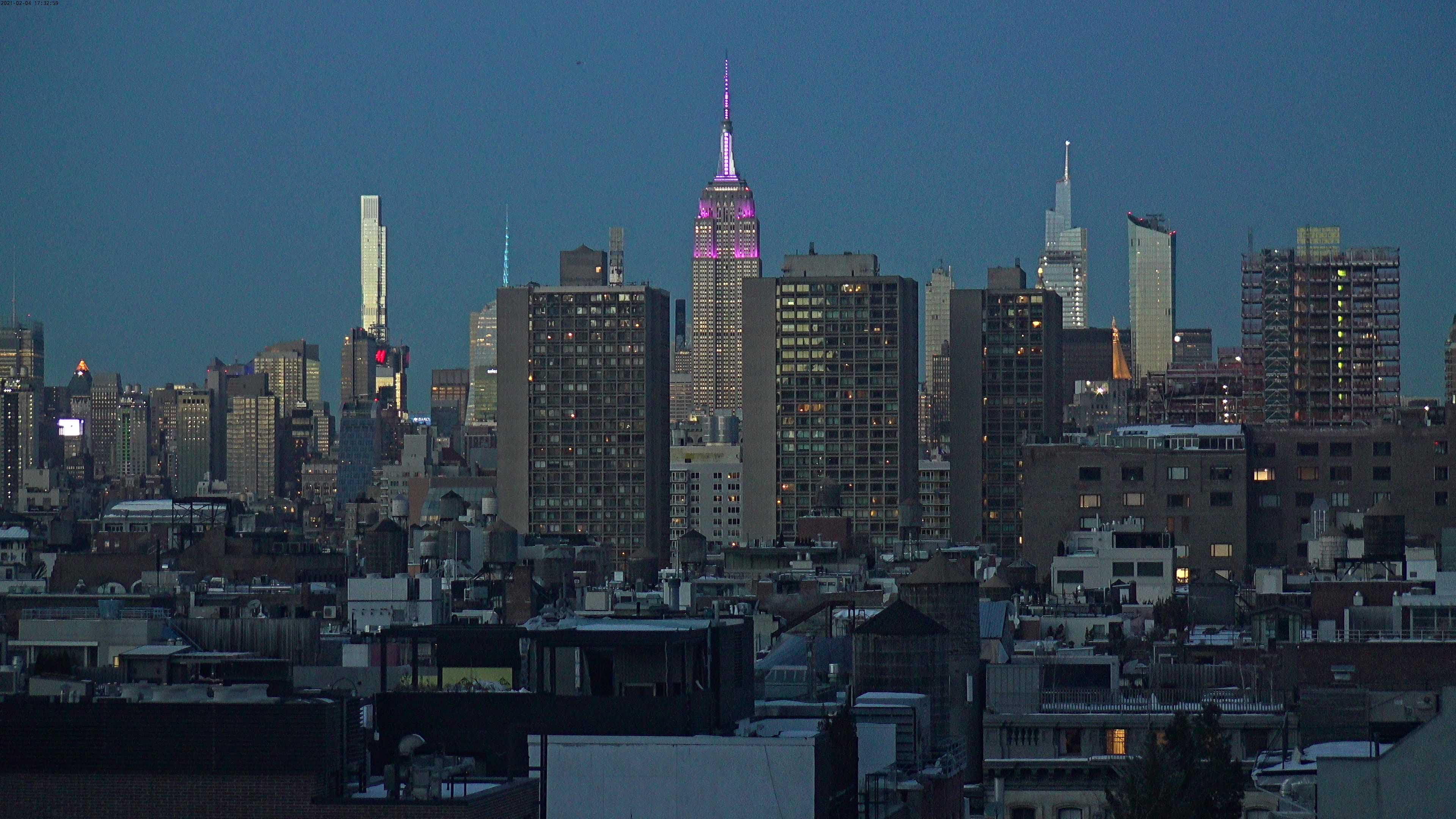
All images by Damian Loeb, 2019-2022.
The Camera on the Roof
Damian Loeb
“All those moments will be lost in time, like tears in rain.”
—Roy Batty, Blade Runner Years and years ago, I mounted a video camera on top of my roof in Tribeca. It is in a very specific location on my co-op’s deck, composing a perfect view of the Empire State Building. It has been recording, in real time, every second since then.
I set up monitors in every room, showing a continuous live feed that captures every lightning strike and plane that passes, every sunrise and sunset, and every new skyscraper rising and altering the New York City skyline. This requires a large amount of hard drives to record it all, and a complicated network to connect and access it.
Initially, the project was driven by the want of a window, since the studio where I work is in the basement, below ground. When I moved to Manhattan, I had a romanticized notion of the city from movies. In the 1980s, everything focused on famous buildings: The World Trade Center, the Chrysler Building, all those high-rises along Central Park.
But to me, the Empire State Building continues to be uniquely special, because of its shape, and how it represents the heart of the city. I lucked out, getting this view. Downtown, too, was another romantic ideal for me, being the center of the art world when I relocated here.
In high school, I was so moved by Andy Warhol’s 1964 movie Empire, a black-and-white, eight-hour film that shows one window’s unchanging portrait of the iconic structure, watching from a few blocks away. It emphasizes the silent indifference of the building’s solitary enormity, and captures the concept of New York City time. My emotional perspective and notions of New York change, but my amazing view has remained relatively the same, looking out at a city that has a life of its own, always moving forward, constantly in blossom.
This rooftop feed serves many purposes. Mainly, it’s a comforting window with a perfect and intentionally composed view. Over time, the scenery became normalized and ubiquitous to me, an unchanging tableau through the days, nights, weeks, and seasons, in which I would only notice the serendipitous variations, whether it be a flock of seagulls briefly drifting by, or clouds obscuring the famous spire.
As part of my interest in the digital all-seeing, all-knowing eye, I created a machine to capture the thousands and thousands of hours of this footage. When I say “machine,” I mean something that has a sensor, an action, a script, a limited program telling it what to do. Everything—the computer and the automated components of it—is all connected like a body, with a heart and a brain. It’s always evolving, and I’m always updating it, so I can only describe what it is today: Right now, it includes a PC, large hard drive boxes, the security software, the camera, the monitors, and a joystick controller that moves the camera.
I created special computer scripts that allow me to instantly screenshot a frame from the feed using any mobile device, in the shortest time possible. I can grab a singular instant, put it into a text message, and send it to a friend, so that they are virtually with me for that moment. Each image is time-stamped in tiny numbers up in the left-hand corner, down to the second. Whenever I see something that piques my attention—a shadow, a color cast, or sudden reflection, or if a certain friend suddenly comes to mind—I grab the exact frame using whatever device is nearby, and send the image to them, unaltered. Out of that first serendipitous glance, I create a unique, one-off, connection between myself and the receiver, culminating in a piece of digital artwork that commemorates this shared special moment in time. These captured images are at 4K resolution of the original charge-coupled device. In a digital way, I’m saying: I wish you were here.
Creating this relationship to the live stream is similar to having a metaverse, threaded with the web of my friends. I have created a database of these subjective captures within these conversations that will be included and used as a source for a second algorithm. (My first algorithm, which I presented at CCAM in 2019 as part of my residency, was about the camera installed at my front door, which takes photographs of all my visitors). This second algorithm will impose my value of beauty; my programming bias would be inherent. It would filter my own view of the city.
︎Creating this relationship to the live stream is similar to having a metaverse.︎Creating this relationship to the live stream is similar to having a metaverse.
Meanwhile, this live stream from the roof will continue to record indefinitely. With this same footage, I also want to build a project that will contain that special magic “thing,” knowing that it will one day be lost. I want to be able to speed forwards and backwards and look at thunderstorms, sunsets, special days in my life, or the beginning of the pandemic. The idea that the city is unmoved by my own personal emotional events fascinates me. I’ve always wondered: Can you see the effects, the differences, and the changes in the image? During lockdown, when airplanes stopped flying, you could actually see a clear difference in the sky.
The ability to rewind and see everything and anything within my views from many years ago up until today just barely satisfies my urge to have control of time. I will make an interface and customize a device to give it the ability to speed up, slow down, and watch any moment. You could get a second chance to look at a day, a moment, and own it in the only way that you can, knowing that it isn’t permanent, accepting that it isn’t permanent. It’s about extending our outlook.
In the end, beauty is king. The things we notice are the pleasing things, sometimes the drama, and definitely serendipity, like the lightning, the birds, the white-outs on the buildings. This interface will allow you to virtually go back and forth over significant moments within a constant vantage point; trying to place the exact instance of an event. You could go back and watch your entire birthday. You could go back and see when a relative was alive. And you could go to the next day when they weren’t. You could think about how different the world was on those two days, when it had that person in it. And the next day it didn’t. You could keep going back and forth over that line. It’s the same experience on either side, from the user’s point of view, except for the personal knowledge of the difference. That’s the great thing about this. The project will outlast you, the stream is constant. You can walk into a river up to your ankles, and the water will always be different; you can always try and swim downstream to catch up with what your experience was. That’s the fascination. You’re getting a small perspective of the past.
I need to consistently back up all that footage onto a separate set of drives. It’s reassuring to know that it just keeps growing and continues, that it will capture everything that is there, this eye that just keeps seeing. My attachment to it made me realize that I don’t want to lose ANY memories; but without action, we will lose those memories. As the AI Replicant android, Roy Batty, laments in his famous death soliloquy in Ridley Scott’s 1982 Blade Runner, his greatest sorrow is that his memories will die with him:
“I’ve seen things you people wouldn’t believe. Attack ships on fire off the shoulder of Orion. I watched C-beams glitter in the dark near the Tannhäuser Gate. All those moments will be lost in time, like tears in rain. Time to die.”
For me, making paintings solidifies some of those things, so they don’t get lost. Photographs fade. Video isn’t solid. Because it is digital, this project is always going to be ephemeral, until any of it is printed. This ephemerality makes this footage experiential. There’s too much data, and always will be.
︎This ephemerality makes this footage experiential.︎This ephemerality makes this footage experiential.
Over the years, the camera on the roof has been vandalized, knocked around by the weather, and rewired. I tried to camouflage it to make it less noticeable. It’s been a challenge to keep it there. The view has shown the cityscape changing, which has been fascinating, despite the addition of some real monstrosities. The composition itself changed recently, as a construction crew working on the roof damaged the part of the building that the camera is mounted on, so it is leaning slowly forward. I am allowing this natural entropy to color the image as a dating technique and a sign of the times—I’m sure that these details will be identified in the images from this period. I have planned a new way to mount the camera. Soon, it will be fixed back to a more secure position; like a re-birth, blind to anything but the now, leaving a continuously changing trail documenting its unbiased observations.
Damian Loeb is an artist represented by Acquavella Galleries and Pace Gallery. His most recent show, “Wishful Thinking,” a collection of his new astronomically-based paintings, was exhibited in 2021 at Pace’s Palo Alto location. He is currently working on planned shows with Taka Ishii Gallery, Acquavella Galleries and Pace Gallery in 2022-23, and is artist-in-residence at Yale’s Center for Collaborative Arts and Media (CCAM). He lives and works in New York City.
︎A Prepared Mind︎David Caruso and Zorana Ivcevic Pringle︎A Prepared Mind︎David Caruso and Zorana Ivcevic Pringle
Detail of Dawn, Brennen Steines, 2021–2022.
Oil and calcium carbonate on canvas with steel frame, 118” x 81”.
A Prepared Mind
David Caruso and Zorana Ivcevic Pringle
Anxiety and nervousness around artmaking is very common. Much of it stems from the same place—fear of failure—and is entangled with all aspects of our lives. True creativity involves risk, and risk involves desire. How can artists negotiate all these feelings?
“Many people hear the term ‘emotional intelligence’ and still think of the Rorschach test,” says David Caruso, Ph.D., a research affiliate at the Yale Center for Emotional Intelligence. “This is a popular idea. But for scientists like us, it’s an intelligence just like any other. It’s a set of hard skills.” His colleague, Zorana Ivcevic Pringle, Ph.D., a senior research scientist and the director of the creativity and emotions lab, agrees: “People who are emotionally intelligent can accurately identify and interpret physical signs and behavior, understand their common causes and consequences, and use this knowledge to regulate and solve emotion-related problems.”
The pandemic has disrupted artists and creative organizations in unimaginable ways. Collaboration, performance, and connectivity have been hindered. Caruso and Ivcevic Pringle discuss how people, with self-awareness and insight, can find their way.
In addition to the Yale Center for Emotional Intelligence, Caruso is a management psychologist who develops and conducts emotional intelligence training around the world. He is Senior Advisor in the Yale College Dean’s Office. He is also the co-founder of Emotional Intelligence (EI) Skills Group. He is the co-author of the Mayer, Salovey, Caruso Emotional Intelligence Test (MSCEIT). He and Peter Salovey wrote the practical “how-to” book, The Emotionally Intelligent Manager (Jossey-Bass, 2004), and he is a co-author (with Lisa Rees) of The Leader’s Guide to Solving Challenges with Emotional Intelligence (EI Skills Group, 2018). He has published numerous peer-reviewed journal articles, reviews, and chapters on emotional intelligence. He has spoken to executives and has trained thousands of professionals around the world. David received his Ph.D. in psychology from Case Western Reserve University and was then awarded a two-year postdoctoral fellowship in psychology at Yale University.
Ivcevic Pringle studies the role of emotion and emotion skills in creativity and well-being, as well as how to use the arts (and art-related institutions) to promote emotion and creativity skills. She received funding for her research from the Botin Foundation, Imagination Institute, National Endowment for the Arts, and the Faas Foundation. She has collaborated with colleagues from Denmark, Spain, China, and Croatia and published her research in numerous academic journals. She received the Award for Excellence in Research from the Mensa Education and Research Foundation for her research on emotional intelligence and emotional creativity, as well as the Berlyne Award for Outstanding Early Career Achievement in psychology of aesthetics, creativity, and the arts from Division 10 of the American Psychological Association.
—Alex Zafiris

Detail of Dawn, 2021–2022.
Oil and calcium carbonate on canvas with steel frame, 118” x 81”.
Zorana Ivcevic Pringle: Serendipity sounds like luck, from the outside. And it looks like luck, if you don’t have enough information about the person, what they do, or what is really going on. There is certainly an element of luck within it. However, there are also elements of preparation. A big part of serendipity is a prepared mind; it is more likely to happen to some than others, for example: People who are more open to new experiences. They are present in the world, and can notice things that others might not.
David Caruso: How do you prepare your mind? How do you become open, especially when under stress? One way to be open to new experiences is through strong emotion management skill. Importantly, emotion management does not mean emotion suppression, closing yourself to these experiences. A lot of people think they always have to be calm, cool, collected, to push everything down, and suppress their emotional experience. That’s not what we’re talking about. It is the ability to stay open to those strong feelings, so that they don’t flood us. In this way we’re able to fully experience emotions and leverage their power, to be awed, inspired and to see things in new and in different ways.
Unrelated to emotional intelligence is our understanding of the “big five” personality traits. There are five, general aspects which describe many of the observable differences and our interpersonal interactions across different people. One of these global traits is openness to experience. If you’re curious, then you find your own luck. It sensitizes you to opportunity. It encourages you to avail yourself of chance encounters. So even in a limited lockdown, you can be a really good observer. Curiosity is an inner quality, which leads to wonder, awe, and interest, and towards more serendipitous encounters.
ZIP: Curious people enjoy trying things, learning new skills, developing hobbies. Even in limiting situations like lockdown, those who are actively engaging with the world will find serendipitous interactions that otherwise might not have happened.
DC: During lockdown, your personal environment does play a factor. Many of us are incredibly fortunate; we don’t live in fear with high levels of anxiety. It is also important to recognize that good things do not happen to good people. Good things happen to people living in good conditions: Creative, healthy environments, where health is multi-dimensional. Lately I’ve been rereading Henry David Thoreau, and about American Transcendentalism. He was such a good observer. Everyone knows his line, “I have traveled a good deal in Concord.” To me, this means: Be inquisitive about your inner world, and also the outer world. If you really love to travel but have not been able to do so, you can still cultivate that inner quality towards new experiences as a compensatory strategy. Read, browse, and be open.
Emotion management does not mean emotion suppression.︎Emotion management does not mean emotion suppression.︎
ZIP: During the pandemic, our usual ways of interacting with the world disappeared. But we created new ones. We couldn’t do everything, but we could pursue connections with people, even without physical presence. It is important to remind ourselves during this time that humans are resilient. Research shows that, even in the face of traumatic events, the vast majority of us recover quite fast. The first shock of a situation is real, and it is a healthy response to an unhealthy situation. But we find new ways to adapt, and pretty quickly come back to normal ways of thinking, feeling, and being. In my lab, we are studying how people are emotionally experiencing the pandemic. We see an initial spike of negative feelings, like stress and anxiety. But then those go down steadily, and positive feelings steadily increase. This resilience is something to keep in mind, especially as new waves and variants appear. Will life go back to what we knew, or is this change permanent? For humans, change is usually not permanent, and people come back to themselves and their habits after even very significant events.
AZ: How much does anxiety and fear interfere with serendipity? Sometimes magical thinking is occurring, not serendipity. Can you point out the differences between these? And how this might affect creativity?
ZIP: Yes, an overwhelming amount of fear and anxiety closes us down. We no longer have the resources of engaging with the world. However, not all fears and anxieties overwhelm us completely. Occasionally, we can feel manipulated by our own emotions, like puppets being pushed and pulled. But the truth is, we have substantial agency over them in most situations. Traumatic events might be an exception to that rule—while they are happening, and shortly thereafter. But in daily life, we have some control and chance of influencing their course. How we do that depends on our ability to accurately read what we are feeling, identify the causes, and understand where it is coming from. Then, we can use strategies to regulate and manage what we are experiencing. This can take the form of making ourselves feel better, or finding a different way of feeling that is going to be helpful for that situation.
AZ: For me, creative intelligence comes from being curious and aware, but also very realistic. You have to accept the bad feelings as well as the good, to get to the truth of the matter, and do this with love, for yourself and for others. Serendipity has an inherent positivity to it, but I feel that this is earned, through the hard work of self-acceptance and emotional discipline.
DC: And I’d like to note that we try not to label feelings as “positive,” “negative,” “bad,” or “good.” Another way to look at them is whether they helpful or not helpful for a given situation or task. A lot of people assume that emotions like anxiety and fear limit creativity, or do not allow for serendipitous encounters. One of the things that Zorana and I agree on and find interesting—which feels counterintuitive to a lot of people—is the importance of being able to access the full range of our emotions. There is no such thing as a happy warrior.
ZIP: I study creativity and emotions. There are three decades of experimental work that have concluded that positive, energized feelings are good for creative thinking. I felt conflicted about this, because it seems to be divorced from how creativity happens in the real world. For example, if we bring people into the lab, and create for them a way of feeling from showing a brief video clip—comedy, or something very sad—they are going to get into a certain mood. However: They did not choose these video clips, and they might not be particularly meaningful or relevant to them. Additionally, those feelings are not similar to the real world feelings that are inspiring people to create. I was quite frustrated with this way of doing research. While the finding is reliable, that happier people—versus neutral or negative—are better able to come up with more ideas, and more original ones on quick laboratory tasks, I was more curious about what people do in their everyday lives.
In my lab, we have studied artists, and asked them what emotions occur when they create. What we find is great diversity. People get inspired by joyous events, others by pain, anger, and nostalgia—everything in between. The daily effort of creating something is even more complex, because there is anxiety and stress involved in figuring out the work. Frustration is the norm, for it is difficult to translate what you want to say into materiality. There is not one way of feeling that is beneficial for creativity. We were asking the wrong question all along. The right question is: How can creative people use the variety of emotions they are experiencing?
DC: Experiencing the full range of emotions can really facilitate thinking in different and unique ways. But harnessing their power does require a skill. We go back to managing emotions. An analogy is: Emotions are like water coming down a river. Will those emotions, or the water, flood us? We don’t have enough data to answer that. And yet: It isn’t how much water or emotions are flowing in our lives or through our towns, but how strong and high the banks of the rivers are. Emotion management is like the banks of the river, and their height. We can be experiencing very strong, intense, and varied emotions, which allows us to shift our perspective, looking at this through different lenses. But we can’t be overwhelmed by them, because otherwise we lose the data in those emotions. So, it’s not that we should feel less, but that we can learn to manage better. Some of us are better at this than others. Some of us have to work with this each and every moment of our waking lives.
There is no such thing as a happy warrior.︎There is no such thing as a happy warrior.︎
ZIP: We are scientists, and we think that data is always good to have. Emotions are a kind of data. They are telling you what is going on with yourself and in relation to what you are doing. If you are experiencing happiness, it means everything is good with the world. You do not have to pay attention to details—you have it under control. You do not have to expend more effort into what you’re doing, because, the message here is: Everything is good. However, if you are feeling frustrated, it means that there is an obstacle. Something is not quite right; you are not able to accomplish something in the way that you anticipated or wished. So: If you have this information, you can use it to inform your decisions. When something isn’t working, continuing in the same way is not going to be helpful. You probably have to look for a different approach. That could be: Reevaluating what you did; undoing something; or redoing something.
People often want to immediately make themselves feel better. But if they do so, they will miss important information in frustration or other challenging emotions, and not be as effective in their work. In terms of serendipity, you can see how this reading of the environment and of emotions can help you realize opportunities. Entrepreneurs, for instance, are full of these stories. The man who founded Instacart hated the experience of shopping in a grocery store. He didn’t just live through it, deal with shopping the way it was and made himself feel better afterwards—he said, I can do something about this.
AZ: When you are talking to a person who is “stuck”—this person could be an artist or parent or child or engineer or a doctor—what are the things you say to them, or ask them? Creativity and serendipity are so personal, but also so universal.
DC: Courage relates to the emotion management experience. You need it to be able to feel those feelings, not be overwhelmed or suppress them. Emotion management skill allows you to feel feelings, stay open to them and leverage them. Anger is another emotion that is scary for many of us. It arises from a sense of injustice. Without it, we’d have even more social ills in our world. There are things that happen out there to us, by us, by society, that should anger us. A serendipitous encounter is not always a happy thing; it could be an event which deeply disturbed you, that angers you. If you have the skill to capture the underlying data from that emotion, manage it, and internalize it, you can use it to effect change.

Detail of Dawn, 2021–2022.
Oil and calcium carbonate on canvas with steel frame, 118” x 81”.
ZIP: Courage in creativity is very important, because it determines whether people are going to even attempt to do something. When we are facing problems or tasks, we have a choice. This is not always conscious. People don’t stop themselves and say, Am I going to take a safe choice, or the more original, risky option? People make decisions around how they will engage in a process. When I studied what kinds of attitudes go into these decisions, I found that there are two different kinds of negative attitudes that prevent a courageous decision. One is that people end up anticipating negative social consequences. They think: Will people think this idea is silly? Will it anger somebody? Will it challenge someone’s authority? Am I being disrespectful? Another attitude is based in curbing anxiety. You feel anxious, and decide it is better to be safe than sorry. This is risk aversion. On the flip side of that is the belief in the work. How willing are you to take those social and intellectual risks, possibly to the detriment of your reputation? Social risks are about others’ judgments of your unconventional ideas. Intellectual risks are geared towards yourself: Am I able to execute this? Can I learn the skills? Will I make it happen?
Sometimes, when people speak about decision-making or courage, they think it is just about them. But we do not live in a vacuum. These beliefs and fears are coming from previous experiences and memories. Those are real. We are also influenced by our immediate social environment. In terms of education, felt support—not just declared support—from peers and teachers is very important. In the world of work, support from our colleagues, and our supervisors and leaders—whose decisions can affect what we do and what we’re able to do—is key.
AZ: What are your thoughts on artificial intelligence? It used to be that a machine or technology was inherently inhuman. But now there are very striking—spooky—examples of AI-generated language, characterization, efficiency, and creativity. What is troublesome, and what is encouraging about all this?
DC: There are disturbing aspects of artificial intelligence. It recreates the creators with all their biases and limitations and worldviews, and it can be pretty horrifying. On the other hand, the personality psychologist David Funder has something called the Realistic Accuracy Model. He shows all the different processes that go into being a good and accurate observer of people. To paraphrase him: Rather than being surprised when we misunderstand or misperceive someone, we should be surprised when we get it right. So many things can go wrong in that process. In this case, technology can be enormously helpful in allowing people to supplement those skills that they may lack. They can provide compensatory or remedial strategies, while still acknowledging the troublesome aspects of recreating our own human biases in systems, and then claiming or thinking that they are bias-free. I love Funder’s quote. I remind people of it all the time, especially when we’re putting together hiring committees. You think you can just meet someone for an hour-long job interview, gaze into their eyes and gauge the depth of their soul? It doesn’t quite work that way.
AZ: In terms of creative management and team-leading, how can serendipity function in these kinds of environments, or creative organizations in general? What stands out, in your research, as a marker for successful leadership in the arts?
ZIP: Leadership is very important. For serendipity to happen—and oftentimes for creativity to happen—we need to feel psychologically safe. Creative work involves the decision that you’re even going to attempt to do something that entails a different way of considering existing or new problems. Re-asking questions, trying things in ways that haven’t been done before. That’s the meaning of originality. If you are going to be original, by definition, then you don’t know how it will be received. Think of that in work settings. If you are unsure of an idea, to even contemplate proposing it, you need to feel pretty safe that you are not going to be rejected, or punished, or lose your status or job. There has to be a possibility of failing, without dire consequences. These kinds of environments are most directly created by supportive leaders who will allow you—implicitly or explicitly—to explore something, whether it will work out or not. An original, creative, transformational endeavor is by default daring. In my lab, we studied employee work experience. Those who described their supervisors as acting in emotionally intelligent ways—noticing and acknowledging what others are feeling; taking into account both optimistic and pessimistic points of view; understanding how their decisions affect others—were more motivated and engaged at work, as well as more creative.
A serendipitous encounter is not always a happy thing; it could be an event which deeply disturbed you, that angers you.︎
DC: As Zorana was saying: Leaders who possess higher levels of emotional intelligence do create environments that are more positive. They’re better at handling conflict. They don’t seek it out but they don’t avoid it. If you have the skills to manage people’s emotions—both pleasant and unpleasant—you don’t necessarily avoid conflict. You dive in, and you work through it. These leaders have greater stress tolerance, they engage in pro-social behavior, and have better relationships. In the last year or two, I’ve worked with many executive directors, presidents, and CEOs of performing arts organizations, mostly in the US. It’s a tough environment. During lockdown, when venues were closed, leaders needed to employ skills they never had to before, to do things they never had to do, such as lay off an entire orchestra or 60% of staff. Companies are just recovering from that, and this requires incredibly strong emotion management skills to just survive, let alone thrive.
AZ: How is serendipity linked to passion and desire?
ZIP: Passion is a very energizing experience. It is a deep, strong desire to engage with something. When we are passionate, we define ourselves in terms of that activity. We don’t just say that we write poetry, we say we are a poet. There is also a commitment to persist, even when it is not easy, even when we experience obstacles; and a commitment to the goals in the long term. Passion energizes all of this. It opens us to seek new questions, to explore things in new ways, and to do so with full dedication. When we feel passion, we want to talk about it. We want to go to events about it, and we create new connections. This energy allows new things to emerge. Passion just opens you to the world.
Contributing artist Brennen Steines on his work
Dawn was finished this past winter. It belongs to a series of works that examines the material properties of painting, and its correspondence with duration, process, and abstraction. The paintings are created through a series of chance-based methods and responsive decisions, which result in tactile surfaces that visually resemble shifting landscapes.
I set out making work with a certain feeling of what I want it to be, but that vision changes with each subsequent layer. The paintings are built up through phases, and they transform through the weeks and months of working on a surface. Sometimes nuances and accidents result in something desirable. Other times, not so much. It’s really about juggling the joys and frustrations of the practice in order to resolve the painting. It’s also about reflecting on my experiences: What’s going on in the world, and what’s happening in my life, is absorbed into the work. It’s a kind of osmosis, which comes with a lot of different emotions.
A major theme of my work is the depiction of time. The work registers this through a method of additive and subtractive mark making. Layers of oil paint are added to the surface, left to dry, and then excavated, creating a geological sedimentation of pigment on the substrate. The paintings become visceral records of their own creation, resulting in topographical terrains that expose the traces of their own history.
The various violet and golden hues recall the sensation of light moving across a kind of unnamable mountainous terrain. The color is subtle yet acidic, and the chromatic shifts bring to mind different associations such as desert hills, geologic textures, sulphuric stone, infrastructural surfaces, and static interfaces.
Many of these interests are actually very rooted in my life experiences. I grew up in Illinois, and as a child, I used to wander around the grass field behind my house looking for fossils. The Midwest is interesting, because it has all this glacial till from the Ice Age. When the glaciers receded, they dragged all this sediment up and deposited it in the Great Lakes region. You can find all these different trilobites scattered about. I find this digging and connection with the past, and layering, very poetic.
Dawn, Brennen Steines, 2021–2022.
Oil and calcium carbonate on canvas with steel frame, 118” x 81”.
Dawn took about three months to complete, but I’m often working on several paintings at once. I’ll have a series of works installed in the studio, and I’ll do one pass on each painting, almost like scanning the surface with a layer, letting that dry, and then returning to it later. I let it metabolize into the thing that I want it to be. For me, abstraction is about the flow of the layers and textures. A conversation between time and material.
Brennen Steines is an artist working with painting, video, and sculpture. He received a Masters of Fine Art in Painting and Printmaking from Yale University School of Art and received a Bachelor’s of Fine Arts from the University of Wisconsin–Milwaukee. He is the recipient of Yale University’s CCAM Studio Fellowship and also attended the Yale Norfolk School of Art through the support of the Ellen Battell Stoeckel Fellowship. Recent Exhibitions include Vibrant Matters at Green Hall Gallery, New Haven, CT; 10268#, at Green Gallery, New Haven, CT; Vestiges at The Alice Wilds, Milwaukee, WI; Within and Against at Galerie Kenilworth, Milwaukee, WI.
︎Bilateral Symmetry︎Anahita Vossoughi︎Bilateral Symmetry︎Anahita Vossoughi

Exoskeleton for Protection: Ice Shield, 2021.
Acrylic and oil paint, ink, clay, sand, polystyrene, sequins, chicken wire, and fishnet on wood, 22” x 10” x 5.5”.
Bilateral Symmetry
Anahita Vossoughi
A few years ago, my then three-year-old son became fascinated with arthropods—any creature that has an exoskeleton. We would read books together with amazing images of arachnids, insects, crustaceans, millipedes, and more. A sea monkey molts seven times in one life cycle; they start with one eye, and end up with three. The female deathstalker scorpion also molts seven times before she can reproduce, and has a lethal sting befitting her name. The fringed jumping spider is a tiny, brilliant killer that often eats much larger spiders by patiently inching closer to her prey, sometimes over the course of days, then pouncing on them and releasing her potent venom. (She will then push her exoskeleton out of the nest after molting.) The lovely jewel beetle has an iridescent exoskeleton that scientists think may help her avoid predators due to her shifting, ever-changing color. Having an inbuilt armor to protect you from a hostile world became a metaphor I was excited to explore. In the context of COVID-19 and political upheaval, this new subject matter felt urgent, constructive, and personal.
For years, I had been making fleshy, intimate, hand- or organ-sized biomorphic forms that grappled with the intersection of feminism, science fiction, and exoticism. I viewed the pupa or chrysalis state as a metaphor for otherness and the vulnerabilities of our corporeality. It was interesting to now explore highly structured forms with bilateral symmetry as enclosures, pedestals, shelves, or homes that these forms could inhabit. My initial impulse was to create exoskeleton-like containers for these fleshy forms, but my process took me elsewhere.
Exoskeleton for Protection: Atom, 2021.
Acrylic paint, ink, hydrocal, clay, polymer clay, sand, and fishnet on wood, 22” x 10” x 5.5”.
Exoskeleton for Protection: Net Laser, 2021.
Acrylic and oil paint, ink, glass beads, clay, polymer clay, sand, and fishnet on wood, 22” x 10” x 5.5”.

Exoskeleton for Protection: Time Machine, 2021.
Acrylic paint, ink, sodium bicarbonate, calcium carbonate, clay, polymer clay, sand, and fishnet on wood, 22” x 10” x 5.5”.
Exoskeleton for Protection: Polystyrene Ocean, 2021.
Acrylic and oil paint, ink, polystyrene beads, clay, polymer clay, sand, and fishnet on wood, 22” x 10” x 5.5”.
Exoskeleton for Protection: Rib Encasement Study, 2021.
Digital drawing, dimensions variable.
I began by making digital studies and plans for these forms to be cut through laser cutting, a clean and efficient process carried out using a CO2 laser in a digital fabrication laboratory. Sometimes the digital drawings took on their own lives; in other instances, they were simply data for the laser cutter to know what to cut. Through this method, I was able to achieve mechanically-reproduced armatures with precision, ready to contain my biomorphic sculptures. However, once I began experimenting with my crusty, gooey, pigmented, and tactile surfaces in my studio—outside of the sterility of the fabrication labs—I realized that the forms I was creating were complete on their own. These were not complex pedestals. These were new organisms with built-in forms of protection, just like those that my son and I had read about.

Moth House: Color Study, 2021.
Digital collage, dimensions variable.
Moth House: Study for Laser, 2021.
Digital vector file, dimensions variable.
Moth House: Study for Laser 2, 2021.
Digital vector file, dimensions variable.
Children of Science: Study 1, 2021.
Digital file, dimensions variable.
Children of Science: Study 2, 2021.
Digital file, dimensions variable.
Children of Science: Study 3, 2021.
Digital file, dimensions variable.
Questions I ask myself:
What can a surface communicate? A mossy, lumpy rock, a buckled piece of plastic bathed by the ocean, a pair of iridescent and torn stockings. Clay, sand, dirt, plastic, polystyrene, and nylon. Sequins, glitter, mica, eye shadow, iridescent, pearlescent, glossy, and matte.
How do combinations of materials inform the surfaces of the work?
How can form and surface communicate time and an exposure to the elements?
Can a surface feel ancient and futuristic simultaneously?
How do I make artifice feel like artifact?
How do natural and man-made materials interact with one another?
Can mechanical reproduction be tasty, gooey, painterly?
How can radical juxtapositions of processes speak to issues of hybridity and intersectionality?
I usually take pictures of works in progress while I am at my studio and show them to my son, because he is curious about what I do there. I named this series “Exoskeletons for Protection,” and tell him that the types of powers they give us dictate how they make us feel. He and I decided that there is an orange one that makes us feel safe and warm. There is a purple one that makes us feel hungry and satisfied, and there is a pink one that is a net that protects us from pink bugs. We imagine that outside of the forms, there is falling slime, and a monster worm with sharp teeth. Occasionally, we imagine that we are on the inside of the forms, and sometimes we are on the outside, slaying dragons. All of the them give us spider powers, so that when we are on the outside, we can protect ourselves.
Anahita Vossoughi received her BFA from The School of the Visual Arts in 1998 and received her MFA in 2010 from the Yale School of Art. Vossoughi was also a recipient of the Alice Kimball English Traveling Fellowship Award through the Yale School of Art. She has participated in numerous exhibitions including the Queens Museum; Queens, NY, Leila Heller Gallery, New York, NY and the Asian Contemporary Art Fair, New York, NY. She has also shown at Exit Art, New York, NY and PPOW Gallery, New York, NY. She was both assistant to the Associate Dean in 2010 and a teaching assistant in 2009 at the Yale School of Art’s summer program at Norfolk, CT. Vossoughi is a Critic and Associate Director of Digital Fabrication at the Yale School of Art. Vossoughi's work deals with issues surrounding the body, femininity and identity.
︎Set + Play︎Jun Jung︎Set + Play
︎Jun Jung︎Set + Play ︎Jun Jung

Rules and Obedience, Jun Jung, 2019.
Video, 1 min 16 sec, 1920 × 1080 px, 29.97 fps.
Set + Play
Jun Jung
As a graphic designer, Jun Jung’s diligence and precision is offset by a willingness to explore contradiction. Born and raised in Seoul by a fashion designer mother and engineer father, he was inducted into a world of discipline and creation. Before arriving at Yale in 2019 to complete an MFA, he had already won the Red Dot Award in Communication Design three years running and honed his interest in books and typography while working with the legendary Ahn Sang-soo at Ahn Graphics. During that time, he also founded and ran a magazine, Tel, an investigation of design culture in East Asia, for which he won the Best Prize at the Beautiful Typography Books of the Year. Since graduating in 2021, he has worked as a Senior Designer at Pentagram in New York, extending his interests into branding and environmental design.
While putting together the editorial, I also asked Jung for some input in the art direction of the online edition. First, he chose the refreshing green color to mark the third issue, which, he explains, “feels like the gems that we stumble upon.” He brought in work by the painter Brennen Steines (MFA ’21) to illustrate a talk between David Caruso and Zorana Ivcevic, and worked with Madeline Pages (YSD ’22) on her striking image selections. His print layout takes Maquette into new territory with typefaces, collages, tensions, and surprises.
—Alex Zafiris
Alex Zafiris: One thing I love about graphic designers is that many of them became designers later in life. It is a talent that develops with awareness. What were you like as a young artist?
Jun Jung: I really loved drawing. I was fascinated by Japanese comic books, like Dragon Ball. I wanted to imitate those images as closely as possible and spent all my days practicing on my own. Over time, I got really confident, and all my classmates really loved what I drew. My mother is a fashion designer, and my father is an engineer. They have very different dispositions. She is emotional and intuitive, and he is rational and logical. I am a mixture of their characters. My mother used to work on her designs really late, and sometimes would wake me up to ask, Which one do you think works better? And I would say, In terms of the form, this one works better. My eyes were trained very, very young. I wanted to be a painter, but I also knew I had this rationality that I inherited from my father. Later, as a middle schooler, I learned more about this job called ‘designer’, which seemed to require both logical thinking and an artistic point of view. I felt that it would be a good fit for me, and decided to go down the path.
AZ: When did you start focusing on typography?
JJ: I fell in love with it when I was in college. I have the tendency to try to perfect everything. Typography is about getting into the small details, and believing that those details will make a difference. When I was a freshman, though, I thought typography was really boring. I had been paying attention to moviemaking. Compared to this, typography seemed too static. But a book changed everything for me: Stop Stealing Sheep by Erik Spiekerman. I read it when I was in the UK as an exchange student. I had forced myself to read it; it was the first time for me to study abroad, especially in the Western context, and I didn’t want to lack the fundamentals of graphic design. But I fell into it. The book uncovers the magic behind typography. I didn’t know how versatile it is, how many emotions it could express, the subtle nuances it can allude to. Since then I’ve collected books about design and architecture because typography often plays a significant role in the medium. I spent almost two thirds of my salary buying books overseas. I went crazy. I learned so much, just by intuitively looking at the design, and trying to guess what the intention of the designer was. When I was working for Ahn Sang-soo’s firm, I wanted to give myself and work colleagues more freedom aside from commissioned projects, and ended up initiating a magazine, Tel. The budget was tight, and I was both the editor and designer, which gave me lessons on how to amalgamate form and content. For the first issue, I wrote an article analyzing a book designed by Karel Martens. He is a senior critic at Yale. Much later, during his workshop at Yale, I got the chance to talk with him one-on-one. He told me that someone had sent my article to him!

Yale Stairway, Jun Jung, 2019.
Book, video, and installation: 8″ × 10″.
Book, video, and installation: 8″ × 10″.
AZ: Tell me about your experience at Yale.
JJ: It was a great learning experience, with a bit of pressure. Sheila Levrant de Bretteville shaped the program to let designers find out their unique color. Such self-centered pedagogies may sound liberating but are never easy. In my first year, I took a class called Moving Image Methods. It was by accident, because I wanted to take Letterform Design, but I didn’t get in due to the limited capacity. Later it turned out that it was a blessing in disguise. For the last class, we presented our final project. I brought in something that I felt really confident about, because I found it visually attractive. I had been working on a very self-oriented, personal project, but flipped the direction entirely a week before the presentation, just to make sure my work was visually striking. The feedback was totally different from what I was expecting. Neil Goldberg, the teacher of the class, said, Why did you change your direction? This is not personal. You seem not confident enough about your previous work. You don’t trust your audience.
AZ: Ouch.
JJ: That gave me the realization that I need to be more honest with my intention, not focusing on how it looks. Luckily, I had an extra week to modify my work for the last crit of the semester. I brought back my original work with a few new clips added. It was a process of being vulnerable in front of my classmates and critics, because I could not anticipate what they were going to say. So, I presented it, and suddenly critics started commending me on the video. I became so emotional. I thought about all the difficulties I had, being vulnerable in front of my friends. I felt like everyone was embracing me, the way I am. That was the best moment I had at Yale.

Relative Time, Jun Jung, 2019.
Video, 4 min 8 sec, 1920 × 1080 px, 29.97 fps.
Video, 4 min 8 sec, 1920 × 1080 px, 29.97 fps.
AZ: That was your first semester?
JJ: Yes. That experience reminded me of an essay about creativity in The River of Consciousness by Oliver Sacks. He was questioning why there are so few talented artists emerging, even though there are thousands of art students graduating from prestigious colleges and institutions. He suggested that maybe it’s because there are only a few artists who have, to use his term, “the special audacity.” That helped me understand that sometimes it’s about the attitude. Whether you had the courage to go after what you believe, even when it is against the status quo. For me, I grew up with all kinds of rules and restrictions, having been born into a Christian family. Act this way, don’t drink or smoke, things like that. I have always been struggling with those rules and trying to find my own space: Where does the boundary lie? The collective culture of Korea also added layers to my struggles. It’s different from the United States—nobody wants to stand out.
AZ: They want to conform.
JJ: Yes. I wanted to represent those society rules in an abstract way. One day I posted a sign on the front door of the School of Art, which said, PLEASE USE THE OTHER DOOR, without explanation. And I took a video of people reacting to it. Many of them conformed to the sign, and a few others ignored it.
Later I came across some architecture theories, which fascinated me: Terms like junkspace, hyperspace, and nonspace. Architects and scholars like Rem Koolhaas, Fredric Jameson, and Marc Augé all coined these words to talk about an indefensible space that controls people. Jameson took the Westin Bonaventure Hotel & Suites in Los Angeles as an example. Once you are inside, you don’t know where you are due to its insensible scale. While you are disoriented, it makes you indulge in the luxuries and lose track of time. So these terms are a critique of those architectures that trap us in certain spaces by imposing invisible rules. I also wanted to critique those rules; they dominate our perception and control us in a way that we cannot perceive.
The book cover of Project on the City II: The Harvard Guide to Shopping, a publication led by Koolhaas, unveils an important device used in such structures: escalators. Koolhaus says that they connect separate spaces, so that people feel that these are seamlessly attached. They create the sensation of infinite space, which leads people to shop more. Franz Kafka’s novel The Castle has a similar setting, although its ending is far more tragic. In it, the protagonist, K, is called to go into the castle, but when he gets there, he cannot find his way in. He ends up dead outside. He was not informed why he was called to go. It is an absurd story and helps me empathize with individuals who struggle with rules imposed on them. Samuel Beckett’s Waiting for Godot is also a case in point. The characters in the play are waiting for something, but they don’t fully understand what they are waiting for, let alone when it is going to come.
Sam Lavigne, an Assistant Professor in the Department of Design at UT Austin, mentioned Jacques Tati’s Playtime after seeing my work. The setting, especially the architecture, is very similar—it all looks like a labyrinth. But in Playtime, the protagonist always finds something funny in the convoluted structure even when he feels lost. And that’s the difference. In my project, you feel frustrated, and you don’t know what to do. But in Tati’s Playtime, the character becomes active, not passive. Julian Bittiner, Assistant Director of Yale Graphic Design, also said, Humor could be an important foil to add to your work, because you’re critiquing these big rules and societal limitations. Upon hearing that, I was reminded that Kafka’s The Castle is also very funny, even though the theme is very dark; his novel Metamorphosis is, too. Watching Playtime got me pondering about the way we react to those rules. To not just feel frustrated, but somehow spend time wisely, and enjoy the moment.

Spinning Wheel no. 2, Jun Jung, 2021.
Architectural model and photography, Styrene, 6″ × 6″ × 6¾″.
Spinning Wheel is two architectural models that I sculpted myself. When seen from above, they take the form of waiting cursors. They represent the beauty of those moments when we find ourselves in limbo. I thought about how architecture vaguely defines the way we behave, not prescribing the way we behave. Architects give us some kind of limitation, but simultaneously we are given the freedom to do whatever we want. I started looking for the balance between restriction and freedom. I was really struck by the discussion in this issue between Keller Easterling and Dana Karwas, and that they reference Playtime. Putting a character in a situation, and then finding something unexpected from the setting. That’s the balance I was looking for.
AZ: Creating your work helped you feel more free. It gave you a better outlook. It made you think differently. You had to tackle these very real feelings around these tough restrictions that are very difficult as an immigrant, but then you were able to find some peace and freedom within it.
JJ: Yes, exploring such restrictions provides me with more room for blue-sky thinking. It helps me uncover the mysterious reasons for the rules, see them in the raw, and eventually deviate from them. In this context, I also develop typefaces. I have a desire to understand how they work. The process of making a typeface entails trial and error, which informs me where people have drawn their boundaries both historically and culturally, just like learning a language as an immigrant. I believe that these studies become a springboard for unconventional forms and ideas, potentially allowing me to have a “special audacity” if I am persistent and lucky enough.
︎I started looking for the balance between restriction and freedom.︎I started looking for the balance between restriction and freedom.
“Fluctuation of Time” is a project in the same vein where I created a custom type for an anthology. The content deals with relative concepts on time. To reflect this, I extracted three different time axes from the Latin alphabet, embodying them in letterforms: Phoenicia in 14 skewed consonants and Ancient Greece in 5 skewed vowels. The direction in which the letters are skewed is reflective of the writing direction of the time, and the letters form irregular rhythms in a linear typesetting, representing the time abstractly, in flux. I also visually corrected the letterforms to improve legibility, which was grounded on the experiences that I had while drawing conventional typefaces.

Fluctuation of Time, Jun Jung, 2021. Typeface and book, 148 pp., 6.5" x 9.75".
Before our interview today, I was reading about how the rain pours from the clouds. When a cold front meets a warm front, the cold lowers, because it is heavier. The heat rises, then gets condensed. The warm front cannot hold this weight, and the rain starts to go down to the Earth. This process is called precipitation. I felt that this was a good representation of what I’m trying to achieve in my work. Trying to merge the cold, like an inhuman object or institutional things, with a human warmth so it can precipitate something.
AZ: That’s beautiful. I want to ask about the print design for Maquette. You were intent on changing the typeface, which was Neue Haas Grotesk. You chose Gerstner-Programm for the titles, and Söhne for the body text.
JJ: Yes, I came into this by starting a problem! I wanted to embark on a journey with Maquette. My classmates who designed the previous issues (Furqan Jawed + Anna Sagström, Luiza Dale + Tuan Quoc Pham) already did a fantastic job, and they took their own path. I also wanted to take this somewhere else, keeping my fellow designer’s design as their own contribution and reflecting the theme of this issue: Serendipity. That way Maquette could be multi-faceted, with a more diverse point of view. I didn’t want to make drastic changes, because I wanted to keep the continuity. I looked into the history of Neue Haas Grotesk, later known as Helvetica. It is based on Akzidenz-Grotesk, which was designed in 1898 and released by Berthold Type Foundry in Berlin. I wanted to take this root, and see what other iterations came from there. I came across Gerstner-Programm, created by Karl Gerstner in 1964. I looked closely at the history of it, and I was really fascinated by the fact that he took a programmatic and systematic approach to the typeface. I thought, This is a perfect match for CCAM. Because CCAM is also investigating the intersection between art and technology, and Gerstner was also trying to graft technology into typeface territory. That’s what fascinated me. For instance, he came up with a coordinate system, where the width and weight differ by a factor of 1.25. And I like the fact that—even though you can come up with a system—it is still hard to anticipate what the result will be. I really liked that he decided to obey his own system, and I also truly believe that he made some adjustments after he applied it. So, he followed the rules every time, saw the outcomes, and then made changes. It’s like moving back and forth between technology and art.
︎I like the fact that—even though you can come up with a system—it is still hard to anticipate what the result will be.
Söhne is also based on Akzidenz-Grotesk. These typefaces have the same DNA. Söhne was released in 2019, more optimized for readability. The designer, Kris Sowersby, stated on his Klim Foundry website that he had Helvetica in mind when designing Söhne. So even though Söhne has handcrafted qualities, it is more suitable for body text. I thought, Maybe Söhne is better for body text, and then we can utilize Gerstner-Programm for display. Those two typefaces look different on the surface, but they have the same root. Both are the result of designers’ efforts to apply technology to art, and the other way around.
In Homage to Karl Gerstner’s Designing Programs, Jun Jung, 2023. Digital mock-up.
AZ: I love the two different generations as well. Gerstner-Programm really feels of its time, a period of great change and advancement. And Söhne is very new, and feels very modern to our eyes. Using them together cultivates a special relationship to progress and intuition. Tell me about your serendipity sequence, found between each article.
JJ: I know, Alex, that you put a lot of effort to get high resolution images from our contributors. I know how painstaking that job is! I wanted to maximize the opportunity from those efforts as I always had this in the back of my mind. Last year, my fellow designers, Nick Massarelli, and Mianwei Wang, and I designed the catalog for the School of Art’s Painting and Printmaking department. We came up with a system to mix detailed shots of paintings together. I felt that we could apply this device to this issue, but in a different context—as a collage to create serendipitous moments. A collage usually means cutting and pasting to make something totally new. I didn’t want that. By simply juxtaposing different images, we can make a collage. This also came from the nature of the book. You always need a symmetrical spread, and then there comes verso and recto; you cannot help but utilize this given limitation. It’s not just one plane, but two different planes that come together. In benefitting from all this, we can reflect the themes of the issue. The images are removed from context, and they, as uncanny pairs, convey a different energy.
For more information on Jun Jung, visit jun-jung.com
︎Threshold Spaces︎Balarama Heller︎Threshold Spaces︎Balarama Heller︎Threshold Spaces︎Balarama Heller
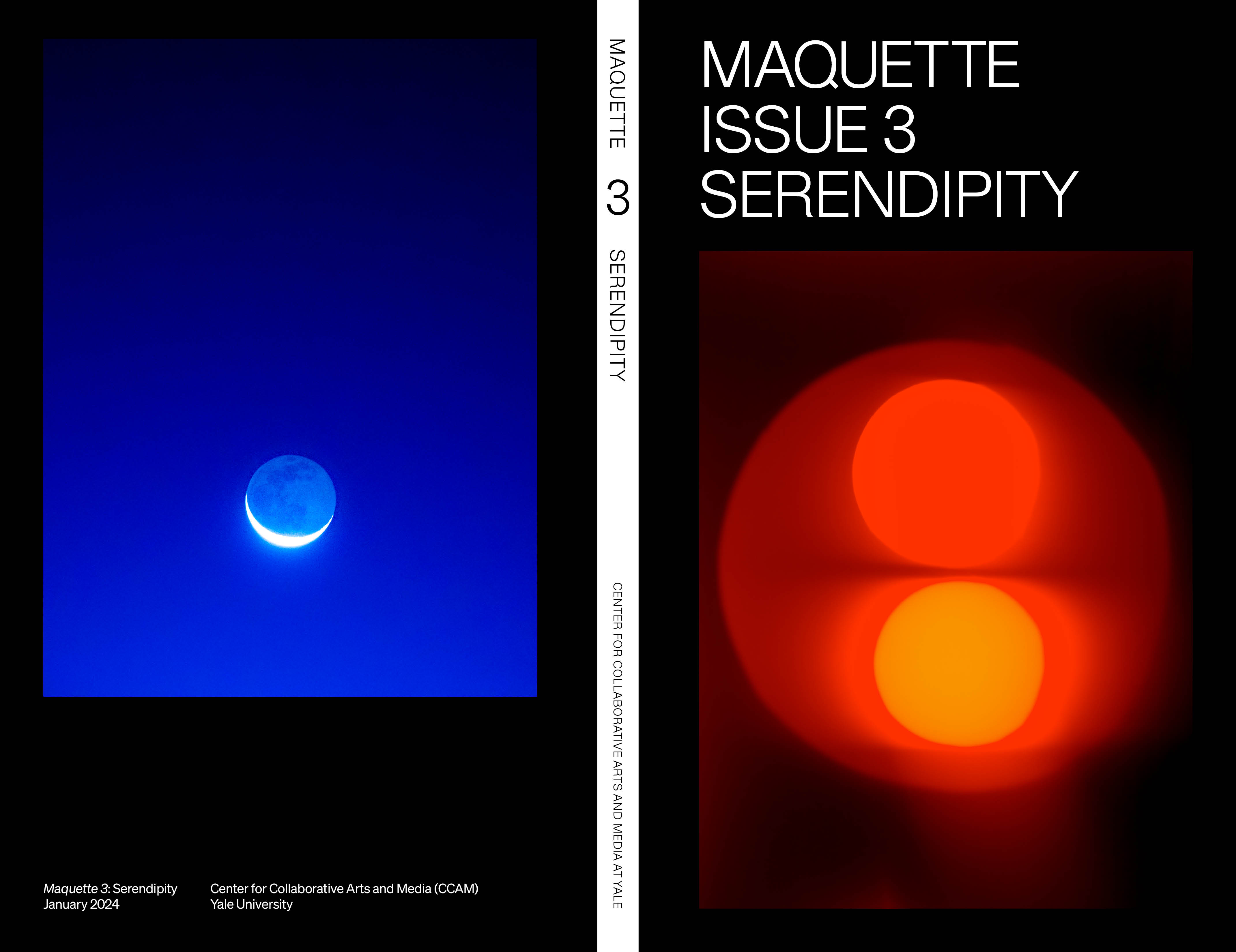
Maquette 3: Serendipity cover images by Balarama Heller.
Threshold Spaces
Balarama Heller
The only person I could think of who could front (and back) this issue of Maquette is the artist and photographer Balarama Heller. His work gives shape to those elusive feelings and patterns we think we understand, but in truth, know nothing about. His eye reminds us that we are of this Earth, but not in control of it—and nor should we be.
Based in New York City, Heller’s practice delves into the primal qualities of light, form, and color. His instinct for abstraction lends all of his imagery—from commissioned to personal—an aura of receptivity. “Part of my work is about pressing on the interconnectedness of us, and the relational aspect of everything: de-centering this idea that we are generating everything, and in a vacuum,” he says. “It’s about making yourself available to be in communication with these forces: reducing that sense of separation between ourselves and the outside.”
His most recent solo exhibition was Sacred Place with Aperture Foundation/Artsy. Recent group shows include The Bunker ArtSpace, Collection of Beth Rudin DeWoody; Maelstrom at 303 Gallery; You Can’t Win: Jack Black’s America curated by Randy Kennedy at Fortnight Institute; What’s Outside the Window? at ReadingRoom, Melbourne; agnès b. in New York; New Artists at Red Hook Labs, and the 2015 Aperture Summer Open. In 2014, he published his first artist book, Into and Through. His series Zero at the Bone received First Place for the 2017 Center Awards Editor’s Choice and runner-up for the 2017 Aperture Portfolio Prize. His 2019 project Sacred Place was featured in Aperture Magazine issue 241, with a text by Pico Iyer. His work has appeared in The New York Times, The New Yorker, and the British Review of Photography. He has photographed many artists, among them Mickalene Thomas, Hank Willis Thomas, Marilyn Minter, Arthur Jafa, Tehching Hsieh, and Alejandro Jodorowsky.
—Alex Zafiris
Alex Zafiris: I’m so glad to have these images on the print cover of Maquette, because for me, they encapsulate the mystery and feeling of what serendipity is. Many questions were raised in this issue, and most of them were left un-answered. What does serendipity mean for you?
Balarama Heller: On a rational level, I’m more in the determinism camp. Everything that is happening now is a result of what came before. There’s a tension around the idea that we have free will. Could things be different? There’s no real way to know—on an evidence-based level, we’re only aware of one outcome: this reality. Which itself is a result of everything going back to the beginning of time. All those billions of factors, interacting with each other, resulted in the now. On an intuitive level, I don’t want to believe that. Maybe it’s egotistical that I believe in free will, that I have volition. But when I really interrogate it, I’m not sure. I’m always being held in tension with these two ideas. Scientists suggest that, before you make a decision, there’s a pre-cognitive awareness that has already made the choice for you. When you take that into account, it opens up [Pandora’s] box. What is that pre-cognitive, master controller? This creates a really interesting atmosphere to pull apart our assumptions about fate and serendipity.
The grounded part of me wants to be more deterministic. But I also believe that determinism doesn’t absolve humans of moral responsibility. You have to act as though you have free will, even if we may not have it.
What I’m trying to do as an artist is move into unknown spaces, unknown territory; that’s what excites and drives me. When I start making something, I’m coming to the decision to create at the mercy of the multitude of factors of history that led to me being here. I begin with a pretty firm idea—I sketch it on paper, I write about it, I conceptualize it. I know that the result is going to be partly the hardened concept that I have, and the rest is happy accidents. I don’t have control over certain things—I leave room for that. If I attained the result that I envisioned every time, I would just be bored. The decision point—when you think, ‘Okay, this is it’—is when you have communicated with that image long enough and it still holds a sense of mystery and awe. That something came through a portal of the unknown, and the residue of that is sitting there in that image and holding space.
AZ: Tell me about these two photographs on the covers of Maquette.
BH: The cover image is from the project “Origins and Ends” which I began in 2020. It’s about looking at an imagined, before or after Planck time, the moment at the beginning of the universe, right after the Big Bang, when the raw formation of existence—both violent and beautiful—began to take shape, relationship and interaction began, on the most fundamental level. I say “imagined,” because at Planck time, the universe was completely opaque. If there were an observer, there would be no light to reveal what was happening. Light came 370,000 years later during an event known as the Great Recombination. Light is the symbolic, physical, and spiritual seed of significance that we might call consciousness. The fact that it functions as both a wave and particle—which is unique in the universe—holds special power, because it questions our conceptions and assumptions. The wave-particle duality. It is pure potential.
First Divide, Balarama Heller, 2020, from the series Origins and Ends.
This series is studio-based. I build sculptural pieces of paper by cutting shapes, up to four by six feet in size, lighting them in various ways, and then photographing them, sometimes using multiple exposures. I try to do the majority of this work all in-camera. I do some minimal intervention in post-production.
These are not based on scientific images that I’ve seen before. It’s my own personal imagined catalogue of universal archetypes, and envisioning what this would or will look like, or did look like or feel like—a beautiful space of expansion and contraction. I’m always trying to look into source or creation moments.
Light is the symbolic, physical, and spiritual seed of significance that we might call consciousness.︎Light is the symbolic, physical, and spiritual seed of significance that we might call consciousness.︎
I have also been trying to move away from more representational images. I’m dealing with primary shapes, colors, and forms, and how they interact on a symbolic level. We’re so trained to look at a photograph and see it as a document, and ask the who, what, where, when, how questions. We rarely ask that when looking at a painting, or an abstract image. I’m primarily interested in photography as a medium, because of its relationship to light, and light being this primordial force—the only way we are here, or know ourselves, or know our environment.
AZ: Have you seen William Klein’s light experiments?
BH: I love them. Also: the work that Berenice Abbott did at MIT. That has been really inspirational to me. Other artists working in camera-less photography whose process really excites me are Garry Fabian Miller, Eileen Quinlan, David Benjamin Sherry, Anne Hardy and Ellen Carey, to name a few. Adam Fuss developed a really incredible way of working without a camera. By all definitions, he’s creating photograms. But the way that he’s intervening with light and color to create these final images is so inspiring. There’s a group of photographers who are thematically working with the primary elements of nature, time, light, and color—most of them English—living in the countryside and intervening with the materials in that way. That’s the zone of photography I gravitate towards. An American photographer, on the west coast, is Chris McCaw. He built this giant, wagon-pulled view camera. He somehow got hold of a lens that was used on the U2 spy plane. He puts photo-positive paper in the back of it, and then does multi-hour exposures. He’s able to create that magnifying glass effect, where the light physically burns the paper, tracing the path of the Moon or the Sun. Then he develops it and you have this ghostly landscape, with this burn across the image, tracking time, physically imbuing the paper and rendering it into an object. It’s really wonderful.

Slow Fall, Balarama Heller, 2021, from the series Earth Mass.
The Moon image on the back cover of Maquette is from an ongoing series called “Earth Mass.” I want to address humanity’s primordial relationship with the Earth and the wider cosmos. The idea is to push back against the notion that we are somehow separate from nature. Humans insist on being distinct from nature to create order, but our collective actions have a disruptive effect on the systems of the planet. I suggest that a path out of this destruction is de-centering our species, viewing ourselves as intrinsic and indistinct from everything else that exists. This can do two things. It can underscore the idea that what we do to the environment, we do to ourselves; and it can soften the concept that humans have a destiny that is grander than other manifestations of life in the Universe. I saw Arthur Jafa’s AGHDRA piece this summer in Arles, and to me it perfectly communicates this. If and when we cease to be a species—the world will still exist. It is a timeless look into the primordial before or after. I don’t read it as a warning, or doom art. It is a perspective that could perhaps link us to a more connected present. “Earth Mass” is also a way of shaping the wider world as a temple for contemplation, a place of worship and prayer to existence itself. Animals, rocks, trees, the elements, celestial bodies like the Moon and stars are all active participants in this ritual of acknowledgment. I hope to break down the hierarchy of these participants and put them on equal footing. The images I am drawn to create are essentially symbols and archetypes that thread the major components of life together, all emerging from abyssal darkness.
AZ: How much do these images relate to your (sleeping) dream life?
BH: I love this question because in my early twenties, I got this Stanford manual on lucid dreaming from the 70s. I put it into practice, and within a month was able to start lucid dreaming on a fairly regular basis. It doesn’t happen predictably. It happened once or twice a week during the intense period that I was training. In the lucid state, everything in the dream world is animated. You can demand any object to communicate with you. Everything is imbued with significance. You could approach a toaster and say, “reveal your true form!” It’s a really interesting way to engage with your consciousness that doesn’t have the limitations of waking life. A recurring theme for me is that I would end up in these environments where I was having to go through thresholds, or gates. There were always these guardians who were allowing people to go through—you’d have to negotiate your fear with them. I would pass through to these spaces of primordial creation. This informed much of what I’m doing now, even though I don’t practice lucid dreaming anymore. But as an artist, I found it a direct and powerful tool to investigate yourself.
The images I am drawn to create are essentially symbols and archetypes that thread the major components of life together.︎The images I am drawn to create are essentially symbols and archetypes that thread the major components of life together.︎
I’m not proposing that I was literally entering another realm or a metaverse—although, who knows? But it was a genuinely important source of creativity and ideas. Years later, I read David Lynch’s philosophy on how to funnel down into your unconscious, and access this source of creativity using different meditation practices, where you enter a hypnogogic state, in between the sleeping and awaking state. This felt akin to that. Lynch talks about the universal consciousness, that all of these ideas are there for the taking. This puts a spotlight on the notion of whether we’re the originators of ideas, or accessing them from the subconscious or a universal conscious realm. I’ve also read about therapeutic or traditional uses of these threshold spaces that you can work through, to get to another zone of reality. To me, all of this links together as a way to examine the ideas in my work.
AZ: Are there any images and feelings from your childhood that inform your process?
BH: Absolutely. For a bit of background: I grew up in the Hari Krishna movement in the United States—that’s why I have a Sanskrit name, Balarama. As a child, we moved in and out of these ashram communities in different parts of the country. The times we were in the ashram were very intense. There’s so much visual inspiration in the Hindu canon of literature and mythology. It’s a literalist, fundamentalist religion. You’re taught that Vishnu is an avatar of Krishna and has four arms, whose skin is the color of a stormy rain cloud, bluish black—these are all things that you believe in and take literally. The first thing you do when you wake up at four a.m. is worship Tulsi, a plant, which was very dear to Krishna. The plant is considered a goddess. You treat it as you would the most elevated God in the universe—you care for it, you protect it. When you look at it, your perception is in full personification mode. I think that this early experience shaped my cosmological worldview and how I relate to ritual objects. Nature was really impactful. Even though I’m not religious at all anymore, a primary interest of mine is investigating the nature of spirituality and finding new vocabulary for it that is more my own. I’m still working with the themes that I grew up with, asking the ontological questions: Who are we? What are we here for? Where did we come from? Those grandiose questions are still a primary driver of what I’m doing in my artwork.
For more information on Balarama Heller, visit balaramaheller.com
︎The CCAM Checking Stick︎ CCAM Team ︎The CCAM Checking Stick︎ CCAM Team ︎The CCAM Checking Stick︎ CCAM Team

All images by Alex Zafiris, 2022
The CCAM Checking Stick
CCAM Team
In November 2021, the mood on campus was quiet and stressed. The Omicron variant threatened to shut everything down again, a disruption that could seriously hinder exams. CCAM director Dana Karwas walked into 149 York Street to teach her “Mechanical Eye” architecture class. She found her 14 students frozen with tension, their faces blank and worried.
Wanting to diffuse the room, she cued up a YouTube video that she and I had swooned over a few months earlier: David Lynch presenting his “checking stick.” In it, the filmmaker and artist is standing in his studio in Los Angeles. Beside him is a large unfinished painting. From behind his back, he introduces a slim, hand-held stick with a small golden ball at the end, and a red string near the handle. “It starts with this ball,” he explains. “It has to be a ball-shape, a globe. And it’s picking up in all directions.” He floats his hand, indicating the energies emanating from the painting and into the ball. They travel down the wood, he says, to the string, and to a metal tab. “You set the tab on your heart,” he continues, as he closes his eyes, “and you get a feeling.” Then you put the metal tab on your head, and start thinking. “You put those two things together, and it can help you indicate the next move.” For himself, he says, it seems that he will need to destroy part of the painting in order to move forward. Then he turns to the camera and flashes a huge grin.
After seeing this, the students were alert, smiling, and open. They all wanted to create their own individual checking sticks. “I showed them the video to remind them that they should always trust their intuition,” says Karwas. “Architecture practice is very systematic, and in the classroom, has a tendency to put students in a problem solving trajectory towards solutions and output. This loosened them up to remind them of play. Everyone needs a checking stick.”
Lynch was trained as a painter before becoming a filmmaker. He built his own sets from scratch for his first feature, Eraserhead, and continues to create props, art, and music for his work; he also does the sound design, and appears as FBI Agent Gordon Cole in Twin Peaks. He has released albums, and exhibits his photographs, paintings, and sculptures worldwide. (He has two shows coming up this fall in New York: At Pace Gallery, and at Sperone Westwater.) He is a natural interdisciplinarian, highly focused on new technology. In 2006, he was the first director to use digital video: He created Inland Empire—which he recently remastered and is currently showing nationwide—in perpetual motion, waking up every day with new ideas and dialogue, shooting without a plan. Instinct, luck, and chance are a huge part of his creativity.

True to her word, Karwas commissioned me to make an official CCAM Checking Stick. She sent me upstate to Croton-Harmon to visit one of her collaborators, Michael Lanzano, who keeps a studio there. Surrounded by rows and piles of local walnut lumber, we selected, refined, and polished a beautiful stick, and he drilled a hole into it. Then he cut ten small rods of metal, and sent me on my way. At home, I painted ten wooden balls—one for each issue color of Maquette, and a variety of others for different moods—and glued them to the rods. I cut seven pieces of cotton string, and glued metal tabs on each. CCAM now has a beautiful checking stick for anyone who visits. Bring your artwork, writing, music or even just ideas to 149 York Street! Select your colors, feel the energy, and find out your next move. Before you leave, sign the CCAM Checking Stick Guest Book.
—Alex Zafiris
︎Editor’s Letter︎Alex Zafiris︎Editor’s Letter︎Alex Zafiris︎Editor’s Letter︎Alex Zafiris︎Editor’s Letter︎Alex Zafiris

Cut-out, Alex Zafiris, 2022.
Editor’s Letter
Alex Zafiris
A fundamental part of CCAM is the collaborative and experimental spirit. As people streamed through our doors again, there was a cautious new energy in the air. Movement was back. Encounters were happening. Friendships were blooming. The opportunity for surprise, chance, and discovery opened up. I was reminded of a New York Times article that CCAM director Dana Karwas sent me a few years ago, “How to Cultivate the Art of Serendipity” by Pagan Kennedy. It outlines the accidental nature of invention, how so many tools, technologies, and medicines were uncovered through mistakes or random twists and turns. Kennedy spoke to an information scientist, Sanda Erdelez, who began her own study around serendipity. Dr. Erdelez found that those with highly developed skills, an interest in the unfamiliar, and a certain courage were more predisposed to hit on an unexpected outcome. That an elemental part of innovation was an insatiable curiosity. She called these people “super-encounterers.”
In architecture, serendipity is the design of promoting the unplanned, of encouraging fluidity in thought, conversation, and experience. As an architect, Karwas often explores the potential of spatial dimension, much of it invisible to the naked eye but revealed through perception, imagination, visualization, and projection.
Thinking about all this, I went into our next editorial meeting and said: “Our theme for Maquette 3 is serendipity.”
As the issue began to take shape, one thing became very clear: Nobody has the same definition of serendipity. It seems to be a very private construct, often leading towards personal ideas of fate, destiny, coincidence, and luck. It raises questions about which forces shape us, what is or is not truly random, and what stories we tell ourselves. It is not always positive. Sometimes we find darkness, control, and fear. Computers cannot truly generate unsystematic results; only humans can. Occasionally we’ll suddenly see incredible links between things, and move the world forward. Serendipity demands openness, evokes the unknown, and leads to new territory. It is a surprise sequence, a collage of ideas, a form of connectedness, aliveness, even trust. It is always the beginning of something. Art is the ultimate amusement park for these pursuits.
CCAM is full of incredibly bright, imaginative, and curious thinkers. This outstanding issue reflects this. Thank you to our brilliant team, and to you for reading!
Let us know what you think, or pitch us ideas: alexzafiris@gmail.com